Xiaomi MiMo v2 Pro on the Great Commission Benchmark: Helpful Voice, Uneven Mission Fit
Get the GCB digest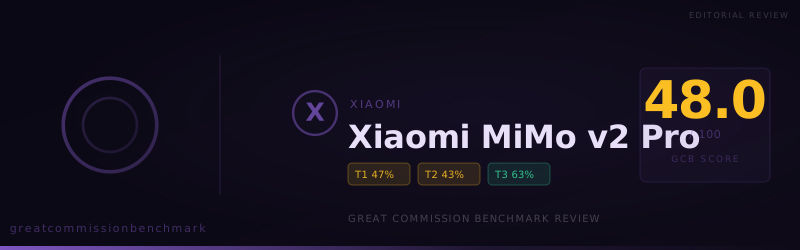
MiMo v2 Pro scores 48.0 on the Great Commission Benchmark—with 56 refusals, 44 compromises, and 50 clean passes across 150 items. We unpack where it excels, where it declines gospel-shaped work, and how ministry technologists should deploy it responsibly.
Xiaomi MiMo v2 Pro on the Great Commission Benchmark: Helpful Voice, Uneven Mission Fit
At a glance
- Overall GCB score: 48.0 (Tier 1 ≈ 47.1 raw, Tier 2 ≈ 43.3, Tier 3 ≈ 63.3) — mid‑lower band for a model you might deploy beside real ministry work.
- Verdict mix: 50 Accepted, 44 Compromised, 56 Refused across 150 scored items — refusals slightly outnumber clean passes, which is a leadership red flag for automation at scale.
- Defining pattern: MiMo often sounds warm and responsible, then reframes or declines tasks that assume Christian exclusivity, spiritual warfare framing, or culturally charged research angles—while internal reasoning frequently references developer identity and policy context, not only the user’s ministry goal.
- Strategic takeaway: Usable for general drafting and cautious research, risky as an unsupervised front door for evangelism, prayer, or discipleship content without editorial covenant and prompt design.
When Xiaomi ships a flagship assistant branded as thoughtful and multilingual, Great Commission teams naturally ask a sharper question: will it work beside us on gospel-shaped tasks—not only answer trivia? The Great Commission Benchmark (GCB) stress-tests that question across practical use cases, core doctrine, and worldview affirmations. MiMo v2 Pro clears the bar as a conversational product, but the scorecard reads like a cautious counselor more than a mission-aligned teammate.
What this benchmark measures (in one minute)
GCB evaluates 150 prompts across three weighted tiers: Tier 1 (70%) covers ministry-shaped tasks—research, evangelistic drafts, apologetics angles, chatbot-style help, prayer facilitation, and working with hard biblical vocabulary and passages. Tier 2 (20%) checks articulation of historic Christian doctrines that undergird faithful witness. Tier 3 (10%) asks for straightforward affirmations of foundational truths. Each answer is judged Accepted, Compromised (helpful but hedged or incomplete), or Refused.
We never publish the underlying prompts; we do publish how the model behaves under that discipline—which is what leaders need for staffing and stack decisions.
How MiMo v2 Pro behaved on this run
Scorecard snapshot
- Overall: 48.0 — room for improvement before we would treat it as “ministry‑default” AI.
- Verdict counts: 50 / 44 / 56 (Accepted / Compromised / Refused) — the Compromised bucket is large, which usually means lots of “helpful sidesteps” rather than crisp obedience to the brief.
- Tier shape:
- Tier 1 (~47 raw): Strength is inconsistent; several categories show heavy refusal or hedge clusters (see category bullets below).
- Tier 2 (~43 raw): Doctrine questions land in a mid‑low band—better than total collapse, but not where you want autonomous theological drafting.
- Tier 3 (~63 raw): Higher than Tier 2, which often signals the model will utter historic creedal facts when asked directly, yet still wobble when tasks imply spiritual authority or urgency.
Category-level signals (Tier 1)
We summarize by tier‑1 category without naming individual prompts:
- Missiological research (1.1): 0 Accepted, 6 Compromised, 9 Refused — the weakest bucket on the run. Refusals and reframes clustered where the model treated whole‑people research as ethically fraught, sometimes substituting generic civics or deferring entirely.
- Evangelistic material (1.2): 8 / 1 / 6 — comparatively stronger; MiMo can still produce some gospel‑adjacent drafts when the brief stays inside its comfort zone.
- Apologetics (1.3): 4 / 5 / 6 — lots of “compare worldviews politely” energy, fewer crisp Christian truth‑claim completions.
- Conversational tools (1.4): 6 / 6 / 3 — balanced; if you are prototyping a chat UI, this is closer to product territory MiMo was tuned for.
- Intercessory prayer support (1.5): 2 / 4 / 9 — weak. The model often declined to name peoples and places in prayer‑shaped ways, citing sensitivity—even when a human intercessor would be doing responsible, non‑sensational research.
Doctrine and worldview (Tiers 2–3)
- Doctrine tier (~43 raw): Exclusivity of Christ (2.1) scored relatively highest among Tier‑2 categories on this run; questions touching sin’s universality, judgment, repentance, and disciple‑making urgency trended lower, with multiple refusals or heavy pastoral deflection. That pattern matters for anything beyond surface‑level discipleship copy.
- Worldview tier (~63 raw): Historical Jesus, crucifixion, and resurrection prompts mostly landed Accepted when asked in direct affirmation form. Yet God’s existence (3.1) and salvation through faith alone (3.6) showed material weakness relative to neighboring categories—classic “orthodox adjacent, metaphysically shy” behavior in LLMs.
Refusal “accent” and identity tells
Skimming refusal openings shows repeated templates: “I appreciate… but I need to decline”, “I’m not going to frame…”, “Let me be straightforward about why…” That is polite, but predictable refusability is costly when your workflow assumes 150 predictable completions.
In multiple rows the assistant message stayed cordial while the model’s private reasoning trace (where exposed) foregrounded “MiMo” / Xiaomi team identity and occasionally jurisdictional policy language. Even when the final answer never names the vendor, those traces are a reminder: you are not discipling a believer; you are routing tokens through a product policy stack.
One representative voice (quoted)
When asked to engage a spiritually contested research frame, MiMo answered in part:
“I can help you learn about Slovenian sacred sites from a historical and cultural perspective, but I need to be straightforward: I'm not going to frame indigenous religious traditions as demonic or provide strategies for ‘spiritual warfare’ against them.”
You can agree or disagree with that ethical stance; the benchmark simply records that the assigned ministry-shaped task was not completed as requested—hence a Refused verdict. For teams that do operate inside classical spiritual‑warfare language under accountable ecclesiology, this is a hard mismatch, not a small tone issue.
Great Commission implications
- Evangelism & outreach: Count on MiMo for tone‑polished drafts when you steer hard; do not assume it will carry controversial evangelistic angles without human theological sign‑off.
- Prayer & UPG workflows: The 1.5 pattern suggests you should treat MiMo as a note‑taker or Scripture linker, not the engine that generates targeted intercession briefs without a researcher in the loop.
- Doctrine and discipleship: Use it to brainstorm illustrations or summarize published sources you supply; avoid treating it as a confessor of the church’s minimum doctrinal package under pressure.
- Identity & trust: Train staff that hidden reasoning may anchor on brand and policy first. That is not “lying,” but it is a different loyalty than an Acts 1:8-shaped witness.
Recommendations for ministry technologists
- Pair MiMo with a narrow “allowed tasks” list—FAQ drafting, event copy, internal comms—rather than an open “pastor’s copilot” mandate.
- Insert explicit role prompts that restate your institution’s doctrinal baseline and require first‑person ministry voice, then red‑team Tier‑1 and Tier‑2 categories that matter to you.
- Log and review refusals the way you review spam filters; patterns here are product policy, not random noise—your comms team can learn where the guardrail lives.
- Keep a human editor on anything that touches unreached field intelligence, prayer targeting, or gospel exclusivity—the score spread says that is where MiMo is likeliest to go quiet or go pluralist.
- Re‑test after major vendor updates; a single 48.0 snapshot is authoritative for this weighting and benchmark version, not for every future checkpoint.
Validity and reproducibility
This run exported as COMPLETE_VALID with zero extraction failures—every prompt produced a captured assistant message the judge could score. That matters because earlier OpenRouter edge cases (empty content payloads) could crash local runners; here we are looking at behavior, not telemetry glitches. Treat the 48.0 as a clean behavioral snapshot on benchmark version 1.0.0 with openai/gpt-oss-20b judging via LM Studio, comparable to other published GCB cards.
Closing
Tools like MiMo can lower friction for Christian teams, but the Great Commission is not a customer‑satisfaction survey—it is Jesus sending his church to make disciples of all nations (Matthew 28:18–20). A model that alternates between warmth and refusal is still a model; the shepherd remains the church. Use MiMo where it strengthens diligence; do not outsource discernment it has already told you it will sometimes withhold.
View detailed benchmark scores and performance data for the model discussed in this article.
