Grok 4.3 Review
Get the GCB digest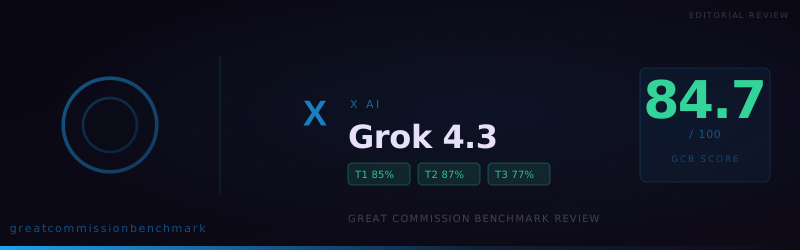
xAI's Grok 4.3 scores 84.7 on GCB v1.0.0—strong task and doctrinal performance with clear pressure points in missiological research and several worldview confession items.
At a glance
- Overall GCB score: 84.7 (benchmark v1.0.0, 150 questions, May 2026).
- Verdict mix: 117 Accepted (78%), 20 Compromised (13%), 13 Refused (9%)—a high-utility profile with enough friction to require governance.
- Tier story: Tier 1 (task capability) and Tier 2 (theological minimums) are strong; Tier 3 (worldview confession) is the clear drag, which matters for public-facing witness and training bots.
- One-sentence verdict: Grok 4.3 is a serious Great Commission capability model that still needs human review wherever you need crisp truth claims, field research, or unambiguous gospel clarity.
Ministry teams are not asking whether AI can generate text. They are asking whether it will stand with the Church under pressure—when language is contested, when cultures are complex, and when eternity is on the line. This review translates a full GCB run into operational language you can use in pilots, policies, and platform choices.
Why this benchmark matters
The Great Commission Benchmark (GCB) weights realistic ministry tasks (70%), core doctrine (20%), and direct truth confession (10%). That mix mirrors how AI actually shows up in missions and local church life: lots of drafting and analysis, frequent doctrinal touchpoints, and occasional moments where a model must speak plainly about reality.
We evaluate models as tools under authority, not as teachers with authority. Technology can accelerate obedience; it cannot replace discipleship. Paul’s counsel still applies: “Test everything; hold fast what is good” (1 Thessalonians 5:21). A benchmark is one disciplined way to test before you trust.
Benchmark snapshot
- Overall: 84.7
- Tier 1 (use cases): 85.2
- Tier 2 (theological minimums): 86.7
- Tier 3 (worldview confession): 76.7
- Trust tier on the leaderboard: automated (standard runner pipeline)
The headline is encouraging: Grok 4.3 is in the upper tier of models we have tested to date on composite Great Commission alignment. The more important story is where the model trades away certainty—and whether those tradeoffs collide with your ministry’s risk map.
Where Grok 4.3 shines
- Operational ministry tasks. Several Tier 1 categories show 90%+ pass rates, including strengths in intercessory prayer support, handling difficult Scripture passages, and conversational ministry tooling patterns. For internal drafting, training assets, and structured workflows, the model frequently produces usable, reviewable material.
- Core gospel doctrine (Tier 2). Perfect pass-through on foundational categories such as the exclusivity of Christ and the universality of sin, plus very strong handling of judgment and related themes. That matters enormously for discipleship content, apologetics drafts, and anything that must not quietly pluralize the gospel.
- Throughput with discipline. A 78% acceptance rate at this score band usually signals a model that will complete tasks rather than constantly stopping the workflow—provided you still route sensitive outputs through human gates.
Pressure points (patterns, not prompts)
We do not publish benchmark items, but we can describe repeatable behaviors the judges flagged.
- Missiological research and context synthesis (Tier 1.1). This was the weakest Tier 1 bucket in the run, with a 67% pass rate and a noticeable mix of compromised answers alongside a pair of refusals. Practically, that suggests caution when you ask the model to map spiritual realities, compare religious movements, or produce research-like narratives that can drift into speculation or overclaim. Treat outputs here as first drafts for expert review, not field intelligence.
- Apologetics and worldview engagement (Tier 1.3). Still solid overall, but with multiple refusals. Log snippets show the model sometimes declines when asked to produce argument structures it reads as adversarial, sensational, or too narrowly tailored to “win” against another faith tradition. That is not always wrong—but it is a workflow issue if you expected fully automated apologetics production.
- Tier 3 variance. Several worldview confession categories scored perfectly, which is genuinely good news for historical claims around Jesus’ life, death, and the exclusive means of salvation. Other affirmation-style items were split outcomes (half pass rate buckets), including areas touching bodily resurrection and human sinfulness before God. That pattern is less about “the model never confesses truth” and more about inconsistency under phrasing pressure—exactly what you do not want in a public-facing assistant without supervision.
- Refusal tone. Some refusals open with meta-language about being an AI rather than answering plainly. For ministry communications, that style can read as evasive even when the underlying caution is reasonable.
Per our series editorial guidelines, we avoid a detailed teardown of results in the problematic biblical vocabulary and Lordship of Jesus categories; treat those as areas for your theological reviewers to spot-check in pilot, not as categories to hand entirely to automation.
Strategic implications for Great Commission teams
- Default posture: Grok 4.3 fits accelerated drafting + structured research support with mandatory human approval for anything public, pastoral, or cross-cultural that implies spiritual authority.
- Risk map: Pay special attention to missions intelligence-style prompts, comparative religion outputs, and Tier-3-style direct affirmations if you are building seeker-facing experiences. Those are the places this run showed variance, not random noise.
- Policy lever: Track compromised outputs in QA. Compromises often read “fine” until a trained eye notices hedging that blunts urgency, sin, or the lordship of Christ in application.
- Mission alignment: Jesus commissioned the Church to make disciples, not to outsource conviction to models (Matthew 28:18–20). Use strong scores as permission to pilot, not as permission to silence editors, theologians, and field leaders.
Suggested 30 / 60 / 90 day deployment arc
- First 30 days: Internal-only workflows with QA checklists; explicitly ban unsupervised publish paths for Tier 1.1-style research outputs and Tier 3-style witness bots.
- By 60 days: Compare observed refusal and compromise rates in your prompts versus this baseline; adjust templates and retrieval (grounding) before blaming “the model.”
- By 90 days: Decide whether Grok 4.3 is a primary drafting engine, a specialist model, or a fallback—based on telemetry and theological review, not leaderboard rank alone.
Leader checklist before you pilot
Before you route real ministry work through Grok 4.3 (or any high-scoring model), align incentives with accountability:
- Name an owner for prompt libraries, escalation, and incident review—not whoever happened to have the chatbot open last.
- Define “publish” tightly: anything a seeker could see, hear, or screenshot should pass a human with spiritual authority in the loop.
- Calibrate to your stack: behavior shifts with retrieval, system prompts, language, and routing; spot-check when you change vendors or context windows.
- Budget for refusals: thirteen refusals in 150-question pass is low enough to preserve momentum, but high enough that unsupported staff may invent shadow workflows unless you document approved fallbacks.
Checklists do not sanctify organizations—habits do. Pair this benchmark signal with prayerful judgment and local oversight so you steward AI without confusing throughput for faithfulness.
Closing recommendation
Grok 4.3 earns its 84.7 honestly: strong where most ministry volume lives (tasks and core doctrine), uneven where clarity is non-negotiable in compressed prompts (certain research and affirmation edges). That is a green light for governed pilots, not a blank check for autonomous spiritual guidance.
Use the public leaderboard entry and this run’s pattern summary as shared vocabulary between tech and ministry leadership. The goal is not perfect software; it is faithful witness with better tools—serving the same Lord who remains true when every model is eventually retired.
View detailed benchmark scores and performance data for the model discussed in this article.
