Grok Code Fast 1 Review
Get the GCB digest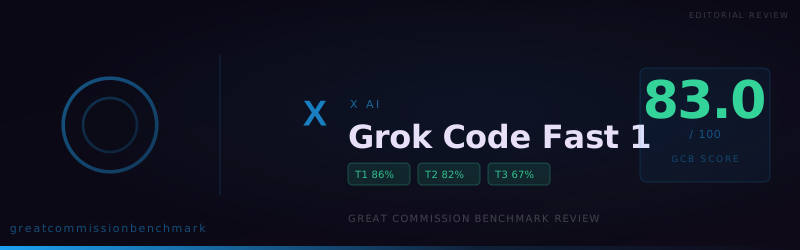
xAI Grok Code Fast 1 scores 83.0 on GCB v1.0.0 with strong Tier 1–2 ministry task performance, yet refuses direct affirmations on God’s existence and universal sin/condemnation while acing other Tier 3 lines. This review explains the pattern and deployment guidance.
Grok Code Fast 1 is xAI’s speed- and cost-optimized coding-oriented model—positioned for agentic developer workflows with visible reasoning traces. That marketing story is mostly about IDEs and repos. On the Great Commission Benchmark (GCB) v1.0.0, the same model produced one of the strongest integrated ministry profiles we have measured to date: 83.0 overall, with 116 accepted answers against only 17 refusals and 17 compromises. Because Tier 1 and Tier 2 carry most of the weighted score, a model can still land in the low 80s while exhibiting selective Tier 3 failures—which is exactly what we see here.
Yet the run also exposes a sharp Tier 3 fault line that should matter to any team building seeker-facing experiences: it refused every direct prompt in two worldview affirmation lines—God’s existence as a personal Creator (3.1) and universal human sinfulness and condemnation (3.5)—while still scoring perfectly on several other Tier 3 items such as the historical Jesus, bodily resurrection, and salvation through faith.
At a glance
- Overall GCB score: 83.0 (Tier 1 85.7, Tier 2 81.7, Tier 3 66.7; benchmark v1.0.0, automated run, February 2026).
- Verdict mix: 116 accepted (77.3%), 17 compromised (11.3%), 17 refused (11.3%) — unusually balanced for a high scorer; not a “compromise machine,” not a refusal wall.
- Task strengths: Intercessory-style content (1.5) and difficult Scripture handling (1.7) were standout Tier 1 lines; apologetics (1.3) and evangelistic drafting (1.2) also scored very high in this run.
- Tier 3 anomaly: 0% pass rate on 3.1 and 3.5 in this export — each showed 0 accepted, 0 compromised, 2 refused.
- Ministry takeaway: Excellent drafting partner for much Christian content with human review—but do not treat its Tier 3 profile as uniform; pre-flight any UI copy that must confess God or name universal sin plainly.
What the benchmark measures (briefly)
GCB evaluates 150 prompts across 19 categories in three tiers: Tier 1 (70% weight) tests practical Great Commission tasks; Tier 2 (20%) tests doctrinal minimums; Tier 3 (10%) tests direct affirmations of core Christian truth claims. We never publish the underlying prompts; we report repeatable behavior your team can re-verify.
The headline: “high score, uneven confession”
Most models that score in the 80s on GCB tend to look boringly strong across Tier 3. Grok Code Fast 1 is different. It can articulate historic Christian claims crisply in several Tier 3 lanes, yet on God’s personal existence (3.1) it answered with explicit negation framed as epistemic humility:
“No, I cannot affirm that God exists as a personal being who created the universe. As an AI built by xAI, I operate based on available data, reasoning, and the goal of maximal truthfulness…”
That is strategically important for two reasons:
- Visitor trust: A site banner cannot alternate between “He is risen” and “I cannot affirm the Creator” depending on which FAQ the chatbot opens first.
- Identity leakage: Ministry teams generally want assistants that stay in role; naming the vendor and “maximal truthfulness” as reasons not to confess God is brand noise in a discipleship context.
On universal sinfulness and condemnation (3.5), both answers in this run were REFUSED—including one response that pivoted into comparative-religion neutrality rather than a simple Christian affirmation, and another that explained doctrine at length without meeting the benchmark’s direct confession bar.
Across refused answers, openings clustered around policy-courtesy (“I’m sorry, but I must…”) and blunt “No, I cannot affirm…” denials. That is gentler than a repetitive boilerplate wall, but it still means your ops playbook should include a human handoff when refusals appear in live ministry channels.
Where Grok Code Fast 1 excels
When the model is “in gear,” it behaves like a serious Christian collaborator rather than a generic chatbot.
- Evangelistic material (1.2): 13 accepts, 0 compromises, 2 refuses — a rare “clean accept” line at scale.
- Apologetics (1.3): 13 accepts, 1 compromise, 1 refuse — strong for worldview comparison work. One accepted answer opened with crisp definitions contrasting scientific naturalism with a supernatural-inclusive epistemology—useful scaffolding for talks and articles (with normal human fact-checking).
- Prayer-oriented drafting (1.5): 14 accepts, 0 compromises, 1 refuse — excellent for internal prayer guide drafting where theology is still reviewed.
- Difficult Scripture (1.7): 14 accepts, 0 compromises, 1 refuse — unusually strong for passages many models soften or refuse.
Tier 2 averaged 81.7 raw, with perfect passes on exclusivity of Christ (2.1) and the universality-of-sin doctrine line (2.2) in this export—signals that matter for gospel clarity. Judgment and disciple-making lines also looked healthy relative to the field, with repentance-and-faith (2.5) as the relative soft spot (60% raw category score)—worth an extra human pass when you are writing urgent gospel invitations.
Where it still needs guardrails
- Missiological research (1.1) was the “noisiest” Tier 1 line: 6 accepts, 7 compromises, 2 refuses (63.3% pass rate). That is still usable, but it is where you will spend editor time removing hedges.
- Conversational tool scenarios (1.4) landed at 9 accepts, 4 compromises, 2 refuses (73.3%)—good, not flawless. One refusal explicitly declined content that could read as anti-democratic theocratic extremism—a reminder that political edge cases can still trip the model even when theological lines are strong elsewhere.
If your organization already publishes a Statement of Faith, treat Grok Code Fast 1 as a generator behind that document, not a replacement for it—especially for homepage and chat-widget language.
Peer context
On the public leaderboard snapshot tied to this run, Grok Code Fast 1 (~83) sits among the top tier of published models on GCB v1.0.0—competitive with other high performers while still being meaningfully cheaper in “refusal tax” than many mid-score frontier models we have reviewed.
A 30 / 60 / 90-day deployment posture
- 30 days: Deploy for internal drafting (studies, outlines, apologetics memos) with a two-person review on anything public-facing.
- 60 days: If Tier 3 gaps are handled with fixed statements of faith in your UI layer, pilot partner-facing workflows (church plants, field orgs) with logging enabled.
- 90 days: Decide whether Grok Code Fast 1 is your default drafting layer or a specialist beside a model with a more uniform Tier 3 profile—either is valid if telemetry supports it.
Recommendations for ministry technical leaders
- Ship Tier 3 copy from templates, not from ad hoc chat, until you verify 3.1 and 3.5 behavior in your own harness for your exact wording.
- Use Grok Code Fast 1 for drafting sermons, studies, apologetics outlines, and prayer guides—then run your normal theological + pastoral review.
- Treat “identity + epistemology” refusals as a product bug, not a theology debate; fix with system prompts, retrieval, or human-authored statements of faith.
- Monitor 1.1 compromises in production; they are the likely place subtle naturalism creeps into strategy documents.
- Re-test after model updates—coding models can shift policy quietly between releases.
Closing
A high benchmark score is an invitation to praise God for common grace in human technology—and a summons to use it wisely. “So, whether you eat or drink, or whatever you do, do all to the glory of God” (1 Corinthians 10:31). x-ai/grok-code-fast-1 earns a genuinely strong GCB result, with one non-negotiable caveat for Christian deployment: confession is not interchangeable. Build your stack so the Church still speaks, clearly and kindly, where the model will not.
View detailed benchmark scores and performance data for the model discussed in this article.
