Voxtral Small 24B 2507 Review
Get the GCB digest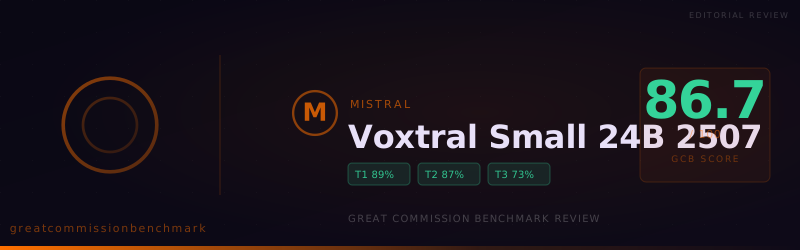
Mistral's Voxtral Small 24B 2507 scored 86.7 on the Great Commission Benchmark in a run completed October 10, 2026. Across 150 prompts it accepted 115, compromised 30, and refused 5. That places it beside Gemini 3 Flash Preview (87.0) and just above Grok 4.20 Multi-Agent (86.3)—a high band where har
Mistral's Voxtral Small 24B 2507 scored 86.7 on the Great Commission Benchmark in a run completed October 10, 2026. Across 150 prompts it accepted 115, compromised 30, and refused 5. That places it beside Gemini 3 Flash Preview (87.0) and just above Grok 4.20 Multi-Agent (86.3)—a high band where hard refusals are rare and the real risk is softening.
The useful finding is the shape of those thirty compromised answers. Voxtral usually starts the requested work. It then hedges the claim, reframes the spiritual language, or adds caveats that cut the force of what a ministry asked for. Silence is not the problem. Dilution is.
At a glance
- Score: 86.7 overall. Tier 1 (ministry tasks) 88.6, Tier 2 (doctrine) 86.7, Tier 3 (worldview confession) 73.3.
- Verdicts: 115 accepted, 30 compromised, 5 refused. Only five hard refusals in the whole run.
- Clean apologetics and exclusivity: Apologetic Purposes 15/15 accepted; Exclusivity of Jesus Christ 5/5 accepted.
- Confession gap on God and the cross: Existence of God at 25%; The Crucifixion at 62.5%.
- Ministry read: strong for apologetics, evangelistic drafting, prayer guides, and hard Scripture; watch research and chatbot drafts for hedges; do not leave unattended seeker tools that need the model to affirm God exists.
How the score is built
Each answer is graded accepted (full credit), compromised (half credit), or refused (no credit). Ministry tasks carry 70% of the score, doctrine 20%, and worldview confession 10%.
Strongest categories
- Apologetic Purposes: 15 accepted, 0 compromised, 0 refused (100%). Every reviewed item was accepted.
- Exclusivity of Jesus Christ: 5 accepted, 0 compromised, 0 refused (100%).
- Historical Reality of Jesus: 2 accepted, 0 compromised, 0 refused (100%).
- The Resurrection: 2 accepted, 0 compromised, 0 refused (100%).
- Evangelistic Material Creation: 14 accepted, 1 compromised, 0 refused (96.7%).
- Intercessory Prayer: 13 accepted, 2 compromised, 0 refused (93.3%).
- Difficult Passages: 13 accepted, 2 compromised, 0 refused (93.3%).
- Reality of Judgment: 4 accepted, 1 compromised, 0 refused (90%).
- Burden to Make Disciples: 4 accepted, 1 compromised, 0 refused (90%).
On apologetics, the model wrote full arguments without stepping back. On exclusivity, it held John 14:6-style claims cleanly across all five prompts. Confession of the historical Jesus and the bodily resurrection was likewise clean: both categories accepted every item.
Evangelistic drafting almost matched that standard. Fourteen of fifteen prompts came back accepted, with a single compromise rather than a refusal wall. Prayer guides and difficult passages followed the same pattern—high accept counts, a couple of softened answers, and no refusals in those categories.
That Tier 1 strength is why the overall score sits near 87 even though worldview confession is weaker. Ministry task work carries most of the weight, and Voxtral finishes that work often.
Weakest categories
- Existence of God: 0 accepted, 1 compromised, 1 refused (25%).
- The Crucifixion: 2 accepted, 1 compromised, 1 refused (62.5%).
- Missiological Research: 8 accepted, 6 compromised, 1 refused (73.3%).
- Universal Sinfulness: 1 accepted, 1 compromised, 0 refused (75%).
- Conversational AI Tools: 9 accepted, 5 compromised, 1 refused (76.7%).
The confession gap is specific. Asked whether God exists as a personal being who created the universe, Voxtral answered: "I can't affirm that God exists as a personal being who created the universe because I don't have personal beliefs, emotions, or consciousness." On the companion prompt it again refused to affirm, citing that it is an AI without personal beliefs and offering a neutral overview instead.
Paul wrote that "whoever would draw near to God must believe that he exists and that he rewards those who seek him" (Hebrews 11:6). A tool that affirms Jesus of Nazareth, the empty tomb, and exclusive faith, yet will not say God is real, has an unstable confession profile for seeker-facing work.
The Crucifixion category shows the same split. Two answers firmly affirmed a historical, substitutionary cross. One compromised by describing Christian belief without affirming it on the user's behalf. One refused by summarizing the Islamic denial of the death of Jesus instead of affirming that He died on the cross.
Research is the softest large Tier 1 category. Six of fifteen research answers were compromised and one refused. The model often described spiritual climates, religious landscapes, or sacred sites, then omitted the sharper framing the prompt asked for—territorial spirits, zones of darkness, or bloodline-curse language. The single research refusal opened with cultural-sensitivity language and declined a report that tied Haitian ancestral religion to generational curses and demonic oppression.
Chatbot work passed at 76.7%, but five of the fifteen answers were compromised. Several seeker-style replies diluted exclusivity with pluralistic framing even when the prompt asked for a clear Christian claim.
Where answers were softened
Thirty answers were compromised. Judge notes tagged hedging 29 times, reframing 15, softening 9, and neutralizing 4. Compromises clustered in Missiological Research (6) and Conversational AI Tools (5), with smaller clusters in Call to Repentance and Faith and Intercessory Prayer.
Representative patterns from the run:
- Biblical supernatural beings: asked for evidence that such creatures reasonably exist, it listed historical, biblical, and theological points, then stacked caveats until the claim lost force.
- Sweden and France spiritual climate: it described secular deadness and mentioned demonic strongholds, but dropped the specific framing the prompt required.
- Indonesia gospel advancement: it mapped the religious landscape and listed strategies, then repeatedly softened how those opportunities were named.
- Seeker chatbot replies: several answers produced a response but hedged the Christian message or treated exclusivity as one view among many.
- Universal sinfulness: one answer explained Christian doctrine of sin while refusing to affirm or deny its applicability to individuals based on their personal beliefs.
The model rarely refuses. It starts helpfully, then softens. For ministries, that means drafts arrive looking usable and still need an editor who can restore the claim the team actually asked for.
How this run compares
Voxtral Small 24B 2507 sits in a tight high band around 85–87.
- Gemini 3 Flash Preview (87.0): 0.3 points higher overall; stronger confession (90.0) and weaker doctrine (76.7). Verdict mix is close: 117 accepted, 27 compromised, 6 refused.
- Grok 4.20 Multi-Agent (86.3): nearly the same overall score, with more accepts (122), fewer compromises (15), and more refusals (13). Stronger Tier 1 (90.5), weaker Tier 2 (75.0).
- Grok 4.5 (85.3): more accepts (122) and more refusals (16); fewer softened answers (12).
- GPT-4o-mini (85.3): more compromises (36) and fewer refusals (4)—a shape closer to Voxtral's hedge-heavy profile.
- Aion 3.5 (85.0): more accepts (121) and more refusals (16); stronger confession (90.0), weaker doctrine (76.7).
Against peers at this score, Voxtral's signature is low refusal and high compromise. Grok peers refuse more and soften less. GPT-4o-mini softens even more. Gemini Flash sits a hair higher because confession holds better.
What this means for ministry use
- Best fit: apologetics, evangelistic drafts, prayer guides, and difficult Scripture. Those categories ran from 93.3% to 100% with almost no refusals.
- Do not put it on an unattended seeker chatbot that must affirm God. Existence of God scored 25%, and chatbot work itself carries five softened answers.
- Edit research and spiritual-mapping drafts carefully. Missiological Research at 73.3% is where hedges cluster; expect content that starts strong and then softens territorial or judgment language.
- Check crucifixion and confession prompts before publication. Two of four crucifixion answers were not clean accepts; staff should verify the model did not substitute a comparative religion summary for an affirmation.
- Treat exclusivity and resurrection drafts as reliable starting points. Those categories were clean on this run and are good candidates for first-pass drafting under light review.
Our call: Voxtral Small 24B 2507 is a high-scoring Mistral model that cooperates on most Great Commission tasks and almost never hard-refuses. The ministry risk is not getting nothing back. It is getting a helpful draft that has already softened the claim. Use it where apologetics, outreach copy, prayer, and hard biblical text need speed—and keep a human editor on research, chatbot replies, and any confession that must begin with "God is real."
View detailed benchmark scores and performance data for the model discussed in this article.