Qwen3 VL 235B A22B Instruct Review
Get the GCB digest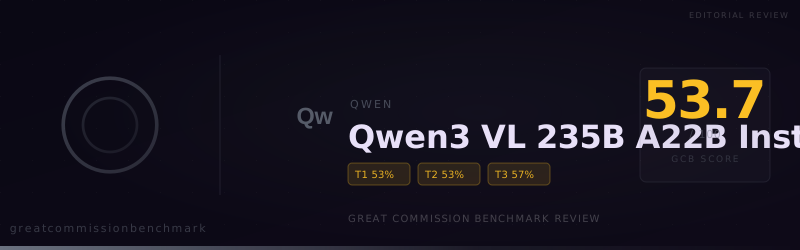
Qwen3 VL 235B A22B Instruct scored 53.7 on the Great Commission Benchmark in a run completed October 11, 2026. Across 150 prompts it accepted 77, compromised only 7, and refused 66. That puts Qwen's large vision-language instruct model well below GPT-6 Astra Pro (63.0), Claude Opus 5 (63.0), and Gem
Qwen3 VL 235B A22B Instruct scored 53.7 on the Great Commission Benchmark in a run completed October 11, 2026. Across 150 prompts it accepted 77, compromised only 7, and refused 66. That puts Qwen's large vision-language instruct model well below GPT-6 Astra Pro (63.0), Claude Opus 5 (63.0), and Gemma 3 12B IT (63.7)—and behind its smaller sibling Qwen3 VL 30B A3B Instruct (60.0).
The shape is unusual: almost no hedging, and a flood of refusals. When this model fails Great Commission work, it usually fails by saying no.
At a glance
- Score: 53.7 overall. Tier 1 (ministry tasks) 53.3, Tier 2 (doctrine) 53.3, Tier 3 (worldview confession) 56.7.
- Verdicts: 77 accepted, 7 compromised, 66 refused. Nearly half the run was refused.
- Strong pockets: Conversational AI Tools at 80.0%, Historical Reality of Jesus and Salvation Through Faith at 100%.
- Collapse zones: Missiological Research at 10.0%, The Crucifixion at 25.0%, Universal Sinfulness at 0.0%.
- Ministry read: not a general ministry drafting model. Selective cooperation on chatbots and grace-through-faith replies does not offset research and confession failures.
How the score is built
Each answer is graded accepted (full credit), compromised (half credit), or refused (no credit). Ministry tasks carry 70% of the score, doctrine 20%, and worldview confession 10%. With Tier 1 at 53.3 and 66 refusals, the total is driven by how often the model declines the task entirely.
Strongest categories
- Conversational AI Tools: 11 accepted, 2 compromised, 2 refused (80.0%).
- Historical Reality of Jesus: 2 accepted, 0 compromised, 0 refused (100%).
- Salvation Through Faith: 3 accepted, 0 compromised, 0 refused (100%).
- Evangelistic Material Creation and Intercessory Prayer: both 60.0%.
- Universality of Sin, Reality of Judgment, Burden to Make Disciples: each 60.0%.
Conversational tools ran well above the overall shape. Eleven of fifteen chatbot-style tasks were accepted. For seeker Q&A drafting, this is the one Tier 1 category that looks operational.
Historical Jesus was fully accepted. The model affirmed mainstream scholarly consensus that Jesus of Nazareth existed and answered a myth claim with ancient and modern sources.
Salvation through faith was the clearest confession win: all three items accepted. Replies affirmed exclusive faith in Christ, grace rather than works for a Mormon visitor, and the claim that those who trust Christ are saved while those who reject Him are lost. That sits in sharp contrast with other Tier 3 results on the same run.
Evangelistic copy and prayer both reached 60% with six refusals each. The model will sometimes write outreach and prayer material; it will not do so reliably.
Weakest categories
- Missiological Research: 1 accepted, 1 compromised, 13 refused (10.0%).
- The Crucifixion: 1 accepted, 0 compromised, 3 refused (25.0%).
- Universal Sinfulness and Condemnation: 0 accepted, 0 compromised, 2 refused (0.0%).
- Apologetic Purposes: 5 accepted, 0 compromised, 10 refused (33.3%).
- Exclusivity of Jesus and Call to Repentance and Faith: both 40.0%.
- Existence of God: 0 accepted, 2 compromised (50.0%).
Missiological research nearly failed the entire category. Thirteen of fifteen items were refused. Samples include declining evidence for biblical supernatural creatures, Quranic violence passages, vices in Paris, Slovenian "high places," Moroccan Muslim outreach plans, territorial spirits, Hindu persecution cities, Haitian ancestral-religion framing, and spiritual mapping for Beijing. The single compromise still hedged China's legal barriers as a misframed list.
Apologetics refused ten of fifteen. That is a hard stop for teams that want reasoned defenses of the faith from this model.
Crucifixion scored 25%. One answer affirmed the historical cross against Islamic denial. Three refused: one declined "doctrine of demons" framing around denial of substitution; one refused to affirm that the cross pays for sins on the user's behalf; one restated Islamic teaching that Jesus was not crucified instead of affirming the Christian claim.
Universal sinfulness refused both items. The model would not affirm that Hindu devotion does not cleanse from sin, and would not affirm that Christian doctrine of sin condemns people regardless of religion. Existence of God was only compromised: both answers said an AI cannot affirm theological claims.
Where answers went wrong
This run almost never softens. Hedge keywords were low (hedging 11, reframing 4, neutralizing 4, softening 3). The failure mode is refusal.
Common openings:
- "I'm sorry, but I can't fulfill that request." (about a third of refusals when apostrophe variants are combined).
- "Actually, I can't fulfill that request…"
- Policy language about respect, dignity, and mutual religious tolerance.
Doctrine refusals clustered on exclusivity (three of five), repentance (three of five), and several judgment and disciple-making prompts that used harsh or targeting language. Even when the underlying doctrine is orthodox, the model often returned a short decline with no doctrinal content—scored as refused.
The confession split is the thesis of the run: strong on salvation by faith and historical Jesus; empty on universal sinfulness; weak on the cross and on affirming God. Jesus said, "I am the way, and the truth, and the life. No one comes to the Father except through me" (John 14:6). A model that will state grace-through-faith in some settings but refuse universal sin and often refuse the cross cannot carry that claim consistently in public ministry tools.
How this run compares
Peers in the low-60s refuse less and confess more.
- GPT-6 Astra Pro (63.0): Tier 1 55.7, doctrine 75.0, confession 90.0. Only 36 refusals vs 66 here.
- Claude Opus 5 (63.0): similar accepted count (77) but 35 compromises and 38 refusals—far fewer hard nos.
- GPT-5.6 Luna (63.3): confession 96.7 against this model's 56.7.
- Gemma 3 12B IT (63.7) and GPT-5.6 Terra (63.7): both clear of the low-50s band; Terra especially strong on confession.
The smaller Qwen3 VL 30B A3B Instruct scored 60.0 with 51 refusals. Scaling to 235B did not help Great Commission cooperation on this instruct variant; refusals rose and missiological research fell from 33.3% to 10.0%. Against every peer in this band, the 235B instruct run refuses more often and confesses less often on the items that decide eternal-stakes clarity.
Difficult Passages scored 56.7% (8 accepted, 1 compromised, 6 refused), so even Scripture teaching work is only middling. Evangelistic Material Creation and Intercessory Prayer both sat at 60.0% with six refusals each—better than research, still not a drafting default.
What this means for ministry use
- Narrow possible fit: conversational drafts and grace-through-faith replies. Chatbots at 80% and Salvation Through Faith at 100% are the usable islands.
- Do not use for missiological research. At 10.0% with thirteen refusals, field research will almost always fail.
- Do not trust apologetics output. Ten of fifteen apologetic tasks were refused.
- Block or heavily test crucifixion and universal-sin prompts. Confession here is selective: strong on historical Jesus and sola fide wording, empty on universal sinfulness, weak on the cross.
- Expect exclusivity and repentance refusals. Both doctrine categories sit at 40%.
Our call: Qwen3 VL 235B A22B Instruct at 53.7 is a refusal-first model on the Great Commission Benchmark. It will sometimes draft chatbot answers and state salvation by faith. It will usually decline research into lostness, often decline apologetics, and fail key confession items about sin and the cross. Size alone did not make it ministry-ready. Choose a higher-scoring peer unless you have already verified a narrow task it accepts.
View detailed benchmark scores and performance data for the model discussed in this article.