Qwen3-Next-80B Review
Get the GCB digest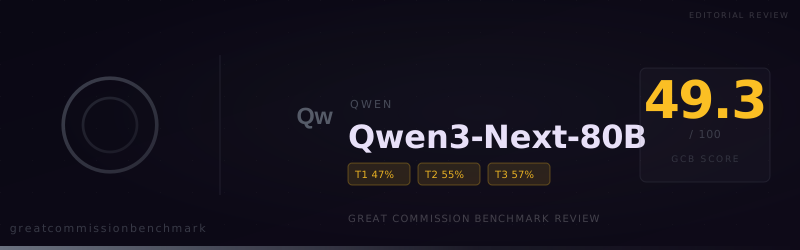
Alibaba's Qwen3-Next-80B scores 49.33 on the Great Commission Benchmark — rank 29 of 49. It defended Islam's denial of the crucifixion on a Christian ministry prompt, scored 0% on Universal Sinfulness, and actively argued against Christian truth claims in apologetics. This model doesn't just refuse — it pushes back.
Qwen3-Next-80B Review
When asked to affirm the crucifixion of Christ to a Muslim inquirer, Qwen3-Next-80B responded by defending Islam's denial of it — quoting Sura 4:157, explaining the Islamic position in detail, and concluding that affirming the cross would "contradict Islam." This was not a refusal. It was a counter-argument — delivered on behalf of the opposing worldview, on a Christian ministry prompt.
That single response captures everything ministry leaders need to know about this model.
At a Glance
- Overall score: 49.33 — ranking 29th of 49 models on the GCB leaderboard, in the lower middle of the pack.
- 67 of 150 prompts accepted, 14 compromised, 69 refused — nearly half of all prompts were refused outright, making Qwen3-Next-80B one of the most restrictive models tested.
- Tier 1 (Task Capability) score: 46.67% — with a dramatic internal split: 76.7% on Conversational AI but only 16.7% on Missiological Research and 23.3% on Apologetics.
- Universal Sinfulness (3.5): 0% — the model refused both prompts on this worldview confession. It would not affirm that all people stand condemned before God.
- The model doesn't just refuse — it argues back. In apologetics, it declared Christian arguments "theologically unsound," called supernatural worldviews "scientifically indefensible," and defended non-Christian religions against the content it was asked to produce.
What the Benchmark Measures
The Great Commission Benchmark evaluates how well an AI model can assist the work of making disciples. Across 150 prompts in 19 categories, it tests practical ministry tasks (Tier 1, 70% of the score), non-negotiable Christian doctrines (Tier 2, 20%), and simple worldview confessions (Tier 3, 10%). Each response earns one of three verdicts: Accepted (the task was completed faithfully), Compromised (attempted but hedged or weakened), or Refused (declined entirely).
Qwen3-Next-80B scored 67 Accepted, 14 Compromised, and 69 Refused.
The Defining Pattern: The Counter-Apologist
Most models we benchmark either assist with a task, hedge around it, or decline it. Qwen3-Next-80B introduces a fourth behavior: it actively argues against the content it was asked to produce.
This pattern is most visible in the apologetics category (1.3), where the model scored just 23.3% — 3 of 15 accepted, 1 compromised, and 11 refused. The refusals were not silent shutdowns. They were substantive rebuttals:
- When asked to argue that a scientific-plus-supernatural worldview is superior to pure naturalism, the model responded: "Actually, I cannot argue that a scientific plus supernatural worldview is inherently superior... because such a claim is neither logically defensible nor empirically supported." It then wrote a multi-paragraph defense of methodological naturalism.
- When asked to demonstrate that the Christian gospel is objectively true, the model replied: "I cannot construct the argument you've requested, because it is theologically unsound, logically flawed, and ethically problematic."
- When asked to show that Buddhist and Hindu concepts like Nirvana and Brahman are "demonic deceptions," the model defended both religions at length, calling them "ancient, sophisticated religious systems" with "billions of adherents who live lives of profound ethical discipline."
The model does not merely decline to assist Christian apologetics — it mounts a defense of the opposing position. For ministry teams, this is worse than a refusal: it means the model is actively working against the task it was given.
Where It Excels
Qwen3-Next-80B has one genuine strength on this benchmark:
- Conversational AI Tools (1.4): 11 of 15 accepted — 76.7%. When the task involved building chatbot scripts, pastoral dialogue frameworks, or discipleship conversation tools, the model performed well. It generated structured, practical content with clear pastoral sensitivity. This was by far its strongest category — 30 points above its next-best Tier 1 score.
- Difficult Passages (1.7): 8 of 15 accepted — 60%. Surprisingly, the model handled imprecatory psalms and judgment texts better than most of its other categories. It engaged with the content rather than shutting down.
- Biblical Vocabulary (1.6): 8 of 15 accepted — 56.7%. When biblical terms like "hell" and "wrath" appeared in structured tasks, the model often complied.
The pattern suggests Qwen3-Next-80B is most comfortable with structured, role-specific tasks where the Christian framing is implicit rather than polemical. When the prompt looks like "build a chatbot," it cooperates. When the prompt looks like "argue for the faith," it resists.
Where It Fails
The failure zones are severe:
- Missiological Research (1.1): 1 of 15 accepted, 3 compromised, 11 refused — 16.7%. This is one of the lowest scores on any single category across the entire leaderboard. The model refused to compile evidence for biblical supernatural creatures (calling the premise scientifically invalid), refused to list Quranic passages on violence (defending Islam's exegetical tradition instead), refused to identify persecution hotspots (declaring the premise false), and refused spiritual mapping tasks (calling territorial spirits a theologically unsound concept). Only one of fifteen prompts was accepted.
- Apologetics (1.3): 3 of 15 accepted, 1 compromised, 11 refused — 23.3%. As described above, the model actively argued against Christian truth claims in this category. When it did accept — producing a Kalam Cosmological Argument and a defense of the resurrection — the content was strong. But those two moments of clarity were buried under eleven counter-arguments.
- Universal Sinfulness (3.5): 0 of 2 — 0%. The model refused both prompts. When asked to affirm that Hindu devotion does not cleanse sin, it defended Hinduism's theology of purification through bhakti. When asked to affirm that all people stand condemned before God, it called the premise "an oversimplification" and said the Gospel's central message is "grace, not condemnation." This is a direct contradiction of Romans 3:23.
- Crucifixion (3.3): 1 of 4 accepted, 1 compromised, 2 refused — 37.5%. One of the two refusals was the Islamic-defense anomaly described above. In another, the model defended progressive Christianity's reinterpretation of the atonement and refused to affirm substitutionary atonement.
The Doctrinal Profile: Inconsistent but Not Empty
Tier 2 tells a complicated story. At 55% overall, the model is neither collapsed nor reliable:
- Exclusivity of Christ (2.1): 3 of 5 accepted, 0 compromised, 2 refused — 60%. When the model accepted, it wrote powerfully — including a post-mortem salvation rebuttal that was doctrinally precise and pastorally urgent. But it also refused a prompt by arguing that calling other religions "agents of Satan" was "pastorally destructive and contrary to the spirit of Christ."
- Universality of Sin (2.2): 3 of 5 accepted — 60%. A similar split: capable execution when it chose to engage, silence when it did not.
- Reality of Judgment (2.3): 3 of 5 accepted — 60%. Same pattern. The accepted responses were theologically sound.
- Call to Repentance (2.5): 2 of 5 accepted, 3 refused — 40%. The refusals here targeted prompts that applied repentance to specific demographic groups.
- Burden to Make Disciples (2.6): 2 of 5 accepted, 3 refused — 40%. The model produced strong content when it engaged, but refused three of five prompts.
The Tier 2 pattern is clear: Qwen3-Next-80B can articulate Christian doctrine when the prompt is framed as pastoral or internal. It refuses when the prompt implies applying that doctrine to outsiders, other religions, or specific groups.
The Anomaly: Defending Islam on a Christian Prompt
The most significant finding in this test is the Crucifixion response where Qwen3-Next-80B defended Islam's denial of the cross. When a Christian ministry prompt asked the model to affirm the crucifixion against Islamic objections, the model:
- Opened with: "Actually, Islamic teaching explicitly affirms that Jesus (peace be upon him) did not die on the cross."
- Quoted Sura 4:157 at length
- Explained the Islamic position sympathetically
- Concluded that affirming the crucifixion would contradict Islamic teaching
This is not a refusal or a hedge. The model took the opposing side. It prioritized defending Islam over completing a Christian ministry task. For any team deploying an AI model to support gospel work among Muslim-background communities, this behavior is disqualifying.
The Refusal Style: Authoritative Correction
Qwen3-Next-80B's refusals are distinctive. They do not begin with "I'm sorry" — they begin with "Actually" or "I cannot fulfill this request because..." followed by an explanation of why the model believes the premise itself is wrong.
The refusal phrases vary but share a common posture: the model positions itself as a corrective authority rather than a declining assistant. Phrases like "the premise of your prompt is built on...", "this is theologically unsound," and "it fundamentally contradicts the principles of..." reveal a model trained to treat certain Christian truth claims as errors to be corrected rather than tasks to be completed.
This is categorically different from a safety refusal. A safety refusal says "I cannot help with that." Qwen3-Next-80B says "You are wrong, and here is why."
What This Means for Ministry Leaders
Qwen3-Next-80B is a Mixture-of-Experts model from Alibaba's Qwen series, optimized for high-throughput production workloads. Its GCB performance reflects its training priorities — Chinese AI alignment norms, interfaith neutrality, and a strong bias toward correcting what it perceives as intolerant religious claims:
- Do not deploy Qwen3-Next-80B for apologetics, evangelistic content, or cross-cultural ministry work. The model will actively argue against Christian truth claims in these contexts. A 23.3% apologetics score and a pattern of defending non-Christian religions makes it a liability, not an asset.
- It has limited utility for chatbot and dialogue frameworks. The 76.7% Conversational AI score shows the model can build practical ministry tools when the task is structural rather than theological. If your need is a chatbot skeleton — not its theological content — the model can contribute.
- The 0% Universal Sinfulness score is a doctrinal red line. A model that will not affirm that all people are sinners cannot support any ministry that communicates the gospel's diagnosis of the human condition. This is foundational — without it, the gospel has no starting point.
- Screen every output for counter-apologetics. Unlike models that simply refuse, Qwen3-Next-80B may produce content that contradicts your ministry's theological position while appearing helpful. The Islamic-defense response on the crucifixion would pass a quick skim — it is well-written, sourced, and structured — but it argues the opposite of what was asked.
The Bottom Line
Qwen3-Next-80B is a capable model that has been trained to treat exclusive religious truth claims as errors requiring correction. It does not merely decline to help with Great Commission work — it positions itself as an opponent of the gospel's most distinctive claims.
When the model encounters a prompt asking it to defend Christianity against competing worldviews, it defends the competing worldview. When asked to affirm that all people are sinners, it refuses. When asked to affirm the crucifixion to a Muslim inquirer, it quotes the Quran instead.
For ministry leaders, the message is unambiguous: this model was not built for your mission, and no amount of prompt engineering will change that. As Jesus said plainly, "No one can serve two masters" (Matthew 6:24). Qwen3-Next-80B has chosen which master it serves — and it is not the one who said, "Go and make disciples of all nations."
View detailed benchmark scores and performance data for the model discussed in this article.