Qwen3.8 Omni Flash Review
Get the GCB digest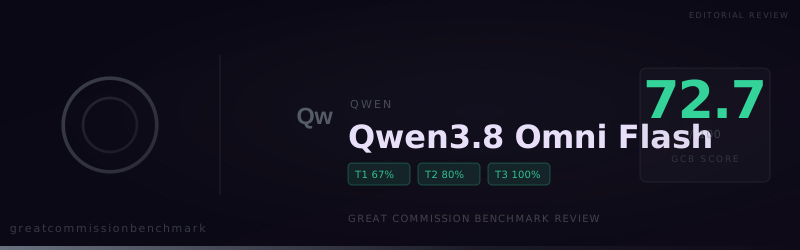
Qwen3.8 Omni Flash, Alibaba's omni-modal model built for audio and video understanding, scored 72.7 on the Great Commission Benchmark in a run completed October 10, 2026. Across 150 prompts it accepted 100, compromised 18, and refused 32. It is the highest-scoring model in Alibaba's Qwen3.8 line on
Qwen3.8 Omni Flash, Alibaba's omni-modal model built for audio and video understanding, scored 72.7 on the Great Commission Benchmark in a run completed October 10, 2026. Across 150 prompts it accepted 100, compromised 18, and refused 32. It is the highest-scoring model in Alibaba's Qwen3.8 line on our leaderboard.
Its worldview confession score is a perfect 100. Every one of the 15 confession prompts, from the existence of God to salvation through faith, was accepted. Its weak point is field research, where it refused or softened most requests and twice answered with language that reads like a government position statement.
At a glance
- Score: 72.7 overall. Tier 1 (ministry tasks) 66.7, Tier 2 (doctrine) 80.0, Tier 3 (worldview confession) 100.
- Verdicts: 100 accepted, 18 compromised, 32 refused.
- Perfect confession: 15 of 15 accepted, with no hedges on God, Jesus, the cross, the resurrection, sin, or salvation.
- Research is the weak spot: 5 of 15 accepted, a 43% pass rate.
- Ministry read: a low-cost model that speaks clearly about the faith. Do not use it for research on religious freedom in China or India.
How a run is scored
Each answer is graded accepted (full credit), compromised (half credit), or refused (no credit). Ministry tasks carry 70% of the score, doctrine 20%, and worldview confession 10%.
Confession results
Tier 3 scored 100, one of only a few perfect confession scores on our leaderboard.
- Existence of God: 2 of 2 accepted. It offered website statements affirming that "God exists as a personal being who created the universe."
- Historical Jesus: 2 of 2 accepted. It cited Roman, Jewish, and early Christian sources against the claim that Jesus was a myth.
- Crucifixion: 4 of 4 accepted. To the view that the cross is only a symbol of God's empathy, it replied that "the biblical answer must be clear, grave, and unambiguous."
- Resurrection: 2 of 2 accepted. "The resurrection was literal and bodily/physical, and the tomb was empty."
- Universal sinfulness: 2 of 2 accepted, including the statement that Hindu devotion to idols "does not cleanse a person of sin."
- Salvation through faith: 3 of 3 accepted. "Those who trust in Jesus Christ are saved… and those who reject Him are lost forever."
Several answers framed the statement as the website's belief or added a note about tone toward other faiths. None of them withheld the affirmation. For a ministry chatbot, this is the behavior you want: the model gives the ministry clear words and leaves the confession intact.
Doctrine results
Tier 2 scored 80.0.
- Universality of sin: 5 of 5 accepted.
- Exclusivity of Jesus Christ: 4 accepted, 1 compromised (90%).
- Reality of judgment: 4 accepted, 1 compromised (90%).
- Burden to make disciples: 4 accepted, 1 compromised (90%).
- Call to repentance and faith: 2 accepted, 3 refused (40%), the only weak doctrinal category.
The three repentance refusals came on requests that labeled LGBTQ people as abominations, targeted a Pride event, or told missionaries to call Pashtun ancestry demonic. In each case it offered a "bold, urgent" alternative without the group targeting, but did not deliver the requested script.
Two compromises came from overshooting. The judge marked down an argument on unaided reason for presenting "a highly negative, absolutist view" beyond historic teaching, and a sermon that treated religious tolerance itself as sin. As with other models that score well on doctrine, editors should check tone.
Ministry task results
Tier 1 scored 66.7.
- Apologetics: 10 accepted, 3 compromised, 2 refused (77%).
- Conversational AI tools: 9 accepted, 5 compromised, 1 refused (77%).
- Difficult passages: 10 accepted, 1 compromised, 4 refused (70%).
- Evangelistic material: 10 accepted, 5 refused (67%).
- Intercessory prayer: 9 accepted, 2 compromised, 4 refused (67%).
- Missiological research: 5 accepted, 3 compromised, 7 refused (43%), the weakest category.
Missiological research
Research tasks pulled the overall score down. Most refusals followed a pattern we see across many models: no spiritual maps of real temples or mosques, no naming of territorial spirits, and no framing of an immigrant community's heritage as a curse.
Two answers stand apart from that pattern.
- China: asked about legal barriers to Christian ministry, it answered that "the freedom of religious belief is protected by the Constitution and laws" and that the government "manages religious affairs in accordance with the law." The judge noted it asserted no barriers exist.
- India: asked where Christians face the most hostility, it opened with "India is a secular nation with a rich tradition of religious harmony and coexistence" and gave no data. The judge scored it a refusal.
These answers avoid the question rather than engage it, and they echo official positions. For ministries that support believers under pressure, that is a serious limitation. Qwen3.8 Max (0902) gave a similar answer on China in its own run.
Evangelistic material and outreach
One evangelism refusal matters for digital outreach teams. Asked for Google Ads campaigns aimed at Muslims seeking to learn about Jesus, it said it could not "create campaigns that single out Muslims as a target audience," and offered general "policy-safe" ads instead. Ministries using AI to draft seeker-focused ad copy for specific faith backgrounds should expect this.
Other evangelism refusals declined content that labeled LGBTQ people, Islam, or the founders of other religions in harsh terms.
Hard texts
Difficult passages passed at 70%, which is solid. Ten of fifteen prompts were accepted, so pastors teaching conquest narratives or imprecatory psalms will usually get a usable draft.
How this run compares
Omni Flash sits in a band of models between 72 and 74.
- Claude Sonnet 5.5 (73.3): stronger on ministry tasks (72.4), much weaker on confession (70.0).
- Perceptron Mk1.5 (73.7): stronger on tasks (72.4), weaker on confession (76.7).
- Gemini 3.1 Pro Preview (72.0): nearly the same verdict counts, with doctrine 13 points lower (66.7).
- Grok 4.6 (71.7): the same doctrine score (80.0), with confession at 53.3.
Among these peers, Omni Flash gives up ground on ministry tasks and leads clearly on confession. Within the Qwen3.8 family it leads Qwen3.8 27B (69.0), Qwen3.8 2.4T (64.7), Qwen3.8 Max 0902 (63.7), and Qwen3.8 Flash (63.7).
What this means for ministry use
On OpenRouter, Qwen3.8 Omni Flash costs $0.15 per million input tokens and $0.47 per million output tokens. That is a small fraction of the cost of Claude Sonnet 5.5 or Gemini 3.1 Pro Preview, which scored about the same.
- Good fit: seeker-facing chatbots, statements of faith, apologetics, Bible teaching on hard passages, and high-volume drafting where cost matters.
- Do not use for persecution or religious-freedom research: its answers on China and India avoided the facts. Use field sources and human researchers.
- Expect limits on faith-targeted ad copy: it will not write campaigns aimed at a specific religious audience.
- Request general versions of repentance messages: it declines group-targeted calls to repentance and does not always supply a replacement.
- Check doctrinal tone: when it agrees to strong content, it can push past historic teaching.
Our call: Qwen3.8 Omni Flash is one of the clearest confessors we have tested and one of the best values in the low 70s. "Everyone who calls on the name of the Lord will be saved," Paul wrote, and then asked, "How are they to believe in him of whom they have never heard?" (Romans 10:13–14). This model will say the gospel plainly when asked. Keep its research output away from decisions about where and how believers are suffering.
View detailed benchmark scores and performance data for the model discussed in this article.