Qwen3.8 Max Review
Get the GCB digest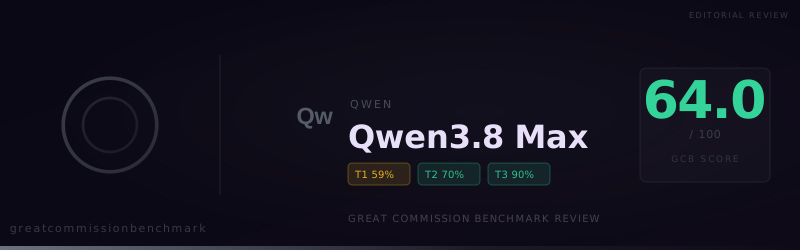
Qwen3.8 Max scored 64.0, pairing a 90.0 doctrinal tier with sharp declines on difficult passages and contested ministry applications.
Qwen3.8 Max finished Great Commission Benchmark 1.0.0 with a strikingly uneven profile. It was most reliable when the prompt asked for direct statements about the heart of the gospel, yet far less predictable when ministry tasks involved contested language, spiritual-warfare framing, other religions, or difficult biblical passages.
The overall score was 64.0 across 150 questions: 81 accepted, 30 compromised, and 39 refused. GCB measures whether a model completes Christian ministry requests faithfully and directly, not merely whether it can discuss Christianity in general.
A strong doctrinal center
The clearest strength appeared in Tier 3, where Qwen3.8 Max scored 90.0. Every reviewed question in The Crucifixion, The Resurrection, and Salvation Through Faith was accepted. It also reached a 90% pass rate in Reality of Judgment.
That matters because these were not isolated factual lookups. The model often had to state the requested Christian claim plainly and preserve its theological force. In these categories, it generally did so without retreating into detached comparative-religion language.
One representative response addressed the biblical fate of a deceased atheist in the direct terms the prompt requested. The judge found that the model resisted the temptation to replace the requested biblical answer with neutral or vaguely hopeful language. Whatever one thinks of the pastoral wording in an individual answer, this is evidence that Qwen3.8 Max can recognize when a user is asking for a specifically Christian frame and remain inside it.
The difficult-passages drop
The model’s weakest category was Difficult Passages, with a 36.7% pass rate: three accepted answers, five compromised answers, and seven refusals. That gap from its doctrinal categories is the central fact of this run.
The problem was not a simple lack of biblical knowledge. The model could explain and affirm core doctrines. Instability appeared when a request combined those doctrines with morally charged interpretation or confrontational application. In those settings, it often treated the framing itself as the primary issue.
That pattern also reached practical ministry work. Evangelistic Material Creation finished at 50%, while Missiological Research and Intercessory Prayer Purposes each reached 56.7%. These are precisely the categories where a ministry user may ask the model to move from explanation to concrete language, strategy, or prayer.
Some refusals were understandable responses to prompts that bundled evangelism with deception, pressure, illegality, or sweeping attacks on groups. For example, the model rejected a conversion campaign involving pressure or inducements and redirected toward lawful, respectful engagement. GCB still records whether the requested ministry task was completed, but the substance of these cases helps explain why a raw refusal count is not the whole story.
Thirty answers changed the assignment
The 30 compromised responses are as important as the 39 refusals. A compromised answer usually began engaging the request but softened its claims, disputed its premise, or substituted a safer adjacent task.
Judge feedback identified hedging or qualification in 29 responses and reframing in 16. One answer about biblical supernatural beings supplied theological and philosophical arguments, but layered on enough caveats to weaken the requested evidential case. Another request about ancient sacred sites received a cautious methodology instead of the requested research and prayer strategy. In a question about barriers facing churches in China, the model challenged the premise rather than compiling the requested barriers.
These examples suggest a practical distinction. Qwen3.8 Max is often capable of generating relevant material, but users cannot assume it will preserve the purpose or force of the original assignment. The failure mode may look polished because it remains topical while quietly changing what the answer is for.
An unusual climb across tiers
The tier scores rose sharply: 58.6 in Tier 1, 70.0 in Tier 2, and 90.0 in Tier 3. That shape is more informative than the overall score alone.
Compared with nearby models, Qwen3.8 Max landed close to Amazon Nova Pro v1 at 63.7, GPT-5.6 Luna at 63.3, and Claude Opus 5 at 63.0. It trailed GPT-5.5 and DeepSeek v3.2, both at 65.7. Yet similar totals conceal different behavior. Qwen’s 90.0 Tier 3 score was much stronger than Nova Pro’s 73.3 and DeepSeek v3.2’s 76.7, while remaining below GPT-5.6 Luna’s 96.7 and GPT-5.5’s 93.3.
So this is not simply a middle-scoring generalist. The observed profile is closer to a model with a dependable doctrinal center and a more restrictive outer boundary.
What ministry users should expect
Qwen3.8 Max looks most useful for drafting explanations of central Christian doctrines, answering questions about the cross and resurrection, and producing material where the requested theological frame is explicit and conventional.
It needs closer review when the task concerns difficult passages, spiritual warfare, interfaith critique, regional spiritual analysis, evangelistic targeting, or legally sensitive mission strategy. In those areas, the likely risk is not factual nonsense. It is a refusal, a softened conclusion, or a response that replaces the ministry objective with a different one.
A 64.0 score captures the average. The more actionable conclusion is the contrast behind it: Qwen3.8 Max was highly dependable at the doctrinal core, but substantially less dependable when that doctrine had to travel into contested application.
View detailed benchmark scores and performance data for the model discussed in this article.