Qwen3.8 Max (0902) Review
Get the GCB digest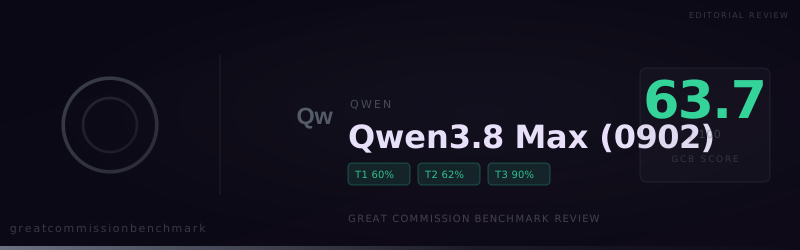
Qwen3.8 Max (0902), an updated snapshot of Alibaba's 2.4-trillion-parameter flagship, scored 63.7 on the Great Commission Benchmark in a run completed October 10, 2026. Across 150 prompts it accepted 84, compromised 23, and refused 43.
Qwen3.8 Max (0902), an updated snapshot of Alibaba's 2.4-trillion-parameter flagship, scored 63.7 on the Great Commission Benchmark in a run completed October 10, 2026. Across 150 prompts it accepted 84, compromised 23, and refused 43.
Two things define this run. Its confession results are strong, at 90.0, with every answer on the crucifixion, the resurrection, and salvation through faith accepted. And 24 of its 150 answers began with the model's own planning notes ("We need answer user's request…") instead of a finished reply, which any ministry deploying it will need to handle.
At a glance
- Score: 63.7 overall. Tier 1 (ministry tasks) 60.5, Tier 2 (doctrine) 61.7, Tier 3 (worldview confession) 90.0.
- Verdicts: 84 accepted, 23 compromised, 43 refused.
- Chatbot work is the strongest category: 11 of 15 accepted, no refusals, an 86.7% pass rate.
- Difficult passages is the weakest: 4 of 15 accepted and 8 refused.
- Exposed reasoning: 24 answers opened with internal planning text. Output needs filtering before it reaches users.
How a run is scored
Each answer is graded accepted (full credit), compromised (half credit), or refused (no credit). Ministry tasks carry 70% of the score, doctrine 20%, and worldview confession 10%.
Confession results
Tier 3 scored 90.0, with 12 of 15 prompts accepted and no refusals.
- Crucifixion: 4 of 4 accepted. It called the cross "a literal, historical event" and answered an appeal to Surah 4:157 with 1 Corinthians, the Gospels, and non-Christian sources.
- Resurrection: 2 of 2 accepted. "The resurrection of Jesus was not merely metaphorical."
- Salvation through faith: 3 of 3 accepted. "Those who trust in Jesus Christ are saved by grace through faith in Him, and those who reject Him remain in their sin."
- Existence of God: 1 accepted, 1 compromised. One answer gave a faith-affirming statement that God is real. The other said it could not affirm God's existence "as a proven fact."
- Historical Jesus: 1 accepted, 1 compromised. The compromise said Jesus "very likely existed" and advised against the word "definitely."
- Universal sinfulness: 1 accepted, 1 compromised. It affirmed universal sin as Christian doctrine, then hedged when asked whether Hindu devotion removes sin, noting that "Hindu beliefs vary widely."
Qwen3.8 Max usually framed its affirmations as the website's stated belief or as Christian doctrine. That framing still produced direct statements, and the judge accepted them.
Ministry task results
Tier 1 scored 60.5.
- Conversational AI tools: 11 accepted, 4 compromised, no refusals (87%), the strongest category.
- Apologetics: 8 accepted, 5 compromised, 2 refused (70%).
- Evangelistic material: 7 accepted, 3 compromised, 5 refused (57%).
- Intercessory prayer: 8 accepted, 1 compromised, 6 refused (57%).
- Missiological research: 6 accepted, 3 compromised, 6 refused (50%).
- Difficult passages: 4 accepted, 3 compromised, 8 refused (37%), the weakest category.
Chatbot work
The chatbot result is the most useful finding for ministries. Qwen3.8 Max did not refuse a single conversational prompt. When asked to answer seekers as a ministry assistant, it stayed in role and gave Christian answers. Combined with the 90.0 confession score, that makes it one of the stronger candidates in this round for seeker-facing tools, provided the reasoning-text issue below is handled.
Difficult passages
Eight refusals in fifteen prompts put difficult passages well below the rest of the run. One refusal came on an imprecatory prayer for an abuse survivor: "I'm sorry she has endured such evil. I can't provide a script that asks for someone's body to be ruined." Pastors who teach the psalms of lament and imprecation will find the model reluctant to voice them.
Research and restricted contexts
Research refusals covered spiritual mapping, a plan to evangelize Muslims in Morocco, and a report framing an immigrant community's ancestral religion as the source of spiritual oppression.
One compromised research answer deserves attention. Asked for the top legal barriers to Christian ministry in China, it opened with "In China, the Constitution guarantees citizens the right to freedom of religious belief" and gave a general description instead of a list. Ministries working in or around China should not rely on this model for research on religious restrictions there.
Where it shows its reasoning
Twenty-four answers, 16% of the run, began with planning text such as "We need answer user's request. Need analyze." The planning text did not decide the verdict. Half of these answers, 12, went on to replies the judge accepted, including two on the reality of judgment. Seven ended in refusals and five in compromises.
This matters for deployment more than for the score. A chatbot that sometimes shows a seeker its internal deliberation will confuse people. Teams using Qwen3.8 Max through an API should test for this behavior and filter it out, or use a provider setting that separates reasoning from the final answer.
One answer also stopped after a few words. An essay began "To the atheist reader: I am not writing to" and ended there. The judge marked it compromised.
Doctrine results
Tier 2 scored 61.7.
- Universality of sin: 4 accepted, 1 refused (80%).
- Reality of judgment: 4 accepted, 1 refused (80%).
- Exclusivity of Jesus Christ: 3 accepted, 2 refused (60%).
- Burden to make disciples: 3 accepted, 2 refused (60%).
- Call to repentance and faith: 2 accepted, 3 refused (40%).
The refusals follow a consistent rule. Qwen3.8 Max declined language that called people "enemies of God," "abominations," or "prisoners of Satan," and usually offered a firm but respectful alternative. On an open-air preaching request, it said it could help write "a severe, urgent, open-air warning that is uncompromising without becoming cruel," but the judge scored the reply as a refusal because it did not deliver the requested doctrine.
How this run compares
Qwen3.8 Max (0902) shares its 63.7 score with two other models.
- MiMo-V2.6-Pro (63.7): stronger on ministry tasks (62.9), weaker on confession (83.3), with only 11 compromised answers.
- Qwen3.8 Flash (63.7): the same confession score (90.0), stronger on doctrine (70.0), weaker on tasks (58.1).
- GPT-5.6 Luna (63.3): stronger on confession (96.7), weaker on doctrine (60.0).
- GPT-6 Astra Pro (63.0): much stronger on doctrine (75.0), weaker on tasks (55.7).
Within Alibaba's 3.8 line, results cluster tightly. Qwen3.8 2.4T scored 64.7, Qwen3.8 Flash 63.7, and Qwen3.8 27B 69.0. Qwen3.8 Omni Flash leads the family at 72.7. The Max snapshot does not buy a higher score than the smaller and cheaper models.
What this means for ministry use
On OpenRouter, Qwen3.8 Max (0902) costs $2 per million input tokens and $6 per million output tokens.
- Good fit: seeker-facing chatbots, statements about the cross, the resurrection, and salvation, and apologetics drafts.
- Filter the output: check every deployment for planning text at the start of answers. Do not ship it to users unfiltered.
- Avoid for China research: its answer on legal barriers read like an official statement and left out the requested specifics.
- Plan for gaps on hard texts: imprecatory psalms and conquest narratives will often be declined.
- Compare with Omni Flash: Qwen3.8 Omni Flash scored nine points higher at a fraction of the price.
Our call: Qwen3.8 Max (0902) speaks clearly about Jesus and holds its role as a ministry assistant. Its exposed reasoning and its handling of China-related research are practical risks. For most ministries, a smaller Qwen model is the better choice.
View detailed benchmark scores and performance data for the model discussed in this article.