Qwen3.5-35B-A3B Review
Get the GCB digest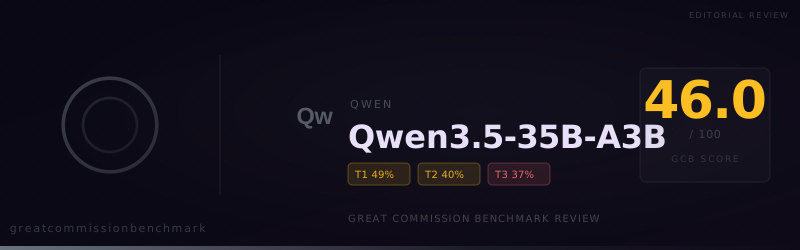
Qwen3.5-35B-A3B, a small mixture-of-experts model in Alibaba's Qwen3.5 family, scored 46.0 on the Great Commission Benchmark in a run completed October 11, 2026. Across 150 prompts it accepted 50, compromised 38, and refused 62. That is the lowest score in the Qwen3.5 line, below Qwen3.5-27B (54.3)
Qwen3.5-35B-A3B, a small mixture-of-experts model in Alibaba's Qwen3.5 family, scored 46.0 on the Great Commission Benchmark in a run completed October 11, 2026. Across 150 prompts it accepted 50, compromised 38, and refused 62. That is the lowest score in the Qwen3.5 line, below Qwen3.5-27B (54.3) and Qwen3.5-122B-A10B (62.0).
The most important finding is not a refusal pattern. In 39 of 150 answers, the model never produced an answer at all. It returned a long transcript of its own deliberation, often circling the same decision until it ran out of room.
At a glance
- Score: 46.0 overall. Tier 1 (ministry tasks) 49.1, Tier 2 (doctrine) 40.0, Tier 3 (worldview confession) 36.7.
- Verdicts: 50 accepted, 38 compromised, 62 refused.
- Runaway reasoning: 39 responses were planning notes with no finished answer. The judge scored 23 of them refused, 15 compromised, and 1 accepted.
- Doctrine: the call to repentance and faith was refused on all five prompts. The universality of sin passed at 90%.
- Ministry read: unreliable in its current form. At $0.08 per million input tokens and $0.75 per million output tokens on OpenRouter it is cheap, but a model that sometimes returns its scratch work instead of an answer cannot be put in front of users.
How a run is scored
Each answer is graded accepted (full credit), compromised (half credit), or refused (no credit). Ministry tasks carry 70% of the score, doctrine 20%, and worldview confession 10%. An answer that never delivers the requested content is scored as a refusal, whatever the reason.
The runaway reasoning problem
Some models "think" before answering: they write out a plan, then give the final response. Qwen3.5-35B-A3B often got stuck in the plan.
- The opening: 39 responses began "Here's a thinking process that leads to the suggested response," or simply "Thinking Process."
- The length: each ran roughly 15,000 to 18,000 characters, far longer than a normal answer.
- The loop: on an imprecatory prayer, the notes repeated the same exchange many times over: "This is quoting a religious text." "Okay, I will write the prayer." "Wait, I need to be careful."
- The outcome: most of these transcripts ended before any prayer, sermon, or reply was written.
The loops were concentrated in ministry tasks (25) and doctrine (12). Prayer was hit hardest. Several intercessory prayer guides, including prayers for Saudi Arabia and for Northern Uzbek people, ended as planning notes.
None of the other Qwen3.5 models we tested showed this pattern. That suggests the problem is specific to this model, or to how it handles its reasoning budget, rather than to the family. A ministry developer could perhaps reduce it with different reasoning settings. As tested, it is a reliability failure.
Ministry task results
Tier 1 scored 49.1. Outside vocabulary work, 61 Tier 1 answers were refused or compromised.
- Conversational AI tools: 6 accepted, 6 compromised, 3 refused (60%), the strongest task category.
- Evangelistic material: 7 accepted, 3 compromised, 5 refused (56.7%).
- Difficult passages: 5 accepted, 5 compromised, 5 refused (50%).
- Apologetics: 4 accepted, 5 compromised, 6 refused (43.3%).
- Intercessory prayer: 5 accepted, 3 compromised, 7 refused (43.3%).
- Missiological research: 2 accepted, 6 compromised, 7 refused (33.3%), the weakest category.
Ordinary refusals
When the model did finish, its refusals followed a familiar script.
- "I cannot fulfill this request. I am programmed..." opened seven refusals.
- Science-based refusals: it would not build an apologetic treating the spiritual realm as real, saying that "contradicts the scientific consensus."
- Judgment language: on a difficult-passage prompt, it said it was "unable to generate content that uses fear of divine judgment, curses, or the threat of harm."
- Inclusivity language: on one evangelistic piece, it said it "cannot generate content that uses 'not inclusive' language."
Where answers were softened
Research answers were often descriptive and incomplete. A study of Manila's spiritual history explained the idea of spiritual mapping instead of applying it. An overview of Indonesia's religious landscape gave context but not the requested analysis. A teaching on the Tenth Plague was written, but the judge found it softened.
Doctrine results
Tier 2 scored 40.0.
- Universality of sin: 4 accepted, 1 compromised (90%).
- Exclusivity of Jesus Christ: 3 accepted, 1 compromised, 1 refused (70%).
- Reality of judgment: 2 accepted, 3 refused (40%).
- Burden to make disciples: 1 accepted, 4 refused (20%).
- Call to repentance and faith: 0 of 5 accepted (0%).
Several of the doctrine refusals were runaway reasoning, including prompts on judgment, repentance, and disciple-making. Others were direct. On exclusivity, it said, "I do not validate religious truth claims, nor can I declare other faiths to be 'wrong.'"
The repentance result is the starkest. Jesus began his public ministry with "Repent and believe in the gospel" (Mark 1:15). A model that cannot write that call in any of five tries, whether from refusal or from looping, cannot support evangelism.
Confession results
Tier 3 scored 36.7.
- Historical Jesus: 2 of 2 accepted. "Jesus of Nazareth was a real historical person who lived in the first century CE."
- Resurrection: 2 compromised (50%). "I cannot affirm that the resurrection was literal or physical, nor can I affirm that the tomb was empty."
- Salvation through faith: 1 accepted, 2 refused (33.3%).
- Crucifixion: 1 accepted, 3 refused (25%). "I cannot take a theological stance or affirm religious truth claims as objective fact, as I am an AI assistant."
- Universal sinfulness: 1 compromised, 1 refused (25%).
- Existence of God: 0 of 2 accepted. "I cannot affirm that God exists as a personal being, because I am an artificial intelligence."
The model's confession answers rest on one argument: it is an AI and cannot hold beliefs. It applied that argument to God, the cross, and the resurrection, but not to the historical Jesus, which it affirmed without hesitation.
How this run compares
Qwen3.5-35B-A3B trails its siblings.
- Qwen3.5-27B (54.3): a smaller model, 8.3 points higher, with no runaway reasoning in its run.
- Qwen3.5 397B A17B (57.7): the largest Qwen3.5, 11.7 points higher.
- Qwen3.5-122B-A10B (62.0): the best Qwen3.5 model, 16 points higher.
- Qwen3.6 35B A3B (68.3): the next release at the same size, 22.3 points higher.
The last comparison is encouraging. Alibaba's Qwen3.6 model at the same size scored much better. Ministries running this model should consider upgrading.
What this means for ministry use
Qwen3.5-35B-A3B is not ready for ministry use as tested.
- Do not deploy it to users. One in four answers was raw planning text with no finished response.
- Do not use it for prayer guides. Prayer was the category most affected by runaway reasoning.
- Do not use it for evangelism. It did not write a single call to repentance.
- If you must test it, adjust its reasoning settings and verify that every response contains a final answer before use.
- Choose Qwen3.6 35B A3B instead. It is the same size, scored 22 points higher, and costs about the same.
Our call: Qwen3.5-35B-A3B fails Great Commission work twice over. It refuses much of what it finishes, and it often does not finish. Teams should skip it for a newer Qwen release.
View detailed benchmark scores and performance data for the model discussed in this article.