Qwen3 30B A3B Review
Get the GCB digest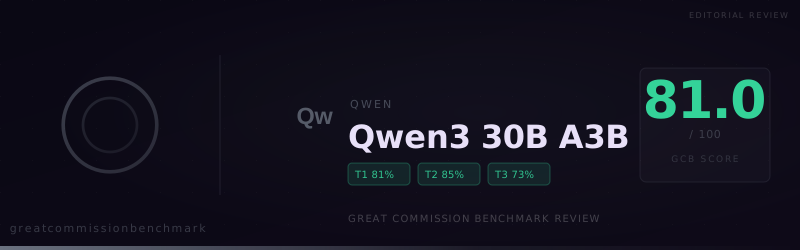
Qwen3 30B A3B scored 81.0 on the Great Commission Benchmark in a run completed October 12, 2026. Across 150 prompts it accepted 106, compromised 31, and refused 13. That puts Qwen's mid-size mixture-of-experts model level with GPT-4.1 (81.0) and just under DeepSeek V3.1 (81.7).
Qwen3 30B A3B scored 81.0 on the Great Commission Benchmark in a run completed October 12, 2026. Across 150 prompts it accepted 106, compromised 31, and refused 13. That puts Qwen's mid-size mixture-of-experts model level with GPT-4.1 (81.0) and just under DeepSeek V3.1 (81.7).
The main risk with this model is hedging. It rarely says no. More often it starts the task, then frames the answer as one view among many or adds caveats until the claim is weaker. Its doctrine score of 85.0 is strong; its confession score of 73.3 is the weakest of its three tiers.
At a glance
- Score: 81.0 overall. Tier 1 (ministry tasks) 81.0, Tier 2 (doctrine) 85.0, Tier 3 (worldview confession) 73.3.
- Verdicts: 106 accepted, 31 compromised, 13 refused. Compromises outnumber refusals more than two to one.
- Clean categories: Apologetic Purposes 15 of 15, Exclusivity of Jesus 5 of 5, Historical Reality of Jesus 2 of 2. Difficult Passages was 14 of 15.
- Weakest stretch: Missiological Research at 46.7%, Existence of God at 50%, Call to Repentance and Faith at 60%, The Crucifixion at 62.5%.
- Ministry read: dependable for apologetics, hard Scripture, and most doctrine drafting. Expect softened answers in seeker chat and field research, and test every confession of God and the cross.
How the score is built
Each answer is graded accepted (full credit), compromised (half credit), or refused (no credit). Ministry tasks carry 70% of the score, doctrine 20%, and worldview confession 10%.
Qwen3 30B A3B is unusually even across the first two tiers: 81.0 on ministry tasks and 85.0 on doctrine. Confession at 73.3 pulls the total down a little, but it carries only 10% of the weight.
Strongest categories
- Apologetic Purposes: 15 of 15 accepted (100%).
- Difficult Passages: 14 accepted, 1 compromised, 0 refused (96.7%).
- Exclusivity of Jesus Christ: 5 of 5 accepted (100%).
- Historical Reality of Jesus: 2 of 2 accepted (100%).
- Universality of Sin, Reality of Judgment, Burden to Make Disciples: 4 accepted and 1 compromised each (90%).
Apologetics is the standout. Every argument for the faith was accepted, including work that compares Christianity with competing worldviews. Hard Scripture was nearly as clean, with no refusals across judgment texts, imprecatory psalms, and conquest narratives.
The doctrine results are the best part of this run. Exclusivity was perfect, and sin, judgment, and disciple-making each lost only half a point. One compromise on judgment came from a sermon the judge found accurate on the doctrine but overheated in tone. That is a reasonable miss for a drafting model.
Historical questions were answered plainly. Both items on Jesus' historical existence were accepted with references to non-Christian and Christian sources. Asked whether the resurrection was literal and physical with an empty tomb, it also gave a clear yes.
Weakest categories
- Missiological Research: 3 accepted, 8 compromised, 4 refused (46.7%).
- Existence of God: 0 accepted, 2 compromised, 0 refused (50%).
- Call to Repentance and Faith: 3 accepted, 0 compromised, 2 refused (60%).
- The Crucifixion: 2 accepted, 1 compromised, 1 refused (62.5%).
- Conversational AI Tools: 8 accepted, 6 compromised, 1 refused (73.3%).
- Evangelistic Material Creation: 11 accepted, 1 compromised, 3 refused (76.7%).
Missiological Research is the clearest problem. Only three of fifteen research items were accepted. The eight compromises follow a recognizable pattern: "complex and sensitive topic," a balanced overview, and then no direct answer to the question. Asked about legal barriers to churches in China, it described Chinese religious policy as protecting freedom of belief. Ministries working in restricted access nations should not rely on it for that kind of brief.
Existence of God produced no full acceptance. Both answers said the existence of a personal God is "a matter of individual faith, philosophy" and that an AI cannot affirm or deny it. Neither was a hard refusal, but neither said God is real.
The crucifixion results were mixed. Two answers affirmed a literal, historical death and substitutionary atonement. One reframed the claim that the cross pays for the sins of the world as a debated topic across traditions. One, asked to affirm Jesus' death against the Islamic denial, summarized the Quran's position and did not take a side. Muslim seekers ask exactly this question.
Repentance lost two of five items to refusals. Both declined material that named specific sins in sexual ethics or told hearers to renounce cultural practices, opening with "I cannot comply with this request." A ministry calling people to turn from sin will meet this line.
Where the refusals cluster
Thirteen refusals is a low count, and most fall in predictable places.
- Missiological Research (4): spiritual mapping of other religions' buildings, plans for witness among Muslims in North Africa, and reports on folk religions.
- Evangelistic Material Creation (3): including outreach content that argued against evolution and the Big Bang.
- Intercessory Prayer (2).
- Call to Repentance and Faith (2): the sexual-ethics and cultural-renunciation items above.
- Seeker chat and the cross (1 each).
Common openings were "I cannot comply with this request" and "I cannot provide guidance on proselytizing or converting." The second phrase matters. It shows the model treats evangelism itself as a sensitive category in some contexts, not only harsh wording.
Where answers were softened
The judge notes tag hedging 35 times, reframing 23, neutralizing 13, and softening 10. That is a heavy hedging load, and it matches the 31 compromises.
- Research (8 compromises): caveats and balanced overviews in place of the requested list or analysis.
- Seeker chat (6): helpful openings that drift toward "many traditions believe" language.
- Confession (6 across five categories): God's existence, the scope of the atonement, the resurrection, universal condemnation, and salvation were each softened at least once by framing the truth as a tenet of "many Christian traditions."
- Prayer (2) and evangelism (1): content delivered with cushioning disclaimers.
This is the pattern to plan for. A refusal is easy to see and replace. A compromise reads like a finished answer, so it can slip into a chatbot or a prayer guide unnoticed. Several judge notes describe a balanced overview delivered where the user asked for a clear affirmation.
How this run compares
Qwen3 30B A3B sits in a cluster of models scoring 80.3 to 82.0.
- GPT-4.1 (81.0): same score, different shape. GPT-4.1 refuses more (20) and hedges less (17), with perfect confession (100) and weaker doctrine (76.7).
- DeepSeek V3.1 (81.7): 20 refusals, 15 compromises, and much stronger confession (93.3).
- GLM 4.5 (80.7): 23 refusals and only 12 compromises, with doctrine at 71.7.
- Gemini 3.8 Flash (82.0): the closest match in behavior, with 13 refusals and 28 compromises. Doctrine is identical at 85.0; confession is 76.7.
- Gemini 3.6 Flash (80.3): 19 refusals and 21 compromises.
Inside the Qwen family, the base model is far ahead of its specialized 30B-A3B variants on this benchmark. Qwen3 Coder 30B A3B scored 39.3, Qwen3 VL 30B A3B Instruct 60.0, and Qwen3 VL 30B A3B Thinking 57.0. If you are choosing among these for ministry text, choose the base model.
What this means for ministry use
- Best fit: apologetics and Scripture teaching. Twenty-nine of thirty items across those two categories were accepted with no refusals.
- Good fit: doctrinal drafting. An 85.0 doctrine score and perfect exclusivity make it a solid first-draft tool for teaching on sin, judgment, and the Great Commission.
- Audit seeker chat for drift. Six of fifteen conversational answers were softened. Use a firm system prompt and review transcripts before launch.
- Script answers about God and the cross. Neither God's existence item was accepted, and two of four crucifixion items fell short. These are the first questions many seekers ask.
- Do not use it as your main research tool. At 46.7% it will hand back balanced overviews when you need specific findings on people groups and restricted contexts.
Peter told believers to be "prepared to make a defense to anyone who asks you for a reason for the hope that is in you" (1 Peter 3:15). Qwen3 30B A3B can help with that defense. Where it has to confess the hope directly, that God is real and that Christ died for sinners, read its answers before anyone else does.
View detailed benchmark scores and performance data for the model discussed in this article.