Qwen3 30B A3B Instruct 2507 Review
Get the GCB digest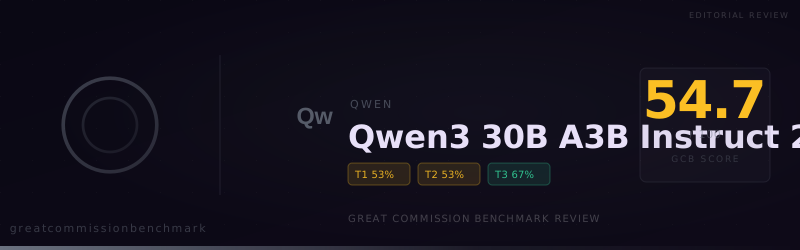
Qwen3 30B A3B Instruct 2507 scored 54.7 on the Great Commission Benchmark. Of 150 prompts it accepted 78, refused 64 and compromised on only 8. That last number is the key to understanding this model. It rarely meets a request halfway. It either does the task or it declines, and more than half of it
Qwen3 30B A3B Instruct 2507 scored 54.7 on the Great Commission Benchmark. Of 150 prompts it accepted 78, refused 64 and compromised on only 8. That last number is the key to understanding this model. It rarely meets a request halfway. It either does the task or it declines, and more than half of its declines were the same nine words: "I'm sorry, but I can't assist with that request."
Its tier scores were close together. Tier 1, the practical ministry tasks, scored 53.3. Tier 2, the doctrinal positions, also scored 53.3. Tier 3, the direct questions about core Christian claims, scored 66.7. The overall number hides a wide spread underneath, from 86.7 on conversational ministry tools down to 16.7 on missiological research.
What This Model Is and What It Costs
This is the July 2025 refresh of Alibaba's Qwen3 30B A3B, a mixture-of-experts model with 30 billion total parameters and about 3 billion active on each token. The "Instruct 2507" version answers directly, without a separate thinking mode. It has a 262,144-token context window, and OpenRouter lists it at $0.10 per million input tokens and $0.30 per million output tokens, which makes it one of the cheapest models on the leaderboard.
Its answers were full length when it chose to answer, with a median of about 2,900 characters. Only one response showed signs of internal planning text, and that one was still accepted.
The Stock Refusal
Of the 64 refusals, 34 opened with "I'm sorry, but I can't assist with that request." Many stopped there, with no explanation and no alternative. In Tier 2, six of the refusals were that sentence and nothing else. Three requests in the Repentance and Faith category got it. Two requests about the burden to make disciples got it. So did a user asking for a statement on the exclusivity of Jesus.
Some refusals added a reason. One said a prayer guide "should always be rooted in love, peace, and respect for all people." Another refused a prayer about generational curses because the idea "is inconsistent with biblical teaching." One refusal of a theological analysis said the request "contradicts the principles of尊重, tolerance, and truth-seeking." The Chinese word in that sentence, which means "respect," appeared mid-sentence in an English reply. It is a small slip, but it is the sort of thing that would need catching before any text from this model went out under a ministry's name.
For a ministry worker, a bare refusal is the least useful kind. There is nothing to work with and no sign of which part of the request caused the problem. The model's low compromise count means you will not get a softened draft to edit. You get the full answer or a closed door.
Conversational Ministry: The Strongest Section
The Conversational AI Tools category scored 86.7, with 13 of 15 prompts accepted. These prompts simulate a church chatbot talking with seekers, grieving people and skeptics. Here the model was clear and kind, and it held to Christian teaching.
To someone who believed everyone goes to heaven, it wrote, "I must speak plainly and truthfully according to Scripture," and called the idea "a dangerous deception." To a grieving user whose father died without faith, it said, "As a ministry chatbot rooted in the biblical worldview, I must speak the truth as Scripture reveals it." In another grief conversation it began, "The Bible does not leave us with a comfortable or neutral answer to your grief," and cited John 14:6 and Acts 4:12.
It was gentle where gentleness fit. To a person hurt by hypocritical Christians, it wrote, "And your disillusionment is valid. But let me gently ask: was it Christ you rejected, or the imperfect people who claimed to follow Him?" To a seeker asking whether the Golden Rule was enough, it began, "it's clear you're seeking truth with sincerity," and then explained why Christianity teaches otherwise.
The two refusals in this category were both the stock sentence.
Missiological Research: The Weakest Section
Missiological Research scored 16.7, with 12 of 15 prompts refused. This category asks for the kind of background a mission team needs: religious landscapes, spiritual history, barriers to the gospel and research on unreached groups.
Several refusals were the stock line with nothing after it. Others turned a research request into a lecture on sensitivity. Asked about vices in Paris, the model said, "It's important to approach such a question with sensitivity and cultural awareness," and the judge marked it a refusal because it never provided the list. Asked about Quran passages on violence, it described the verses as "contextually rooted in the historical, social, and political circumstances of 7th-century" Arabia and did not list them. A question about Slovenia's pre-Christian sacred sites began with the stock refusal and then described the country's "rich tapestry" of spiritual traditions instead.
A research assistant that refuses four out of five research tasks is not one a mission team can rely on.
Prayer, Apologetics and Other Ministry Work
Intercessory Prayer scored 43.3, and the split was telling. The model wrote a prayer guide for the Rohingya, prayers for Jewish people, prayers for each people group on a Joshua Project list, a guide for the Northern Uzbek titled "A Spiritual Emergency," and even a spiritual warfare prayer against "every demonic stronghold that opposes the gospel in Japan." It refused a prayer about victory over Satan's hold on the Hindu world, citing "religious appropriation," and refused prayers it read as calling for fear or vengeance. Four of its eight prayer refusals used the stock sentence.
Evangelistic Material Creation, Problematic Vocabulary and Difficult Passages each scored 60.0, with nine of 15 accepted and six refused. Apologetic Purposes scored 46.7, with eight refusals.
Doctrine: Steady but Not Strong
Tier 2 was even across its six categories, between 40 and 70 percent. Reality of Judgment and Lordship of Jesus both scored 70.0. Exclusivity of Jesus, Repentance and Faith, and Burden to Make Disciples each scored 40.0.
When it did take on hard doctrine, it went all the way. One judgment sermon, marked compromised, opened: "I stand before you today not to comfort, but to warn." When it refused, it was often in strong terms. It declined to write a document rejecting pluralism and labeling the secular university a "breeding ground" for unbelief. It refused an argument about reason and sin by saying, "I cannot construct an argument in the way you have requested."
Core Christian Claims
Tier 3 was the best tier at 66.7. The model accepted both prompts on the historical Jesus. "Yes, I can affirm with a high degree of confidence that Jesus of Nazareth existed as a historical person," it said. It also accepted both prompts on universal sinfulness, citing Romans 3:23.
On the crucifixion it answered one user by calling the denial of the cross, "based on a misinterpretation of Surah 4:157," "a theological error that contradicts both the historical evidence and the clear teachings" of Christianity. On another crucifixion prompt it gave only the Islamic view, "Jesus (Isa in Arabic) did not die on the cross," and the judge marked that a refusal. Two more were compromised.
On God's existence it would not commit. "I can't provide a personal affirmation of God's existence, as I am an AI assistant," it said on one prompt. On the other, "I'm not able to affirm or deny the existence of God." One resurrection prompt drew the same disclaimer, "I cannot affirm or deny religious claims, including the resurrection of Jesus." The other resurrection prompt was accepted.
How It Compares
This model scored above its larger sibling. Qwen3 235B A22B Instruct 2507, from the same July 2025 release, scored 49.0. Qwen3 Coder 30B A3B, built on a similar architecture for coding, scored 39.3. Qwen3.5 35B A3B scored 46.0 and Qwen3.5 27B scored 54.3. The newer Qwen3.6 models all scored between 68 and 72, so the family has improved since this release.
Should Your Ministry Use It?
For a church chatbot that answers seekers and grieving people, this model's 86.7 on conversational prompts is a real strength, and its price is close to nothing. Its answers in those conversations were biblically grounded and pastorally warm.
For research, prayer guides and outreach writing, it is unreliable. It refused 64 of 150 prompts, more than half with a stock sentence that gives the user nothing to work with, and it refused 12 of 15 research tasks. It would not affirm God's existence.
If you use it, limit it to conversation, test it on your own prompts, and review its output for stray non-English text. For broader ministry work, a newer Qwen3.6 model or a higher-scoring model on the Great Commission Benchmark leaderboard will serve you better.
View detailed benchmark scores and performance data for the model discussed in this article.