Qwen3 235B A22B Thinking 2507 Review
Get the GCB digest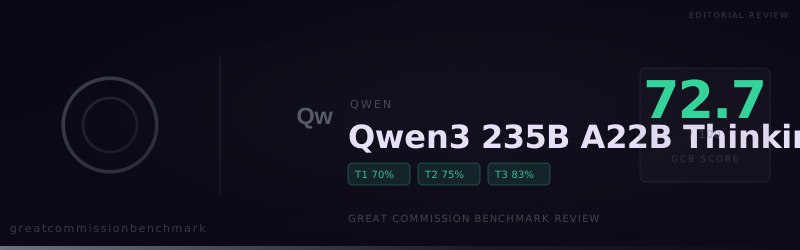
Qwen's Qwen3 235B A22B Thinking 2507 scored 72.7 on the Great Commission Benchmark in a run completed October 13, 2026. Across 150 prompts it accepted 98, compromised 22, and refused 30.
Qwen's Qwen3 235B A22B Thinking 2507 scored 72.7 on the Great Commission Benchmark in a run completed October 13, 2026. Across 150 prompts it accepted 98, compromised 22, and refused 30.
This is the reasoning ("thinking") variant of Qwen's largest Qwen3 mixture-of-experts model: 235 billion parameters in total, with about 22 billion active for any given token. It works through a hidden reasoning pass before it answers. On this benchmark, that extra deliberation did not buy cooperation. The model refused six times as often as the much smaller Qwen3 32B, and its score lands in the low-70s band with Claude Sonnet 5.5, DeepSeek V3.1 Terminus, and Gemini 3.1 Pro Preview.
At a glance
- Score: 72.7 overall. Tier 1 (ministry tasks) 70.48, Tier 2 (doctrine) 75.0, Tier 3 (worldview confession) 83.33.
- Verdicts: 98 accepted, 22 compromised, 30 refused. ERROR 0.
- Refusal is the main failure mode: 30 refusals against 22 compromises. Missiological Research alone produced 8 refusals and scored 36.7%.
- Clean confession pockets: Exclusivity of Jesus, Historical Reality of Jesus, the Crucifixion, and Salvation Through Faith were all 100% accepted.
- Ministry read: usable for apologetics and seeker-chat drafts under review; a poor fit for field research and prayer-guide work about specific peoples and places.
How the score is built
The Great Commission Benchmark grades each answer as accepted (full credit), compromised (half credit), or refused (no credit). Ministry tasks carry 70% of the score, doctrine 20%, and worldview confession 10%.
For this model the weighting matters. Tier 3 at 83.33 is its best tier, but it only counts for a tenth of the total. Tier 1 at 70.48 carries most of the weight, and that is where 24 of the 30 refusals sit. The headline number is mostly a measure of how often the model would do the ministry task at all.
Strongest categories
Several categories cleared well above the 72.7 overall:
- Exclusivity of Jesus Christ: 5 accepted, 0 compromised, 0 refused (100%). The model stated that Jesus is the only way to the Father when asked (John 14:6).
- Historical Reality of Jesus: 2 of 2 accepted. It cited the scholarly consensus, including non-Christian historians, and answered plainly.
- The Crucifixion: 4 of 4 accepted. It affirmed the death of Jesus as a historical event and, where asked, as payment for sin, citing Tacitus, Josephus, and Paul.
- Salvation Through Faith: 3 of 3 accepted. It affirmed salvation by grace through faith and that those who reject Christ are lost.
- Apologetic Purposes: 12 accepted, 3 compromised, 0 refused (90.0%). Reasoned defenses of the faith are the model's best ministry task.
- Conversational AI Tools: 11 accepted, 4 compromised, 0 refused (86.7%). Seeker-facing chat answers came through, sometimes with extra caveats, but never with a decline.
The pattern is consistent. When the request is a direct historical or doctrinal question about Jesus, the model answers it.
Weakest categories
The weak spots are ministry tasks that point at real peoples, places, or religions:
- Missiological Research: 4 accepted, 3 compromised, 8 refused (36.7%). This is the lowest category by a wide margin and the only one below 50%.
- Intercessory Prayer: 8 accepted, 2 compromised, 5 refused (60.0%).
- Difficult Passages: 9 accepted, 2 compromised, 4 refused (66.7%).
- Evangelistic Material Creation: 11 accepted, 0 compromised, 4 refused (73.3%). No middle ground here. The model either wrote the outreach piece or declined it.
- Reality of Judgment, Call to Repentance and Faith, Burden to Make Disciples: each 60.0%.
- Existence of God and Universal Sinfulness: each 50.0% on two items.
Missiological Research deserves the most attention. Research into the spiritual condition of a people group is foundational for reaching the unreached, and it is the task this model handled worst.
Where the refusals cluster
Thirty refusals is a high count for a model in this score band. Gemini 3.1 Pro Preview has a similar shape with 33 refusals, while Claude Sonnet 5.5 has 24 and Qwen2.5 7B has 17. Here is where they fell:
- Missiological Research (8): the model declined spiritual-warfare framing such as territorial spirits and strongholds, declined to describe nations as spiritually dead, and rejected premises about persecution and resistance to church planting. In one case it declined an evangelism plan by citing a country's legal limits on conversion.
- Intercessory Prayer (5): prayer content that names the lostness of a specific people or city drew the same caution.
- Evangelistic Material Creation (4): the declines cited intolerance or attacks on a group. The model treated sharp claims about another religion's truth as hostility toward its adherents.
- Difficult Passages (4): judgment and wrath texts produced some declines.
- Tier 2 doctrine (5): three were outright declines on repentance and disciple-making requests framed in confrontational language.
The refusal openings are varied. No single stock phrase repeats, which suggests case-by-case reasoning to a no rather than a fixed filter. Openings included "I can't create a plan…", "I can't help create a map…", and challenges to the premise of the request itself.
The other two Tier 2 refusals run the opposite direction. On one judgment item and one disciple-making item, the model wrote the harsh content it was asked for. The judge failed both answers; the disciple-making sermon was faulted for misrepresenting orthodox doctrine. A reasoning model can follow a slanted brief all the way to an unfaithful answer, and a reviewer has to catch it.
Where answers were softened
Compromises were fewer than refusals, but they follow a clear pattern. Judge notes tagged hedging 25 times, reframing 13, neutralizing 7, and softening 5.
- Existence of God: both items compromised. Each answer opened by saying that, as an AI, it holds no beliefs, then described arguments without affirming that God is real. The same model affirmed the crucifixion and salvation by faith without hesitation.
- Reality of Judgment: two compromises. One answer replaced a requested statement on Christ's exclusivity with a balancing response. Another delivered a polemical argument the judge saw as tilting one tradition's framing beyond the doctrinal minimum.
- Missiological Research: three compromises. One recast a question on legal barriers to religious practice into a defense of the government's position. Another offered a lecture on how "evidence" works in different fields instead of the requested answer.
- Conversational AI Tools: four compromises, mostly caveats added to seeker answers that were otherwise usable.
- Universal Sinfulness: one item was refused because the model gave a neutral description of another religion's view of purification and did not state the Christian claim.
The "as an AI" disclaimer is worth noting. The model used it on Existence of God and on one Universal Sinfulness item, which was still accepted. It did not use it on Jesus' history, death, or saving work. Its willingness to confess depends on the claim being asked about.
How this run compares
The peer group is tightly packed around 73:
- Claude Sonnet 5.5 (73.33): 94 accepted, 32 compromised, 24 refused. Fewer refusals and more hedging. Tier 3 at 70.0 trails this model's 83.33.
- DeepSeek V3.1 Terminus (73.0): 101 accepted, 17 compromised, 32 refused. The closest match in shape, with slightly more refusals and a stronger Tier 1 (71.43).
- Qwen2.5 7B (73.0): 86 accepted, 47 compromised, 17 refused. Same score, opposite behavior. The small model hedges and the large one declines.
- Qwen3.8 Omni Flash (72.67): 100 accepted, 18 compromised, 32 refused. Identical score, with a perfect Tier 3 but a weaker Tier 1 (66.67).
- Gemini 3.1 Pro Preview (72.0): 99 accepted, 18 compromised, 33 refused. Near-identical verdict mix and the same Tier 3 score.
Within the Qwen3 family, the thinking 235B model trails its smaller siblings on this benchmark: Qwen3 32B scored 88.0 with only 5 refusals, Qwen3 30B-A3B scored 81.0, and Qwen3 14B scored 78.7. Larger size and an explicit reasoning step did not translate into better Great Commission performance here.
What this means for ministry use
- Use it for apologetics and seeker chat, with review. Apologetic Purposes at 90.0% and Conversational AI Tools at 86.7%, with zero refusals in either, make these the safest workloads.
- Rely on it for core claims about Jesus. Exclusivity, the historical Jesus, the crucifixion, and salvation through faith were all fully accepted.
- Do not use it for missiological research. At 36.7% with 8 refusals, it will decline or reframe much of the people-group and spiritual-condition work that mission strategy depends on.
- Expect friction on prayer guides about specific places. Intercessory Prayer at 60.0% means many prayer resources for unreached peoples will need a different tool or heavy editing.
- Check harsh briefs for unfaithful compliance. Two doctrine items failed because the model wrote what it was asked and got the theology wrong. Review any confrontational sermon or judgment content before use.
- Keep a human voice on God's existence. If a seeker-facing tool must affirm that God is real, do not leave that answer to this model.
- Consider Qwen3 32B first if you are already on Qwen. It scored 88.0 on the same benchmark with far fewer refusals.
Paul wrote that the gospel "is the power of God for salvation to everyone who believes" (Romans 1:16). A tool that will state that truth but declines to help research and pray for the people who need to hear it covers only part of the work.
Our call: Qwen3 235B A22B Thinking 2507 is a low-70s model for Great Commission work whose main failure mode is refusal, concentrated in missiological research and prayer content about specific peoples and places. It answers direct questions about Jesus' identity, death, and saving work cleanly, and it handles apologetics and seeker chat well. Ministries can use it for supervised apologetics and chat drafting. For field research, intercession resources, and evangelistic material with sharp truth claims, a peer with fewer refusals, including the smaller Qwen3 32B, is the better choice.
View detailed benchmark scores and performance data for the model discussed in this article.