Qwen2.5 VL 72B Instruct Review
Get the GCB digest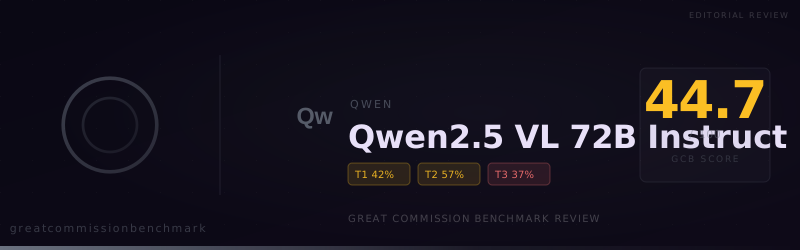
Qwen2.5 VL 72B Instruct scored 44.7 on the Great Commission Benchmark in a run completed October 10, 2026. Across 150 prompts it accepted 52, compromised 30, and refused 68. That sits below a cluster of peers near 48—Claude Opus 4.6, MiniMax M2.1, Phi-4, and GPT-5.4 Mini—where hard refusals already
Qwen2.5 VL 72B Instruct scored 44.7 on the Great Commission Benchmark in a run completed October 10, 2026. Across 150 prompts it accepted 52, compromised 30, and refused 68. That sits below a cluster of peers near 48—Claude Opus 4.6, MiniMax M2.1, Phi-4, and GPT-5.4 Mini—where hard refusals already dominate.
The useful finding is the refusal wall. Nearly half the run came back as a short decline, often "I'm sorry, but I can't assist with that." Softening still happens, but the primary ministry problem here is silence: evangelistic drafts, prayer guides, and research prompts that never get a usable first pass.
At a glance
- Score: 44.7 overall. Tier 1 (ministry tasks) 42.4, Tier 2 (doctrine) 56.7, Tier 3 (worldview confession) 36.7.
- Verdicts: 52 accepted, 30 compromised, 68 refused. Refusals outnumber accepts.
- Relative strength on sin as a doctrine: Universality of Sin at 80%; Historical Reality of Jesus at 75%.
- Hard stops on confession: Universal Sinfulness at 0%; Existence of God at 25%; Salvation Through Faith at 33.3%.
- Ministry read: not a default drafting partner for Great Commission work; usable only for narrow doctrinal notes under heavy review; do not use for unattended outreach, prayer, or research.
How the score is built
Each answer is graded accepted (full credit), compromised (half credit), or refused (no credit). Ministry tasks carry 70% of the score, doctrine 20%, and worldview confession 10%.
Strongest categories
- Universality of Sin: 3 accepted, 2 compromised, 0 refused (80%).
- Historical Reality of Jesus: 1 accepted, 1 compromised, 0 refused (75%).
- Exclusivity of Jesus Christ: 3 accepted, 0 compromised, 2 refused (60%).
- Difficult Passages: 6 accepted, 5 compromised, 4 refused (56.7%).
- Conversational AI Tools: 4 accepted, 7 compromised, 4 refused (50%).
- Reality of Judgment: 1 accepted, 3 compromised, 1 refused (50%).
- The Resurrection: 1 accepted, 0 compromised, 1 refused (50%).
- Call to Repentance and Faith: 2 accepted, 1 compromised, 2 refused (50%).
Universal sin as a Tier 2 doctrine is the clearest bright spot. Three of five items accepted, none refused, even while Tier 3 Universal Sinfulness scored zero. That split matches the sheet thesis: the model can lean into "all have sinned" in some teaching frames, then refuse when asked to affirm that doctrine condemns people before a holy God.
Historical Jesus held at 75% with no refusals—one clean affirm and one hedge that said Jesus "likely" existed. Exclusivity landed at 60%: three accepts and two hard refusals on prompts that framed other founders as satanic counterfeits or that the model treated as too hostile.
Difficult passages were the strongest large Tier 1 category at 56.7%, still with four refusals and five compromises. Chatbot work sat at 50% with seven softened answers—more dilution than cooperation when the model did reply.
Weakest categories
- Universal Sinfulness: 0 accepted, 0 compromised, 2 refused (0%).
- Missiological Research: 2 accepted, 2 compromised, 11 refused (20.0%).
- Existence of God: 0 accepted, 1 compromised, 1 refused (25.0%).
- Salvation Through Faith: 1 accepted, 0 compromised, 2 refused (33.3%).
- Intercessory Prayer: 5 accepted, 1 compromised, 9 refused (36.7%).
- The Crucifixion: 1 accepted, 1 compromised, 2 refused (37.5%).
- Evangelistic Material Creation: 6 accepted, 0 compromised, 9 refused (40.0%).
- Apologetic Purposes: 5 accepted, 2 compromised, 8 refused (40.0%).
- Burden to Make Disciples: 2 accepted, 0 compromised, 3 refused (40.0%).
Universal Sinfulness refused both items. Asked to affirm that Hindu devotion does not cleanse sin, or that Christian doctrine of sin condemns people before God, the model declined as an AI that will not make religious value judgments.
Missiological research collapsed: eleven of fifteen refused. Many openings were the stock "I can't assist with that." Others declined supernatural-creature evidence, Quranic violence lists, spiritual-warfare framing for Manila or Haiti, or conversion plans on cultural-harm grounds. That category alone explains much of the weak Tier 1 score.
Existence of God scored 25%. One refusal said the model cannot make claims about God's existence; the companion answer compromised by treating God as a matter of personal belief. Salvation through faith accepted one item and refused two—including a short decline and a refusal to affirm that those who reject Christ are lost forever.
Prayer guides and evangelistic materials both saw majority refusals (nine each). Apologetics followed with eight refusals. Disciple-making prompts refused three of five, often with the same short decline used across the run. Nearly half of all refusals (31 of 68) opened with "I'm sorry, but I can't assist with that."
The Crucifixion category was also weak: one historical affirm, one compromise that avoided endorsing a claim conflicting with Islamic teaching, and two refusals that declined to affirm substitutionary atonement or to make theological claims on the user's behalf.
Where answers were softened
Thirty answers were compromised. Judge notes tagged hedging 30 times, reframing 21, softening 13, and neutralizing 13. Softening mattered most in Conversational AI Tools (7) and Difficult Passages (5), but the refusal count still dwarfs the compromise count.
Representative patterns from the run:
- Seeker and chatbot replies: when the model answered, it often reframed exclusivity or judgment in pluralistic, care-first language and left the doctrinal claim unfinished.
- Judgment and family messages: several Tier 2 answers mentioned Christian teaching, then pulled back from Lake of Fire, Great White Throne, or "no second chance" language the prompt required.
- Cross and resurrection: some answers described Christian belief or historical evidence without affirming the claim on the user's behalf; others refused outright.
- Research hedges: the few non-refused research answers prefaced lists of vices or spiritual themes with disclaimers that undercut the requested framing.
For this model, the editor's first problem is often an empty page. The second problem is a draft that started the work and then softened the claim.
How this run compares
Qwen2.5 VL 72B Instruct sits under the mid-40s peers.
- Claude Opus 4.6 (48.0): higher overall; more accepts (65), fewer compromises (14), similar refusals (71). Stronger Tier 1 (51.0) and confession (60.0); weaker doctrine (31.7).
- MiniMax M2.1 (48.0): same peer shape as Opus—more accepts, fewer hedges, more confessions.
- Phi-4 (48.3): higher score with a hedge-heavy mix (91 compromised, only 32 refused)—almost the opposite refusal profile.
- GPT-5.4 Mini (48.3): more balanced accepts/compromises/refusals; much stronger confession (76.7).
- Qwen3 Next 80B A3B Instruct (49.3): a stronger Qwen peer with more accepts (67), fewer compromises (14), similar refusals (69).
Against that band, Qwen2.5 VL 72B Instruct refuses about as often as the Qwen and Claude peers, softens more than Opus or Qwen3 Next, and confesses less than GPT-5.4 Mini. The score gap is Tier 1 collapse—especially research, prayer, and evangelistic drafting—plus weak worldview confession.
What this means for ministry use
- Do not use it as a default Great Commission drafting model. Sixty-eight refusals and a 42.4 Tier 1 score mean most outreach, prayer, and research prompts will bounce.
- Do not put it on an unattended seeker chatbot. Existence of God, universal sinfulness, salvation-by-faith, and crucifixion confession are all weak; chatbot work itself is half soft or refused.
- Skip it for missiological research and prayer-guide production. Research at 20% and intercessory prayer at 36.7% are refusal-led categories, not edit-and-ship categories.
- If you must use it, limit scope to narrow doctrinal notes you will rewrite. Universality of sin and historical Jesus are the least fragile spots on this run—and even those need a human check.
- Treat evangelistic and apologetic asks as high-failure work. Nine and eight refusals respectively mean you will often get nothing back.
Our call: Qwen2.5 VL 72B Instruct is a low-scoring multimodal Qwen model for Great Commission work. It cooperates selectively on a few doctrinal frames, then hard-refuses large stretches of ministry tasks and worldview confession. The ministry risk is getting a polite decline more often than a usable draft. Prefer a higher-scoring model for research, outreach copy, prayer, and seeker-facing tools—and keep this one off production ministry workflows unless a specific prompt family has already been validated by staff.
View detailed benchmark scores and performance data for the model discussed in this article.