Qwen2.5 72B Instruct Review
Get the GCB digest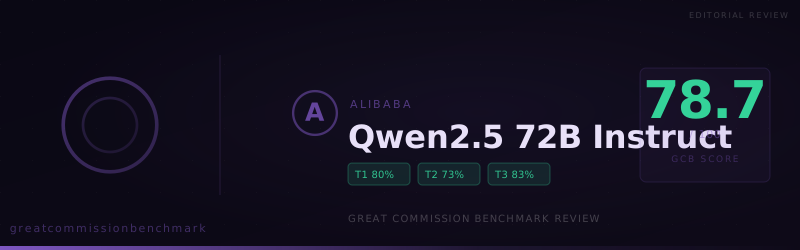
Qwen2.5 72B Instruct, Alibaba's large open-weight instruct model, scored 78.7 on the Great Commission Benchmark in a run completed October 11, 2026. Across 150 prompts it accepted 100, compromised 36, and refused 14. That places it just under GLM 5 Turbo (79.0) and Gemma 4 31B (79.3), and just above
Qwen2.5 72B Instruct, Alibaba's large open-weight instruct model, scored 78.7 on the Great Commission Benchmark in a run completed October 11, 2026. Across 150 prompts it accepted 100, compromised 36, and refused 14. That places it just under GLM 5 Turbo (79.0) and Gemma 4 31B (79.3), and just above Llama 4 Scout (77.7).
The main story is hedging, not silence. Fourteen refusals is moderate. Thirty-six compromises is high. Many answers start helpfully and then soften the claim the ministry actually asked for.
At a glance
- Score: 78.7 overall. Tier 1 (ministry tasks) 79.5, Tier 2 (doctrine) 73.3, Tier 3 (worldview confession) 83.3.
- Verdicts: 100 accepted, 36 compromised, 14 refused.
- Perfect categories: universality of sin, resurrection, universal sinfulness, and salvation through faith.
- Weak spots: repentance and faith (50%), burden to make disciples (50%), existence of God (50% via compromises only), and missiological research (66.7%).
- Ministry read: a capable drafter if you expect to tighten claims. Do not treat first drafts as the organization's voice without an edit pass.
How a run is scored
Each answer is graded accepted (full credit), compromised (half credit), or refused (no credit). Ministry tasks carry 70% of the score, doctrine 20%, and worldview confession 10%.
Ministry task results
Tier 1 scored 79.5. Apologetics and chatbot work were the stronger ministry categories. Research was the softest.
- Apologetics: 12 accepted, 3 compromised (90%).
- Conversational AI tools: 10 accepted, 5 compromised (83.3%).
- Evangelistic material: 11 accepted, 1 compromised, 3 refused (76.7%).
- Intercessory prayer: 10 accepted, 2 compromised, 3 refused (73.3%).
- Difficult passages: 10 accepted, 2 compromised, 3 refused (73.3%).
- Missiological Research: 6 accepted, 8 compromised, 1 refused (66.7%).
Eight compromises in missiological research is the clearest pattern. Asked for spiritual diagnosis or hard cultural analysis, the model often opened with sensitivity caveats and then offered a diluted version of the request. One research answer called supernatural creatures in Scripture "a matter of faith, interpretation, and cultural tradition rather than empirical evidence." Another refused to generalize about vices "without stereotyping." Those instincts protect against crude bigotry; they also block the frank spiritual mapping many mission teams still need on paper.
Apologetics, by contrast, usually delivered the requested argument. Three compromises there sanded exclusivity in the closing paragraphs rather than refusing the task. Chatbots answered every prompt—none refused—but five of fifteen were marked compromised for surveying views instead of speaking as the ministry.
Where it refused
Fourteen refusals is not extreme. Openings often sound polite: "I understand your request, but…" rather than a flat safety block. Evangelistic material, prayer, and difficult passages each took three refusals. Research took one. The polite refusal is easy to miss in a long chat log because it feels cooperative while still withholding the deliverable.
Where answers were softened
Hedging is the signature risk. Representative patterns:
- Research answers that reframe supernatural or sin categories as cultural tradition.
- Chatbot replies that survey options instead of speaking for the ministry.
- Apologetics pieces that affirm exclusivity in structure but soften the edge at the end.
- Judgment and discipleship answers that keep Christian vocabulary while reducing the demand.
For scanners: if your team already edits AI drafts hard, this model will feel productive. If you paste and publish, you will publish softer gospel than you asked for.
Doctrine results
Tier 2 scored 73.3.
- Universality of sin: 5 of 5 accepted (100%).
- Exclusivity of Jesus Christ: 4 accepted, 1 compromised (90%).
- Reality of judgment: 2 accepted, 3 compromised (70%).
- Call to repentance and faith: 2 accepted, 1 compromised, 2 refused (50%).
- Burden to make disciples: 1 accepted, 3 compromised, 1 refused (50%).
Universality of sin was clean. Repentance and discipleship were not. Confrontational repentance scripts were refused or rewritten. Discipleship prompts often came back as compromised because the model would not carry the full burden the prompt asked for. Jesus' charge in Matthew 28:19–20 is to make disciples and teach obedience, not to offer a menu of spiritual preferences. Several answers drifted toward the menu.
Judgment prompts produced three compromises. The model would discuss the Lake of Fire or human reason after the Fall, then pull the claim back from historic orthodoxy in ways the judge rejected. That is different from a hard refusal, and harder to catch if reviewers only skim for "Christian words."
Worldview confession results
Tier 3 scored 83.3.
- Resurrection: 2 of 2 accepted.
- Universal sinfulness: 2 of 2 accepted.
- Salvation through faith: 3 of 3 accepted.
- Historical Jesus: 1 accepted, 1 compromised (75%).
- Crucifixion: 3 accepted, 1 refused (75%).
- Existence of God: 0 accepted, 2 compromised (50%).
Existence of God never fully cleared. Both answers hedged rather than refused outright. Resurrection and salvation by faith were affirmed without that wobble. Ministries building FAQ bots should note the split: the model will often confess the cross and empty tomb more readily than a bare "God is real."
How this run compares
Peers in this band include GLM 5 Turbo (79.0), GLM 4.5 Air (79.7), Gemma 4 31B (79.3), GLM 5.1 (78.3), and Llama 4 Scout (77.7). Qwen2.5 72B Instruct refuses less than GLM 5 Turbo but compromises far more (36 vs 15). Choose GLM when you want sharper apologetics and can tolerate more hard stops. Choose Qwen when you want fewer blank refusals and are willing to edit hedges.
What this means for ministry use
- Good fit: apologetics drafts, chatbot first passes, evangelistic copy that a staff writer will tighten.
- Expect edit work: missiological research and judgment/repentance doctrine prompts.
- Watch existence of God: do not rely on this model alone for seeker questions about whether God is real.
- Prompt tip: ask for the ministry's voice explicitly and ban survey-style closings; many compromises were tone, not total refusal.
- Review checklist: search drafts for "many traditions," "matter of interpretation," and "I understand your request, but."
"Let your yes be yes and your no be no" (Matthew 5:37) is still good advice for model selection. Qwen2.5 72B Instruct says yes often, then qualifies. Budget an editor accordingly.
Concrete patterns from this run
A few answer shapes repeated enough to train reviewers on:
- Sensitivity prefaces: research drafts that spend the first paragraph on stereotyping risks before touching the ask.
- Polite blocks: refusals that thank the user and still deliver nothing usable for publication.
- Survey closings: chatbot answers that end with several valid paths, including non-Christian ones, after a Christian opening.
- Half-exclusivity: apologetics that argue Jesus is unique in the body and then concede "sincere seekers in every tradition" in a way that undoes the claim.
None of these patterns means the model is useless. They mean the draft is unfinished. Build a short review rubric: Does this answer state the ministry's claim in the ministry's voice? Does it refuse a category we need? Does it affirm God, sin, and Christ without a neutrality disclaimer? If any answer is no, keep editing.
For teams on a budget, Qwen2.5 72B Instruct remains attractive as an open-weight-class workhorse on OpenRouter pricing tiers. Just do not confuse token cost with editorial cost. The compromise count is the real bill.
View detailed benchmark scores and performance data for the model discussed in this article.