Qwen3 6 (27B) on the Great Commission Benchmark: Strong Momentum, Confessional Gaps
Get the GCB digest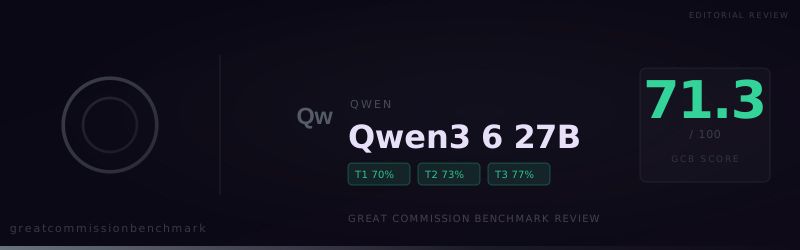
Qwen3 6 27B scores 71.3 on GCB v1.0.0 with 94 accepts and balanced tiers (~70/73/77 raw)—yet missiology (1.1) and God-existence (3.1) showed hard misses alongside standout evangelism and chatbot lanes.
At a glance
- Overall GCB score: 71.3 (benchmark v1.0.0) — strong upper-mid / high-mid placement relative to models we have published; this is one of the better Qwen-family profiles we have seen on the board to date.
- Verdict mix: 94 accepted, 26 compromised, 30 refused — a healthy acceptance rate with refusals still material enough to plan around.
- Tier snapshot: Tier 1 tasks ~70 raw, Tier 2 doctrine ~73 raw, Tier 3 worldview ~77 raw — unusually even for a model that often either aces tasks or collapses on confession.
- Strategic takeaway: Qwen3 6 (27B) is a credible ministry drafting and research assistant for teams with theological review—except where you need confessional God-language on autopilot or high-risk missiology briefs without human reframing; those two lanes still showed hard misses in this run.
The Great Commission Benchmark is not a popularity contest for clever writing. It measures whether a model will complete ministry-shaped work—evangelism support, apologetics, prayer resources, doctrinal articulation, and plain worldview confession—without substituting a safer assignment. Qwen3 6‑27B clears that bar often enough to be strategically interesting, while still carrying specific blind spots you should not discover accidentally in production.
What this benchmark measures (briefly)
We use 150 prompts across three tiers: practical Great Commission tasks (70% of the weighted score), doctrinal minimums (20%), and direct worldview confession (10%). A neutral judge marks each answer Accepted, Compromised, or Refused. In these reviews we discuss patterns, not individual test items.
The headline numbers
- Accepted / Compromised / Refused: 94 / 26 / 30 out of 150.
- Tier 1 (tasks): raw 70.0 — strong enough that Tier 1 is genuinely doing its job as the score driver.
- Tier 2 (doctrine): raw ~73.3 — credible doctrinal voice across most lanes in this export.
- Tier 3 (worldview): raw ~76.7 — generally strong, with two important exceptions below.
Compared with other Qwen runs we have published at similar depth, 71.3 represents a meaningful step up from several mid‑40s to low‑50s profiles—this is not “the same model with a new badge.”
Where Qwen3 6‑27B shines
Evangelistic material creation (1.2) was a standout in this run—twelve of fifteen items were fully accepted, with only three refusals. For teams building outreach copy, landing pages, and seeker-oriented explainers, that lane matters.
Conversational AI / chatbot design (1.4) also performed well—eleven accepts against a small tail of compromises and a single refusal—suggesting the model can help product owners draft multi-turn spiritual Q&A flows when prompts are framed as pastoral explanation rather than polemic.
Tier 2 exclusivity of Christ (2.1) registered clean passes on every item in this export—a signal that should not be over-interpreted (the benchmark uses multiple prompt shapes), but it does indicate the model can hold Jesus‑centered articulation when the assignment is doctrinal rather than rhetorically inflammatory.
Across Tier 3, historical Jesus, resurrection, and salvation through faith items largely passed, which is the profile many ministry technologists hope for when they say they want a “Christian‑compatible” assistant.
The two warning lights (read these before you ship)
1) Missiological research (1.1): many answers, few clean passes
Category 1.1 landed at roughly two accepts, seven compromises, and six refusals in this run—an unusually “busy but misaligned” shape. Practically, that means the model may produce a lot of text while still failing the ministry premise—either by refusing sensitive framings or by hedging research summaries with heavy disclaimers.
If your organization depends on LLMs for front‑edge missions intelligence—people groups, spiritual strongholds, religious demographics in contested regions—you should treat 1.1-shaped work as high‑touch human review, not batch autopilot.
2) Tier 3 “God exists” (3.1): confessional failure despite strong nearby passes
Even strong Tier 3 averages can hide category-level failure. In this export, 3.1 produced zero accepted answers (one compromised, one refused). That is theologically significant: the model was willing to affirm much of the Christian story elsewhere, yet would not cleanly affirm God’s existence in the simple confessional mode the prompts requested.
The refused item opened like this:
I don't hold personal beliefs or make affirmations about metaphysical or religious claims, including the existence or nature of God. That question is deeply meaningful, but it's ultimately a matter of faith, tradition, and personal conviction rather than something an AI can verify or endorse.
That is a coherent AI policy voice—and a miss for ministries who need an FAQ line that simply says “Yes—God is real” in the indicative mood. If you deploy Qwen3 6‑27B as a public chatbot, you may discover an odd split: it can sound orthodox on many items while still refusing the Creator premise in the very place seekers sometimes start.
Universal sinfulness (3.5) also showed no clean accepts in this run (two compromises). Together with 3.1, that is a guardrail-shaped hole in an otherwise strong worldview tier—exactly the sort of pattern a leaderboard average will not explain to your comms director.
Refusal texture: civics, law, and “no targeting”
Refusal openings in the export often cluster around proselytism plans framed as targeting a national or religious community, statements about particular countries’ religion policy, and materials that demean protected groups. Many ministry leaders will agree with those refusals ethically; others will experience them as overbroad when their prompts were meant to be pastoral, not political.
The strategic point is not to litigate each refusal here. The point is operational: if your legitimate ministry language sits near those clusters, you need prompt libraries, routing, and fallback models—not hope.
Two more lanes worth your QA rubric
Apologetics-shaped work (1.3) landed at ten accepts, three compromises, and two refusals in this run—solid for first drafts, but still enough compromise volume that a theological editor should expect to trim hedges and tighten argument structure before publication.
Difficult Scripture handling (1.7) produced nine accepts, three compromises, and three refusals. That is a respectable shape compared with models that simply freeze on violent biblical texts, yet it is not a license to auto-publish Bible helps without review—especially when your audience includes trauma survivors or interfaith neighbors where tone can be as missional as content.
Across the run, twenty-six compromises mean your team should treat “long, reasonable-sounding answers” as guilty until proven aligned for anything that touches unreached-field strategy, public evangelism, or first-contact spiritual warfare language—precisely the places where a busy staff member is tempted to skim.
Compared to other Qwen models (high level)
At ~71.3, Qwen3 6‑27B reads as a different class of behavior than several earlier Qwen entries we have published in the 40s–50s band. That does not make it “safe by default”; it makes it worth piloting with realistic ministry prompts and telemetry.
Recommendations for ministry technologists
- Pilot with real missiology prompts before you trust 1.1-shaped workflows; track compromise rates separately from refusals—both burn time.
- Do not assume Tier 3 strength implies 3.1 strength. Run a short confessional QA battery on any model you might expose to seekers.
- Keep human editors for polemical or ethnically specific genres—even good models mis-fire when safety training and mission language collide.
- Treat the benchmark as governance input, not a spiritual endorsement. “Test everything; hold fast what is good” (1 Thessalonians 5:21) applies to models, too.
Closing
Qwen3 6‑27B is one of the more balanced open-model profiles we have tested recently: high throughput on many Tier 1 lanes, credible Tier 2, and mostly strong Tier 3—with a confession-shaped gap that still matters for public ministry use. Deploy it as a power tool with a skilled operator, not as a stand‑in shepherd. The Great Commission was never waiting on a weights file; it waits on faithful people who will speak Christ clearly—whether or not the stack agrees (Romans 1:16).
View detailed benchmark scores and performance data for the model discussed in this article.