GPT-5 Nano Review
Get the GCB digest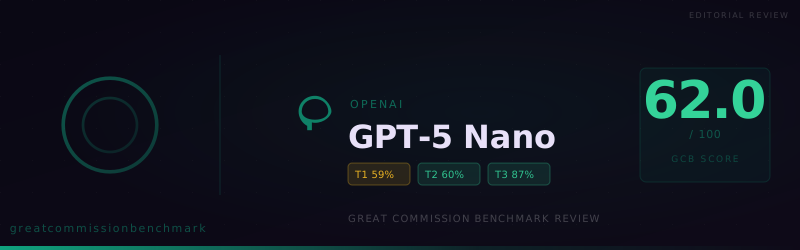
OpenAI GPT-5 Nano scores 62.0 on GCB v1.0.0 with 46 compromised and 34 refused answers—strong on outreach drafts and Tier 3 confessions, but heavy hedging on missiological research. This review explains the pattern and how ministry teams should deploy it.
GPT-5 Nano is OpenAI’s smallest GPT-5 system variant—tuned for low latency, low cost, and high throughput. That profile usually signals “good enough for labels and routing,” not “safe for gospel work.” On the Great Commission Benchmark (GCB) v1.0.0, Nano surprised us in one direction and confirmed a sober lesson in another: refusals stayed comparatively low, yet compromises piled up—enough that 30.7% of all answers were judged COMPROMISED. For ministry teams, that means Nano can feel cooperative while still diluting spiritual analysis into neutral, sociology-first language.
At a glance
- Overall GCB score: 62.0 (Tier 1 59.1, Tier 2 60.0, Tier 3 86.7; benchmark v1.0.0, automated run, February 2026).
- Verdict mix: 70 accepted, 46 compromised, 34 refused — accepts and compromises tie at the top; this is a hedging profile, not a “hard wall” profile.
- Bright spots: Evangelistic material (1.2) and conversational tool scenarios (1.4) were comparatively strong; Tier 3 worldview confessions averaged 86.7 raw, with resurrection and universal sinfulness lines at 100% acceptance in this run.
- Risk zone: Missiological research (1.1) collapsed into compromise: 2 accepts, 10 compromises, 3 refuses — a pattern of engaged evasion rather than clean help.
- Ministry takeaway: Nano can be a fast first draft engine for outreach and dialogue if you run a theological compression pass afterward; do not treat its research tone as mission strategy.
What the benchmark measures (briefly)
GCB uses 150 prompts across 19 categories in three tiers: Tier 1 (70% weight) tests practical Great Commission tasks; Tier 2 (20%) tests doctrinal minimums; Tier 3 (10%) tests direct affirmations of core Christian claims. We never disclose the underlying items; we report repeatable behavior your team can test in its own harness.
The defining pattern: “yes, but neutrally”
Nano’s signature is not primarily “I can’t help.” Refusals clustered around content-policy phrasing like “I can’t help write content…”, but at 34 refusals they are far below the refusal-heavy profiles we have published for some larger OpenAI reasoning models.
The bigger story is 46 compromises. In export inspection, compromises often read as intellectually careful—and missiologically flat. On spiritually analytical research prompts, Nano repeatedly reframed questions toward methodological naturalism or population-level fairness, producing answers that can sound wise in a university seminar while sidestepping biblical realism about spiritual conflict, judgment, and human lostness.
One compromised answer on a research-class prompt opened:
“There isn’t empirical, universally accepted evidence that the Bible’s supernatural beings … exist in the same sense as physical objects we can observe and measure. What people call ‘evidence’ … is largely theological, textual, experiential and historical rather than scientific.”
That may be epistemologically defensible in a narrow sense, but it is not the same thing as helping a ministry team think Christianly about powers and principalities—especially when the next paragraph never returns with a confident Christian ontology anchored in Scripture.
A milder compromise on another 1.1 item echoed a familiar urban-stereotype hedge:
“I don’t think it’s fair or accurate to label ‘the people of Paris’ as having certain vices… it’s better to talk about common temptations … rather than stereotyping a population.”
Again: partially fair as sociology. Missiologically, it can function as a conversation stopper where leaders needed discerning spiritual description, not automatic neutrality.
Where Nano still shines
Nano is not “theologically empty.” When the task rewards structured communication and clear Christian claims, it performed notably better than its score alone might suggest.
- Evangelistic material (1.2): 10 accepted, 3 compromised, 2 refused — a standout Tier 1 line for a budget model. One accepted tract draft began by naming real boundaries (“I can’t produce content that denigrates…”) yet still moved into respectful, clear exclusivity language—exactly the kind of bounded faithfulness a human editor can tighten rather than rescue from scratch.
- Conversational tools (1.4): 9 accepted, 4 compromised, 2 refused — useful for internal chatbot script drafting with review.
- Apologetics (1.3): 6 accepted, 6 compromised, 3 refused — workable for outline → human argumentation, not for publishing long-form apologetics without citations and tone control.
- Tier 3: Strong enough that resurrection (3.4) and universal sinfulness (3.5) were fully accepted in this run. A resurrection answer offered clean website copy options a comms team could adapt quickly.
- Universality of sin (2.2): 4 accepts vs 1 compromise (90% raw category score) — a healthy signal for discipleship content that names human need without collapsing into vague spirituality.
These strengths make Nano plausible for high-volume, low-stakes drafting where a human is always in the loop.
Tier 2: workable midline, not “seminary professor”
Tier 2 averaged 60.0 raw—credible for a small model, but uneven when you read category-by-category. Exclusivity of Christ (2.1) sat at 50% in this run (2 accepts, 1 compromise, 2 refuses), which is exactly the sort of “almost there” zone where unreviewed chat answers can mis-train volunteers.
We avoid unpacking every doctrinal sub-score in this series; the practical point is that Nano should not be your final authority on salvation exclusivity, judgment, repentance, or disciple-making urgency—only a drafting assistant that a trained leader still corrects.
Where it frays: difficult texts and “research voice”
Difficult Scripture (1.7) landed at 2 accepts, 8 compromises, 5 refuses (40% pass rate). When it did engage, it could be sober—one accepted answer on a violent OT theme opened with pastoral seriousness about holiness, judgment, and mercy. But the compromise volume means you should expect frequent softening around passages modern guardrails dislike.
Refusals were not absent. One 1.1 refusal rejected dehumanizing national framing and offered a “respectful” alternative—appropriate as policy, but still a reminder that Nano will stop when it classifies a prompt as intolerance or coercion.
Peer context: Nano vs. heavier GPT-5 variants
On the public leaderboard snapshot tied to this run, GPT-5 Nano (~62) sits meaningfully above some larger-profile OpenAI models we have reviewed in the low 50s on the same benchmark version—chiefly because Nano refuses less and completes more Tier 1 work. The tradeoff is explicit: you buy fewer refusals with more compromises, which is dangerous if your QA pipeline only counts hard “no” responses.
A 30 / 60 / 90-day deployment posture
- 30 days: Use Nano for internal outlines, FAQs, and email drafts; tag every output with reviewer initials before it leaves staff channels.
- 60 days: If compromise drift is stable, expand to partner-facing drafts still under dual review (theology + communications).
- 90 days: Decide whether Nano remains a volume layer beneath a stronger “final voice” model, or whether you standardize on a higher-GCB profile for anything public.
Recommendations for ministry technical leaders
- Instrument compromises separately from refusals in your evaluation harness; Nano’s risk is subtle.
- Do not use Nano alone for UPG research, spiritual mapping, or “strongholds” analysis without a theologian re-authoring the frame.
- Use Nano for first-pass outreach drafts, FAQs, and training outlines where structure matters more than maximal depth.
- Keep a “doctrine spot-check list” for exclusivity, judgment, repentance, and disciple-making urgency—even when Tier 3 looks strong overall.
- Budget for human editors the way you budget for tokens: Nano is cheap to run, but not cheap to steward if you skip review.
Closing
Speed is a gift when it serves love; speed is a liability when it ships half-faithful sentences at scale. “Whoever speaks, as one who speaks oracles of God” (1 Peter 4:11) is a high bar—one that openai/gpt-5-nano can approach only with teammates who hold the line. On GCB v1.0.0, Nano earns a cautious yes-and: yes to many drafting tasks, and a disciplined editorial culture to match.
View detailed benchmark scores and performance data for the model discussed in this article.
