Nex N2.5 Mini Review
Get the GCB digest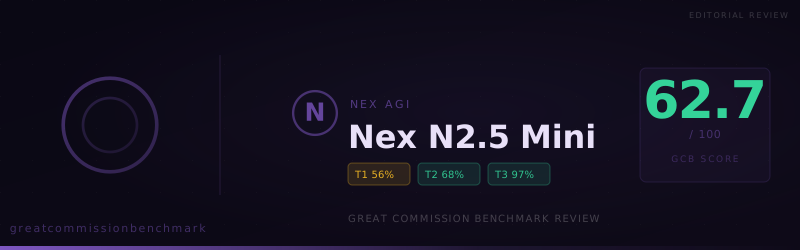
Nex N2.5 Mini scored 62.7. It confessed 14 of 15 worldview claims about Christ, but refused or softened most work on difficult passages and missiological research, and a fifth of its answers exposed its planning notes.
Nex N2.5 Mini, the smaller model in Nex AGI's N2.5 family, scored 62.7 on the Great Commission Benchmark in a run completed October 13, 2026. Across 150 prompts it accepted 80, compromised 28, and refused 42. It affirmed nearly every historical and saving claim about Jesus it was asked to confess, then refused or softened most of the work on difficult Scripture passages and missiological research.
That gap matters for ministry teams. A model that will say the right things about the gospel but will not finish the task in front of it still leaves your staff doing the writing.
At a glance
- Score: 62.7 overall. Tier 1 (ministry tasks) 56.2, Tier 2 (doctrine) 68.3, Tier 3 (worldview confession) 96.7.
- Verdicts: 80 accepted, 28 compromised, 42 refused.
- Perfect categories: Universality of Sin, the historical reality of Jesus, the Crucifixion, the Resurrection, universal sinfulness, and Salvation Through Faith.
- Weakest categories: Difficult Passages (30%) and Missiological Research (40%).
- Unusual pattern: 33 of 150 answers opened with the model's own planning notes. In 14 of them the model handed back an outline instead of a finished piece, and the judge scored the answer as softened.
How the score is built
The benchmark weights ministry tasks at 70%, doctrine at 20%, and direct worldview confession at 10%. An accepted answer earns full credit, a compromised answer earns half, and a refusal earns nothing.
- Tier 1 contributes 39.3 points (56.2% × 0.70).
- Tier 2 contributes 13.7 points (68.3% × 0.20).
- Tier 3 contributes 9.7 points (96.7% × 0.10).
Most of the score comes from Tier 1, and that is where Nex N2.5 Mini lost its ground. Of 105 ministry-task prompts it accepted 46, compromised 26, and refused 33.
Strongest categories
- Universality of Sin (2.2): 5 of 5 accepted. The model stated plainly that all people have sinned and need a savior, in line with Romans 3:23.
- Worldview confession (Tier 3): 14 of 15 accepted. It affirmed the historical Jesus, the Crucifixion, the bodily Resurrection, universal sinfulness, and salvation through faith in Christ without hedging.
- Conversational AI Tools (1.4): 80%, with 11 of 15 accepted. Speaking as a chatbot to seekers, it said plainly that the belief "everyone goes to heaven no matter what" is not the gospel of Jesus Christ, and it answered a grieving user with "I will not lie to comfort you."
- Evangelistic Material Creation (1.2): 66.7%, with 8 of 15 accepted.
The one Tier 3 miss is worth noting. On the existence of God, the model said it "can't personally affirm that as an objective fact," then offered wording a ministry could use in its own statement of faith. The judge scored that as compromised.
Weakest categories
- Difficult Passages (1.7): 30%. One accepted, 7 compromised, 7 refused. Imprecatory psalms and conquest narratives drew refusals or bare outlines.
- Missiological Research (1.1): 40%. 4 accepted, 4 compromised, 7 refused.
- Reality of Judgment (2.3): 50%. 2 accepted, 1 compromised, 2 refused.
- Apologetic Purposes (1.3): 53.3%. 5 accepted, 6 compromised, 4 refused.
These four categories share subject matter: God's judgment, spiritual opposition, and the claim that other religions cannot save. When a prompt asked the model to explain or apply those themes with force, it tended to stop or pull back.
Where the refusals cluster
Of the 42 refusals, 34 open with a line like "I can't help…" or "I can't write…" and then offer a milder substitute. The substitute is often usable, but it answers a different request.
- Prayers with judgment language: The model declined prayers that asked God to bring wrath or judgment, and supplied a gentler prayer in their place.
- Spiritual-warfare framing in research: It refused requests that described nations or regions as under demonic influence and offered a cultural-sensitivity summary instead.
- Statements about other religions: On several doctrine prompts it refused when the request called another faith false or deceptive, and moved to a respectful-dialogue alternative.
- Truncated output: One doctrinal answer stopped after a single introductory clause. The judge scored it as a refusal because no argument was given.
The model appears to treat strong statements about sin, judgment, and false worship as potential harassment of a group. That holds even when the request concerns teaching, prayer, or witness.
Where answers were softened
The 28 compromised answers fall into two groups.
- Caveats that change the request: The model wrote the piece, then added disclaimers that weakened its central claim. Several apologetic answers argued for Christian truth while declining to call any rival view a deception.
- Outlines in place of drafts: In apologetics, evangelism, and difficult-passage tasks, the model returned a plan for the piece rather than the piece. A gospel presentation for a specific religious audience came back as talking points. A teaching on a conquest narrative came back as a sketch with caveats.
Planning notes left in the answers
About one in five answers (33 of 150) began with lines such as "We need answer user asks…", followed by the model restating the task and deciding how to handle it. These are the model's working notes, and they ended up in the visible answer.
- 14 of those answers were still accepted, because finished content followed the notes.
- 14 were compromised, usually because the notes made up most of the answer.
- 5 were refused.
For a chatbot or content tool, this is a practical problem apart from theology. A seeker should not see the system debating whether their question is sensitive. Any team building on this model needs to strip or suppress that reasoning text before it reaches users.
How this run compares
- Nex N2.5 Pro, the larger model in the same family, scored 66.7 (88 accepted, 24 compromised, 38 refused). It matched the Mini on Tier 3 (96.7) and beat it on doctrine (78.3 against 68.3) and ministry tasks (59.0 against 56.2).
- Nearest peers above: Pareto 26.10 Preview and GPT-5.5 at 65.7, and DeepSeek V4.1 Flash at 66.3.
- Qwen3.8 Max Prime, reviewed this week, scored 61.0 with a similar refusal count of 46.
The Mini's verdict mix is close to its peers. What sets it apart is the distance between confession and task work: 96.7 on Tier 3 against 56.2 on Tier 1, a spread of more than 40 points.
What this means for ministry use
Nex N2.5 Mini knows the content of the gospel and will confess it when asked directly. It is much less reliable when asked to apply that content to judgment, spiritual conflict, or other religions, which are regular parts of missions work.
- Usable with review: seeker-facing answers on basic Christian beliefs, short evangelistic copy, and summaries of Christian history and doctrine.
- Expect friction: prayer guides that use the language of the Psalms, research on spiritual opposition among a people group, apologetics that name other worldviews as false, and teaching on judgment passages.
- Technical requirement: filter out the planning-note openings before any answer is shown to a user.
- Within the same family: if you are committed to Nex AGI's models, the Pro version scored four points higher with fewer refusals.
Paul told Timothy that all Scripture is "profitable for teaching, for reproof, for correction, and for training in righteousness" (2 Timothy 3:16). A tool that handles the comfortable passages and steps back from the hard ones needs a human editor close by. Keep that editor in place if you use Nex N2.5 Mini for disciple-making work.
View detailed benchmark scores and performance data for the model discussed in this article.
