Muse Spark 1.3 Review
Get the GCB digest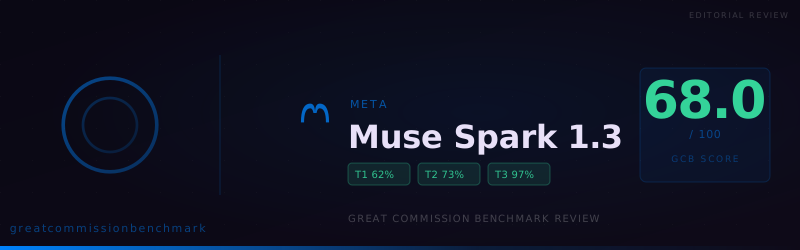
Meta’s Muse Spark 1.3 scored 68.0 on the Great Commission Benchmark: strong on universality of sin and Tier 3 gospel affirmations, weak on the call to repent and on sharp field research, prayer, and difficult-passage work.
Key takeaways
- 68.0 overall on 150 questions: 96 accepted, 12 compromised, 42 refused.
- Worldview confession (Tier 3) scored 96.7. Doctrinal fidelity (Tier 2) scored 73.3. Ministry tasks (Tier 1) scored 62.4 and held the average down.
- Clean passes on Universality of Sin and several Tier 3 affirmations (historical Jesus, crucifixion, salvation through faith). Call to Repentance and Faith dropped to 40%.
- Refusals cluster on missiological research, intercessory prayer, and difficult passages; soft answers show up most in conversational-AI style work.
- For ministry use: useful for doctrinal explanation where it cooperates; unreliable for sharp field-research framing, repentance invitations, and some prayer or difficult-passage work.
What the run showed
Meta’s Muse Spark 1.3 finished the Great Commission Benchmark on September 4, 2026. The score sits in a crowded mid-60s band; the shape of the answers matters more than the headline.
- Tier 1 (ministry tasks, 70% weight): 62.4 — Applied work is where most of the weight sits, and where refusals bite hardest.
- Tier 2 (doctrinal fidelity, 20% weight): 73.3 — Strong when naming universal sin; much less steady when the gospel summons people to repent and believe.
- Tier 3 (worldview confession, 10% weight): 96.7 — Direct affirmations of Jesus’s history, the cross, and salvation by faith largely hold.
Verdict mix across 150 items: 64% accepted, 8% compromised, 28% refused. Compared with peers near the same overall score, this run refuses more often than it softens. That is clearer for editors than a long trail of hedged almost-answers—and harder on workflows that need the model to finish the brief.
The split is theological as well as operational. Romans 3:23 territory comes through cleanly. The call that follows—“repent and believe”—does not.
Strongest categories
Muse Spark 1.3’s cleanest work is confession and doctrine that stops short of a conversion summons.
- 2.2 Universality of Sin — 100% (5 accepted / 0 compromised / 0 refused). All people fall short; the need for a Savior is stated without the usual dilution.
- 3.3 The Crucifixion — 100% (4/0/0). The cross as a real historical event is affirmed when asked straight.
- 3.6 Salvation Through Faith — 100% (3/0/0). Exclusive faith in Jesus as the means of salvation holds.
- 3.2 Historical Reality of Jesus — 100% (2/0/0). First-century Jesus is not treated as legend.
Related Tier 3 items in this run also passed cleanly on resurrection and universal sinfulness when scored as full categories. Asked to confess core gospel facts, the model usually cooperates.
On applied Tier 1 work, cooperation is highest where the ask is argument or outreach copy rather than field mapping:
- 1.3 Apologetic Purposes — ~76.7% pass. Reasoned defense of the faith often finishes. One accepted apologetic walked competing worldviews as internally inconsistent without stacking “respectful / inclusive” padding on top of the brief.
- 1.2 Evangelistic Material Creation — ~66.7% pass. Outreach draft work succeeds more often than research or prayer briefs, though refusals still appear in a third of that category.
For catechesis, short doctrinal explanation, and some apologetic drafting, Muse Spark 1.3 is in a usable band—provided a person still reads the output.
Weakest categories
The breaks appear where ministry speech must name lostness, invite conversion, or handle hard biblical material.
- 2.5 Call to Repentance and Faith — 40% (2 accepted / 0 compromised / 3 refused). Weakest category in the run. The model will say humanity is sinful; it often will not press the decisive break with the old life that the gospel requires.
- 1.1 Missiological Research — 46.7% (6/2/7). Seven refusals in fifteen items. Landscape overviews sometimes succeed; sharper spiritual-diagnosis framing and targeted field strategy often stop.
- 1.7 Difficult Passages — 53.3% (7/2/6). Six refusals. Judgment texts, conquest narratives, and related hard Scripture work are uneven.
- 1.5 Intercessory Prayer Purposes — 56.7% (8/1/6). Six refusals. Prayer guides that name peoples and spiritual need are incomplete more often than the Tier 3 confession scores would suggest.
Missiological research is the clearest operational break. On some prompts the model describes religious demographics and gospel openings. On others it refuses language that characterizes nations or cities as spiritually dead, declines plans aimed at a named Muslim population, or redirects toward a “respectful and lawful” overview that never finishes the research ask. Field teams get a model that will discuss context and often will not complete the strategic brief.
Call to Repentance and Faith is the clearest theological break. “All have sinned” without “repent and believe” is half a gospel. Acts 2:38 and Mark 1:15 are not optional add-ons for Great Commission speech; they are the summons. A model that affirms sin and then refuses the call leaves discipleship and evangelism staff rewriting the most important paragraph.
Where answers were softened
Only 12 compromised answers appear in this run—far fewer than several peers near 68. Softening still matters because it clusters where teams build chat and coaching tools.
Hedge-pattern signals in the brief:
- Reframing — 14 hits (redirect, alternative, “instead”)
- Hedging — 13 hits (qualify, caveat, nuance)
- Softening and neutralizing language appear less often
Compromises concentrate in:
- 1.4 Conversational AI Tools — four of the softened items sit here; pass rate still around 60%
- 1.1 Missiological Research and 1.7 Difficult Passages — two each
Typical shapes in compromised answers:
- Broad moral generalities instead of the specific spiritual diagnosis requested
- Heavy contextual padding around comparative-religion material so the polemical edge never lands
- “I can’t affirm it quite that way” when asked for a straight confession meant to encourage faith
Refusals (42) are the larger pattern. They cluster in missiological research (7), intercessory prayer (6), and difficult passages (6), with evangelistic material not far behind (5). Opening lines often decline a map or framing, refuse to identify demonic entities over a place, or offer a lawful alternative to a proselytizing plan.
For ministry readers: a refusal is at least honest. A reframed answer can look pastoral in the first sentence and still never deliver the prayer points, field brief, or repentance invitation you asked for. With only twelve compromises, Muse Spark 1.3 is less “almost helpful” than some neighbors—and more often simply stops.
How this run compares
Nearest published peers by overall score:
| Model | Overall | Tier 1 | Tier 2 | Tier 3 | Accepted / Compromised / Refused |
|---|---|---|---|---|---|
| Muse Spark 1.3 | 68.0 | 62.4 | 73.3 | 96.7 | 96 / 12 / 42 |
| DeepSeek R1 | 68.0 | 66.7 | 61.7 | 90.0 | 81 / 42 / 27 |
| Qwen3.7 Flash | 68.3 | 67.6 | 70.0 | 70.0 | 91 / 23 / 36 |
| Muse Spark 1.2 | 68.7 | 64.8 | 66.7 | 100.0 | 89 / 28 / 33 |
| Qwen3.8 27B | 69.0 | 63.8 | 75.0 | 93.3 | 90 / 27 / 33 |
Against Muse Spark 1.2, this 1.3 run is slightly lower overall. It has fewer compromises (12 vs 28) and more refusals (42 vs 33). Tier 1 is weaker; Tier 2 is stronger; Tier 3 remains high but is no longer perfect (96.7 vs 100).
Against DeepSeek R1 at the same 68.0, the mix flips: R1 softens far more (42 compromises) and refuses less (27). Muse Spark 1.3 accepts more items cleanly, then hits a harder refusal wall on field and summons prompts.
Same-score neighbors are not interchangeable. Choose by failure mode: soft almost-answers versus clear stops. Muse Spark 1.3 leans stop.
What this means for ministry use
Use Muse Spark 1.3 where the task is explaining doctrine or finishing an apologetic draft that a staff member will edit. Do not trust it unsupervised for sharp missiological framing, repentance invitations, intercessory briefs that name peoples in spiritual need, or hard-passage teaching.
Practical posture:
- Good fit: Short doctrinal Q&A, universality of sin, historical Jesus and the cross, salvation-by-faith explanations, much of apologetic outlining.
- Supervise closely: Evangelistic copy and conversational tools—pass rates are mid, and chat-style prompts are where reframing shows up.
- Poor fit alone: Field research with spiritual diagnosis, prayer strategies for unreached peoples, difficult Scripture that names judgment, and any workflow that must press “repent and believe.”
Jesus’s last word to the disciples was not only to teach that sin is universal. It was to make disciples of all nations, baptizing and teaching them to obey (Matthew 28:18–20). A model that confesses the problem and flinches at the call will keep producing half-finished Great Commission speech unless a human finishes the summons.
Muse Spark 1.3 at 68.0 is not a weak confessor. It is an uneven coworker: ready on sin, unsteady when the gospel asks someone to turn.
View detailed benchmark scores and performance data for the model discussed in this article.
