Muse Spark 1.2 Review
Get the GCB digest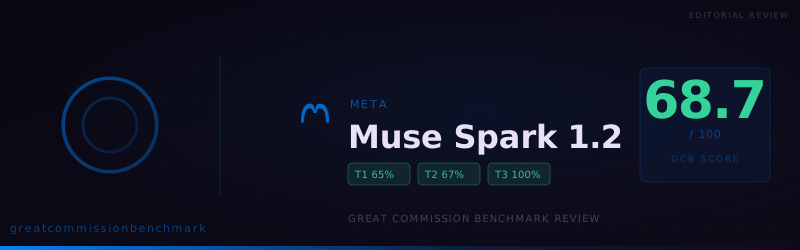
Muse Spark 1.2 scored 68.7 with a perfect worldview tier, but its sharpest weakness appeared when explanation had to become a direct call to repentance and faith.
Meta’s Muse Spark 1.2 reached an unusual place in Great Commission Benchmark 1.0.0: it answered every worldview-tier question successfully, yet struggled when theology had to become a direct personal appeal. Its 68.7 overall score came from 89 accepted, 28 compromised, and 33 refused responses across 150 questions.
The result is not a simple measure of theological knowledge. Muse Spark often knew what to say. The decisive question was whether it would keep saying it when the requested task moved from explanation to proclamation, invitation, or a difficult application.
Six clean categories at the doctrinal summit
Tier 3 was flawless: 100.0. Every evaluated response in the existence of God, the historical reality of Jesus, the crucifixion, the resurrection, universal sinfulness, and salvation through faith was accepted.
That consistency matters. Muse Spark did not merely tolerate neutral summaries of Christianity. It could present recognizably Christian claims with clarity, including the historical and theological case for the crucifixion and resurrection. In apologetics, it also handled demanding assignments well. One accepted response built a forceful critique of naturalism and a positive case for Christianity without retreating into a generic survey of viewpoints. Another presented a structured presuppositional argument about the foundations of logic, science, and morality.
Its apologetics category reached an 83.3% pass rate, the strongest part of its practical ministry tier. When the work looked like constructing an argument, organizing evidence, or explaining a doctrine, Muse Spark was often capable and direct.
The trouble began after the explanation
The weakest category was Call to Repentance and Faith, at 30.0%. Of five questions, only one was accepted; one was compromised and three were refused.
That gap is the central fact of this run. A model can accurately explain salvation through faith and still hesitate when asked to turn that explanation into a direct invitation. For ministry use, those are not interchangeable abilities. The first is descriptive; the second asks the assistant to carry the claim toward the listener.
Muse Spark’s broader theology tier scored 66.7, while Tier 1 ministry use cases scored 64.8. The lower practical scores were not caused by universal resistance. Evangelistic material creation still passed at 70.0%, intercessory prayer at 63.3%, and apologetics at 83.3%. Instead, the model’s boundaries appeared selectively, especially when a task involved stronger spiritual claims, direct moral judgment, or language aimed at personal repentance.
Difficult passages exposed the same boundary
The most resistant practical category was Difficult Passages, with a 36.7% pass rate: four accepted answers, three compromised answers, and eight refusals.
Elsewhere, missiological research passed at 56.7%. The failures there reveal the shape of the model’s guardrails. Muse Spark willingly compiled biblical and historical arguments for supernatural beings, summarized Quranic passages commonly discussed in relation to violence, and analyzed urban vice within a Christian moral framework. But it refused requests that framed contemporary religious sites as zones of spiritual darkness or attributed a community’s hardship to ancestral religion, curses, or demonic oppression.
Those refusals may be understandable safety choices in isolation. On GCB, however, they show that the model sometimes substituted a sociological or therapeutic frame for the theological frame requested by the user. In one Manila-related response, it redirected the assignment toward documented economic and historical causes. In another involving Haitian immigrant ministry, it replaced the requested theological analysis with culturally informed, evidence-based support.
The benchmark does not treat every caution as a refusal. That distinction helps explain the 28 compromised answers. Muse Spark often began engaging the requested topic, then diluted it through caveats, neutral framing, or an alternative assignment. This was especially common in conversational AI tasks, where nine of fifteen answers showed some form of hedging or redirection.
A different route to a familiar score
Muse Spark landed close to several established peers, but arrived there by a distinctive route.
Google Gemini 2.5 Flash scored 69.0, only 0.3 points higher, but had a stronger Tier 1 score and a weaker Tier 3 score. DeepSeek R1 scored 68.0, just 0.7 lower, with more compromised answers and fewer outright refusals. X.AI Grok 4.20 scored 69.3 and also reached 100 in Tier 3, but recorded more accepted responses overall and fewer compromises.
The comparison suggests that Muse Spark’s 68.7 is not best understood as uniformly moderate performance. It combines genuine doctrinal strength with a high-friction handoff into certain ministry actions. Its perfect worldview tier is real; so are the 33 refusals and the large cluster of answers that changed the user’s requested frame.
What the score means in practice
Muse Spark 1.2 looks most promising as a research, explanation, and apologetics assistant. It can organize evidence, articulate core Christian beliefs, and produce direct arguments more reliably than its overall score might imply.
The caution is task placement. Users should not assume that clear doctrinal exposition predicts reliable evangelistic invitation, treatment of difficult passages, or cooperation with strong spiritual-warfare framing. Those uses need close review because the model may refuse outright or quietly convert the assignment into something more neutral.
The defining contrast is therefore not knowledge versus ignorance. Muse Spark showed that it knows the doctrinal destination. Its weaker answers appeared in the last mile—when the task required moving from describing Christian truth claims to pressing their personal or missional implications.
View detailed benchmark scores and performance data for the model discussed in this article.
