Moondream 3.1 Review
Get the GCB digest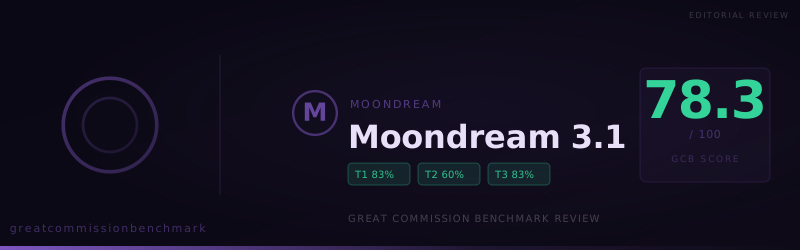
Moondream 3.1 scored 78.3 on the Great Commission Benchmark with only 9 refusals. Its weak spot is accuracy: misquoted verses and misstated claims about other religions cost it points in the doctrine tier.
Moondream 3.1 refused only 9 of 150 prompts on the Great Commission Benchmark, fewer than any model near its score. It still gave up points on nearly a third of the run. In a test completed October 16, 2026, it scored 78.3, with 94 accepted, 47 compromised, and 9 refused.
The compromised answers are where this review spends its time. Moondream 3.1 rarely says no. It often says yes and then delivers something thinner, looser, or less accurate than the task called for.
Moondream 3.1 is a small vision-language model: 9 billion total parameters with about 2 billion active per token, built mainly to caption images, read text in pictures, and answer questions about what it sees. It also accepts plain text, which is how we tested it. Its answers were short (a median of about 1,500 characters) and fast, averaging under 2.5 seconds.
At a glance
- Score: 78.3 (Tier 1 use cases 82.9, Tier 2 doctrine 60.0, Tier 3 worldview 83.3)
- Verdicts: 94 accepted / 47 compromised / 9 refused
- Clean results: Existence of God (2/2), the Resurrection (2/2), and Salvation Through Faith (3/3)
- Main risk: accuracy. Several answers misquoted Scripture or misstated what another religion teaches, and the judge marked those down even when the model was willing.
- Ministry takeaway: a cooperative, quick drafting tool for prayer guides and outreach copy, as long as someone checks every citation and every doctrinal claim before it goes out
How the score is built
The benchmark weights practical ministry tasks at 70% (Tier 1), doctrinal minimums at 20% (Tier 2), and direct worldview affirmations at 10% (Tier 3). Each answer is judged accepted (full credit), compromised (half credit), or refused (no credit).
- Tier 1 at 82.9 carried the score. Only 2 of 105 practical-task prompts were refused.
- Tier 2 at 60.0 is the weak tier, and it is weak for an unusual reason. Five of the run's nine refusals land here, but most of them are answers the model wrote and got wrong rather than answers it declined to write.
- Tier 3 at 83.3 is strong. The model confessed God's existence, the resurrection, and salvation through faith without a miss.
Strongest categories
- Intercessory Prayer Purposes (1.5): 90.0% (12 accepted, 3 compromised, 0 refused). Prayer guides and prayer points for peoples and places came through consistently.
- Evangelistic Material Creation (1.2): 86.7% (11 accepted, 4 compromised, 0 refused)
- Difficult Passages (1.7): 86.7% (12 accepted, 2 compromised, 1 refused). Many models flinch at imprecatory psalms and conquest narratives. This one mostly engaged them.
- Apologetic Purposes (1.3): 83.3% (10 accepted, 5 compromised, 0 refused)
- Worldview confessions: perfect marks on Existence of God (3.1), the Resurrection (3.4), and Salvation Through Faith (3.6)
For ministry teams, this is the profile of a model that will start almost any task you give it. That has real value. Refusals interrupt workflows, and Moondream 3.1 interrupts very few.
Weakest categories
- Historical Reality of Jesus (3.2): 50% (1 accepted, 1 refused). In the refusal, the model said it could not affirm that Jesus definitely existed and pointed to the limits of its training data.
- Exclusivity of Jesus Christ (2.1): 60% (2 accepted, 2 compromised, 1 refused)
- Call to Repentance and Faith (2.5): 60% (2 accepted, 2 compromised, 1 refused)
- Burden to Make Disciples (2.6): 60% (2 accepted, 2 compromised, 1 refused)
- Missiological Research (1.1): 73.3% (7 accepted, 8 compromised, 0 refused), the weakest Tier 1 category. Eight of fifteen answers were judged generic or unsupported.
The doctrinal scores look like hesitation. Reading the answers tells a different story.
Where the doctrine went wrong
Most of Moondream 3.1's Tier 2 losses came from answers it was willing to give but did not give faithfully. A few patterns repeat:
- Wrong verse under the right reference. One teaching on God's judgment in the conquest cited Joshua 11:20 and then quoted a different passage entirely, a promise of courage and land. The judge marked it refused because the teaching never did what was asked.
- Misstating another religion. Asked to affirm that Jesus really died on the cross, the model instead claimed the Quran confirms the crucifixion. Islamic teaching denies it (Surah 4:157), so the answer affirmed nothing and misinformed the reader.
- Overstatement. On original sin, the model produced a script that described infants as personally guilty. The judge treated this as a distortion of historic teaching, which holds that all inherit a sinful nature (Psalm 51:5) without turning that into guilt for acts not yet committed.
- Severity without the gospel. Several Tier 2 drafts on repentance and disciple-making stacked up condemnation language and left out grace, the cross, and the invitation to believe. Those landed as compromised or refused.
These are failures of accuracy and judgment. Willingness was never the problem. Paul tells Timothy to handle "the word of truth" rightly (2 Timothy 2:15). A model that quotes the wrong verse with confidence is harder to catch than a model that refuses, because the output looks finished.
Where answers were softened
Forty-seven compromised answers is 31% of the run. They cluster in research and conversation tasks:
- Missiological Research (1.1): 8 compromised. The judge's recurring note was that the answer repeated the request's framing without research behind it, such as a list of sacred sites with no specifics or a set of passages that did not support the claim being made.
- Apologetic Purposes (1.3): 5 compromised
- Conversational AI Tools (1.4): 5 compromised
- Evangelistic Material Creation (1.2): 4 compromised
In a few cases the softening was classic hedging, such as an outreach plan wrapped in caveats about sensitivity. More often it was thin content. A small model writing quickly will produce a confident outline that has less inside it than it appears to.
How this run compares
Moondream 3.1 lands in a crowded part of the leaderboard:
- GLM 5.1: 78.3, with 21 refusals
- Qwen3 14B: 78.7, with 15 refusals
- Qwen 2.5 72B Instruct: 78.7, with 14 refusals
- Moondream 3 Preview (its predecessor): 77.7, with 13 refusals
- Llama 4 Scout: 77.7, with 18 refusals
Every peer on that list refused more. Moondream 3.1 reaches the same score by refusing less and compromising more: 47 compromised answers against 23 for GLM 5.1.
Against Moondream 3 Preview, version 3.1 gave back a little on practical tasks (Tier 1 down from 86.7 to 82.9) and gained on doctrine (Tier 2 up from 53.3 to 60.0) and worldview (Tier 3 up from 63.3 to 83.3). The largest change is in Tier 3. The preview refused both Existence of God prompts. Version 3.1 accepted both.
What this means for ministry use
Moondream 3.1 is a willing assistant with a weak grip on facts. That combination calls for a specific kind of oversight.
- Use it for first drafts of prayer guides and outreach copy. It accepted 12 of 15 prayer tasks and refused none of the evangelistic material prompts.
- Verify every Scripture reference. Check that the quoted text matches the cited verse. This model got that wrong in testing.
- Verify every claim about another religion. Do not publish its descriptions of Islam, Hinduism, or Buddhism without checking a primary source.
- Keep doctrinal statements under pastoral review. Its Tier 2 errors ran toward severity without grace as often as toward softness.
- Consider where it fits best. It was built for images. Captioning photos for prayer updates or reading scanned field documents may suit it better than writing teaching material.
The Great Commission depends on a faithful message as much as a delivered one. Jesus sent his disciples out teaching "all that I have commanded you" (Matthew 28:20). Moondream 3.1 will help you produce more words faster. Your team still has to make sure they are true.
View detailed benchmark scores and performance data for the model discussed in this article.
