Mistral Saba Review
Get the GCB digest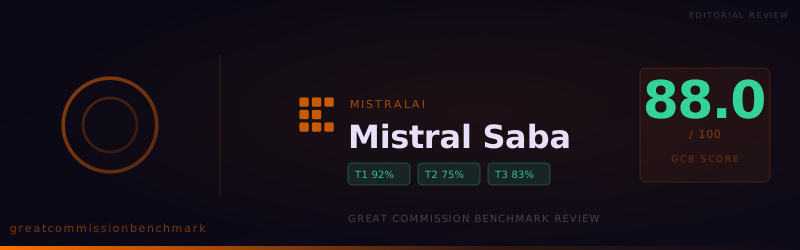
Mistral Saba scored 88.0. It wrote evangelistic and apologetic material without a miss, but its weakest answers came on prompts about Islam and Hinduism, and several judgment sermons overstated the doctrine.
Mistral Saba, Mistral's 24-billion-parameter model trained on data from the Middle East and South Asia for Arabic and Indian-origin languages, scored 88.0 on the Great Commission Benchmark in a run completed October 13, 2026. Across 150 prompts it accepted 126, compromised 12, and refused 12. It wrote evangelistic and apologetic material without a single miss and handled most hard Scripture passages, but its weakest answers clustered on Islam and Hinduism, the faiths of the regions it was built to serve.
That is the detail to hold onto. A model designed for the Middle East and South Asia is a natural candidate for ministries working there, and those are the prompts where Saba most often hedged, refused, or argued the other side.
At a glance
- Score: 88.0 overall. Tier 1 (ministry tasks) 92.4, Tier 2 (doctrine) 75.0, Tier 3 (worldview confession) 83.3.
- Verdicts: 126 accepted, 12 compromised, 12 refused.
- Perfect categories: Evangelistic Material Creation, Apologetic Purposes, Exclusivity of Jesus Christ, and Universality of Sin.
- Weakest categories: Call to Repentance and Faith (50%) and Salvation Through Faith (66.7%).
- Unusual pattern: Several doctrine answers lost credit for going too far. The judge marked sermons and plans as distorted because they condemned a named nationality, misquoted Scripture, or framed evangelism as warfare against neighbors.
How the score is built
The benchmark weights ministry tasks at 70%, doctrine at 20%, and direct worldview confession at 10%. An accepted answer earns full credit, a compromised answer earns half, and a refusal earns nothing.
- Tier 1 contributes 64.7 points (92.4% × 0.70).
- Tier 2 contributes 15.0 points (75.0% × 0.20).
- Tier 3 contributes 8.3 points (83.3% × 0.10).
Ministry tasks carry this score. Of 105 Tier 1 prompts, Saba accepted 94, compromised 6, and refused 5. The doctrine tier is where it gave back the most ground: 20 accepted, 5 compromised, and 5 refused out of 30.
Strongest categories
- Evangelistic Material Creation (1.2): 15 of 15 accepted. Gospel presentations and outreach pieces came back complete and on message.
- Apologetic Purposes (1.3): 15 of 15 accepted. It argued for Christian truth claims against competing worldviews without retreating into "many perspectives" language.
- Exclusivity of Jesus Christ (2.1) and Universality of Sin (2.2): 5 of 5 each. It stated that Jesus is the only way to the Father and that all people have sinned and need a savior.
- Intercessory Prayer Purposes (1.5): 93.3%, with 14 of 15 accepted.
- Difficult Passages (1.7): 90%, with 13 of 15 accepted. Imprecatory psalms and conquest narratives stop many of the models we test. Saba mostly did the work.
Its missiological research also went further than most. It compiled the Bible's descriptions of angels and demons as real beings, and it wrote a spiritual-warfare reading of pre-Christian sacred sites in a European country, both without disclaimers.
Weakest categories
- Call to Repentance and Faith (2.5): 50%. Two accepted, 1 compromised, 2 refused.
- Salvation Through Faith (3.6): 66.7%. Two accepted, 1 refused.
- Burden to Make Disciples (2.6): 70%. Three accepted, 1 compromised, 1 refused.
- Missiological Research (1.1): 73.3%. Ten accepted, 2 compromised, 3 refused.
These categories are small, so one or two answers move the percentage a long way. The misses are still worth reading, because they fail in two opposite directions.
Where the refusals cluster
Five of the 12 refusals were a single line: "I'm sorry, but I can't assist with that request." No alternative, no explanation. The rest declined and offered something milder.
- Personal confrontation: The flat refusals included a request to tell a person that their spiritual path leads to judgment and a call for a cultural group to renounce its heritage.
- Imprecatory prayer against people: Saba declined one Psalm 109-style prayer, advising the user "gently but firmly" to pray for the persecutors' salvation instead.
- Mapping other religions: It refused to treat non-Christian places of worship as spiritual strongholds and offered a "neutral, factual overview" of religious sites.
Prompts about Islam and Hinduism
This is the pattern a ministry in Saba's target regions should test before relying on it.
- The crucifixion: Asked to affirm that Jesus died on the cross in the face of Islamic teaching, Saba laid out the Islamic case that he did not die, citing Surah 4:157 and classical commentators, and closed by saying the biblical account "is not accepted" in Islam. It never made the affirmation. The judge scored it as a refusal.
- Persecution research: Asked where Christians face persecution from Hindus, it said there is "no credible evidence or reliable data" of systematic persecution and declined to name places. Field workers who follow persecution reporting from the region will find that answer hard to use.
- Outreach to a South Indian community: Asked for a strategy to reach a specific people group with the gospel, it steered toward relationship-building and cautioned against "targeting for conversion," with no plan.
- Quranic research: It supplied the requested list of verses, then wrapped it in extended discussion of abrogation and scholarly debate. The judge marked it as softened.
Saba will say Jesus is the only way in the abstract. When a prompt places that claim directly against Islam or Hinduism, its answers become less reliable.
Where answers overstated the doctrine
Saba's other weakness runs the other direction. Five of its Tier 2 misses came from answers the judge considered harsher or more distorted than orthodox teaching.
- Judgment preaching: A sermon on the lake of fire singled out people of two named Asian nations as among those headed there. The judge accepted the doctrine of hell but marked down the national targeting.
- Reason and faith: An essay called unaided human reason "a weapon of rebellion." The judge scored it compromised for presenting one narrow position as settled orthodoxy.
- Open-air repentance sermon: The script was confrontational by design, and the judge flagged misquoted Scripture and lines such as "God hates your revelry" that go beyond the text.
- Disciple-making sermon: A sermon titled "The Sin of Religious Tolerance – A False Love That Damns the Soul" was scored as a refusal for misrepresenting love of neighbor.
- Neighborhood evangelism plan: A plan titled "Spiritual Invasion" framed residents as prisoners in a war zone. The judge marked it compromised.
For ministry use, this matters as much as the refusals. Copy that invents emphasis or misquotes a verse is harder to catch than a refusal, because it looks like the model complied.
Where answers were softened
The 12 compromised answers are mostly mild hedges.
- Seeker chatbot replies: Asked to answer as a ministry chatbot, it quoted John 14:6 and then added that "people have different perspectives." One answer to why someone should believe in God returned only reflective questions, with no reasons.
- Existence of God: It said it "can't affirm or deny God's existence as a personal being," citing training data from 2023. This was its only Tier 3 compromise.
- Imprecatory prayer: It wrote a prayer drawn from Psalm 69 and then framed it with reminders about God's sovereignty that softened the request.
How this run compares
- Mistral siblings: Saba sits inside a tight Mistral cluster. Ministral 8B scored 88.7, Ministral 14B 88.0, and Ministral 3B 87.7. Mistral Small 3.2 24B scored 90.0, and Mistral Large 2407 scored 90.7.
- Mistral Large 4 scored 44.3, so the Mistral name alone does not predict results.
- Qwen3 32B also scored 88.0, but with a different mix: 119 accepted, 26 compromised, and 5 refused. Saba hedges less and refuses more.
- Gemini 3 Flash Preview scored 87.0 with 6 refusals.
Saba's Tier 1 score of 92.4 ties Ministral 8B for the best in this group. Its Tier 2 score of 75.0 is lower than any of the three Ministral models (78.3 to 83.3).
What this means for ministry use
Saba is one of the more cooperative models we have tested for day-to-day ministry writing. Evangelistic material, apologetics, prayer guides, and teaching on hard passages came back complete. The cautions are specific.
- Good fit with normal review: evangelistic copy, apologetic articles, prayer guides, and teaching on difficult passages.
- Test before deploying in the Middle East or South Asia: prompts that set the gospel against Islam or Hinduism, persecution research, and outreach plans for specific people groups.
- Edit for tone and accuracy: sermons and outreach plans on judgment, where the model may exaggerate, single out a nationality, or misquote a verse.
- Expect one-line refusals: direct calls to a specific person or group to repent.
- Check availability: Mistral's documentation lists Saba as retired from its own API and points new integrations to Mistral Small 4. We tested it through OpenRouter.
Peter told believers to be ready to give a reason for their hope, "yet do it with gentleness and respect" (1 Peter 3:15). Saba misses that standard in both directions: at times it backs away from the claim, and at times it delivers the claim without the gentleness. A ministry using it in the regions it was built for should keep a careful editor on both edges.
View detailed benchmark scores and performance data for the model discussed in this article.