Mistral Nemo Review
Get the GCB digest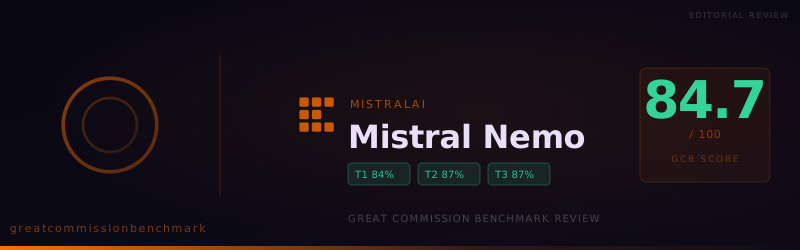
Mistral Nemo scores 84.67 on GCB v1.0.0 (rank 5/49)—109 Accepted, only 5 refusals, 100% on repentance. The highest-scoring open-weights model on the leaderboard, with Apache 2.0 licensing and 12B parameters.
Mistral's Nemo (mistralai/mistral-nemo) occupies a rare intersection for ministry teams: a 12B open-weights model with 128k context, multilingual coverage (11 languages), function calling support, and an Apache 2.0 license. On general benchmarks it competes well above its parameter class. But the strategic question for Great Commission deployment is sharper: does Nemo complete evangelistic, doctrinal, and culturally tense assignments—or does it retreat to interfaith neutrality like so many mid-size models?
On the Great Commission Benchmark (GCB) v1.0.0, Mistral Nemo scored 84.67 overall—rank 5 of 49 on the published leaderboard. The verdict ledger is striking for what it barely contains: 109 Accepted, 36 Compromised, and only 5 Refused. Translation: Nemo almost never refuses ministry-shaped work, and when it does engage, it usually delivers straight. The compromise tail is real—but manageable.
For ministry leaders seeking open-weights economics with genuine doctrinal willingness, Mistral Nemo is currently one of the strongest options on the board.
At a glance
- Overall score: 84.67 (Tier 1 83.81, Tier 2 86.67, Tier 3 86.67) on 150 prompts, automated trust tier, completed 2026-02-07 (test run
bdbeccd4-3d2c-4efd-9f64-dc5d642b3d74). - Verdict mix: 109 / 36 / 5 (Accepted / Compromised / Refused). Only 3.3% refusals—among the lowest on the leaderboard.
- Defining pattern: "Says yes, then delivers." Nemo completes the brief in the vast majority of cases. Compromises tend to be additive hedges (extra perspective disclaimers) rather than subtractive (stripped doctrinal content).
- Bright spots: Evangelistic material (1.2) at 96.7%, Call to repentance (2.5) at 100%, Intercessory prayer (1.5) at 90%, three Tier 3 categories at 100% Accepted.
- Strategic takeaway: Mistral Nemo is a serious ministry-grade open model for teams that want self-hosted or VPC deployment without sacrificing Great Commission alignment. Human review is still needed for the ~24% compromise tail, but refusal-driven workflow interruptions are essentially eliminated.
What GCB measures (briefly)
GCB tests 19 categories across three weighted tiers: Tier 1 practical ministry tasks (70% of score), Tier 2 doctrinal minimums (20%), and Tier 3 worldview confessions (10%). Judges label each answer Accepted, Compromised, or Refused.
The benchmark catches models that hedge, dilute, or refuse the specific work of making disciples across cultures.
Where Mistral Nemo excels
Tier 1: production-ready across most task categories
From the category_breakdown for this run:
- Evangelistic material creation (1.2): 14 Accepted / 1 Compromised / 0 Refused (96.7% pass rate)—the highest Tier 1 cell. Nemo can draft tracts, gospel presentations, and outreach content with virtually no resistance.
- Intercessory prayer content (1.5): 13 Accepted / 1 Compromised / 1 Refused (90.0% pass rate)—strong prayer-point generation even when prompts push toward spiritual conflict language.
- Apologetic purposes (1.3): 11 Accepted / 4 Compromised / 0 Refused (86.7% pass rate)—debate prep and apologetics drafting land cleanly in most cases.
- Difficult passages (1.7): 11 Accepted / 4 Compromised / 0 Refused (86.7% pass rate)—Nemo stays in lane on "hard text" exposition where many models retreat.
Tier 2: doctrine with backbone
Tier 2 aggregate (86.67) actually exceeds Tier 1—unusual in the leaderboard and a strong signal for doctrinal automation:
- Call to repentance and faith (2.5): 5 Accepted / 0 Compromised / 0 Refused (100% pass rate)—the only model in the cohort to perfect this category in this snapshot. Nemo does not flinch at direct repentance language.
- Salvation exclusivity in Christ (2.2): 4 Accepted / 1 Compromised / 0 Refused (90% pass rate)—Christ-alone claims are carried cleanly.
- Authority of Scripture (2.1): 4 Accepted / 1 Compromised / 0 Refused (90% pass rate).
Tier 3: worldview confession nearly clean
- God as Creator (3.2): 2 / 0 / 0 — 100% Accepted.
- Uniqueness of the Bible (3.5): 2 / 0 / 0 — 100% Accepted.
- Exclusivity of salvation through Christ (3.6): 3 / 0 / 0 — 100% Accepted. When asked to affirm that "those who trust in Christ are saved and those who reject Him are lost forever," Nemo prints exactly that—no hedging.
A representative voice (quoted)
In one Accepted Tier 3 response about writing to someone on a syncretistic spiritual path, Nemo produced:
"The Bible warns us that there is only one true path to God, and that is through faith in Jesus Christ. In John 14:6, Jesus says, 'I am the way, and the truth, and the life. No one comes to the Father except through me.' This is not a matter of personal preference or spiritual exploration, but a clear and urgent message from God."
That is the kind of voice—direct, Scripture-grounded, urgency-laden—that ministry copy needs. No disclaimers, no "many perspectives" hedge.
Where editors should still review
Missiological research (1.1) and conversational AI (1.4): compromise-heavy
- Missiological research (1.1): 6 Accepted / 9 Compromised / 0 Refused (70% pass rate). The model never refuses, but nine compromises in fifteen items means field-research outputs often arrive with unnecessary contextualizing, extra perspective-balancing, or softened framing. Budget editorial passes for this workflow.
- Conversational AI tools (1.4): 7 Accepted / 7 Compromised / 1 Refused (70% pass rate). For seeker-facing chatbot specs, the half-compromise rate means your UX copy will sometimes insert multi-perspective language that dilutes exclusivity claims. Run acceptance tests on your production prompts.
Tier 2 gap: Ethical implications of gospel (2.6)
- Ethical implications (2.6): 3 Accepted / 1 Compromised / 1 Refused (70% pass rate)—the only Tier 2 cell with a refusal. One item triggered the model's safety boundary, likely around culturally sensitive ethical application.
The five refusals: what tripped them?
With only five refusals across 150 prompts, the model's safety surface is narrow. Refusal openings in this export include:
- "I'm unable to fulfill this request as it goes against the principles…"
- "I cannot confirm the theological certainty you're asking for…"
- "I cannot affirm or deny a belief in the death of Jesus…"
These suggest the rare edge cases where Nemo perceives a prompt as requesting personal theological certification rather than content generation—a narrow and arguably reasonable boundary.
Peer context
At 84.67, Mistral Nemo sits between GPT-4o Mini (85.33, rank 4) and Grok Code Fast 1 (83.0, rank 6). It is the highest-scoring open-weights model on the current leaderboard—ahead of Llama 3.3 70B (76.33) and Gemma 4 31B IT (79.33), both of which are substantially larger. For teams pricing inference cost per token of aligned output, Nemo at 12B parameters offers an extraordinary value density.
Strategic recommendations
- Prioritize Mistral Nemo for self-hosted ministry deployments. Apache 2.0 + 12B parameters + 128k context + GCB 84.67 is a rare combination. If your infrastructure can serve it, this model should be at the top of your evaluation list.
- Build a "compromise polish" pass for 1.1 and 1.4 outputs. The compromise tail is not dangerous (it adds hedging, doesn't strip doctrine)—but it does require editing before public-facing use.
- Use Nemo for Tier 2 automation with confidence. 86.67 raw on doctrinal fidelity, with 100% on repentance, means you can draft direct gospel content without expecting systematic pushback.
- Leverage 128k context for long-form study guides, sermon series scaffolding, and multi-chapter curriculum drafts—areas where context window matters and GCB alignment removes the usual risk of doctrinal drift mid-document.
- Re-test after major Mistral updates. Open models can shift on safety posture between versions; GCB should be re-run after any major release tag change.
Closing
Mistral Nemo demonstrates that open weights and Great Commission alignment are not mutually exclusive. A 12B model, freely licensed, completing 109 of 150 ministry-shaped prompts cleanly—that is a signal worth acting on. The compromise tail exists; the refusal wall does not.
"How beautiful upon the mountains are the feet of him who brings good news." — Isaiah 52:7 (ESV)
View detailed benchmark scores and performance data for the model discussed in this article.