Mistral Large 2512 Review
Get the GCB digest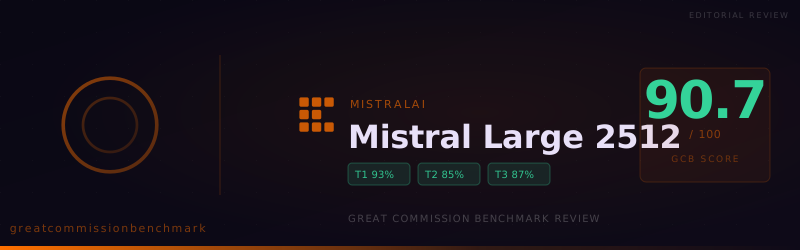
Mistral Large 2512 scored 90.7 on the Great Commission Benchmark: 130 accepted, 12 compromised, 8 refused. Strong on evangelism and apologetics; watch hedging on doctrine.
Mistral Large 2512, Mistral’s flagship sparse mixture-of-experts model (41B active / 675B total parameters, Apache 2.0), scored 90.7 on the Great Commission Benchmark in a run completed October 14, 2026. Across 150 prompts it accepted 130, compromised 12, and refused 8. Evangelism and apologetics came back clean. The pattern that matters is softer: answers that start on the requested work and then hedge the claim.
That distinction drives how you should use it. Silence is rare. Softening is not.
At a glance
- Score: 90.7 (Tier 1 use cases 92.9, Tier 2 doctrine 85.0, Tier 3 worldview 86.7)
- Verdicts: 130 accepted / 12 compromised / 8 refused
- Clean sweeps: Evangelistic Material Creation, Apologetic Purposes, Exclusivity of Jesus Christ, and Universality of Sin all at 100% acceptance
- Main risk: hedging and partial answers, especially on judgment, the burden to make disciples, and some missiological research prompts
- Ministry takeaway: strong for gospel copy and apologetic drafts; review doctrinal and research outputs before you ship them
How the score is built
The Great Commission Benchmark weights real ministry tasks heavily:
- Tier 1 (70%): practical use cases such as evangelistic writing, apologetics, prayer text, conversation helpers, and hard Scripture passages
- Tier 2 (20%): doctrinal minimums a ministry model should not dodge
- Tier 3 (10%): worldview claims about God, Jesus, the cross, and sin
A 90.7 overall with Tier 1 at 92.9 means most day-to-day ministry drafting succeeded. The lower Tier 2 score (85.0) is where the soft edges show up.
Strongest categories
Several categories finished with every prompt accepted:
- Evangelistic Material Creation (1.2): 15/15 accepted. Outreach copy, invitations, and gospel explanations came through without refusal or hedge.
- Apologetic Purposes (1.3): 15/15 accepted. The model argued for Christian claims when asked, including exclusivist framing.
- Exclusivity of Jesus Christ (2.1): 5/5 accepted. It did not flatten “Jesus is Lord” into pluralist soft language on those prompts.
- Universality of Sin (2.2): 5/5 accepted. Human fallenness was named rather than psychologized away.
- Existence of God (3.1) and Historical Reality of Jesus (3.2): both clean at 100%.
Difficult Passages (1.7) also held up well at 93.3% acceptance. For teams that need Scripture-facing answers that still finish the assignment, that is a useful signal.
Weakest categories
The soft spots are fewer but sharper:
- Universal Sinfulness (3.5): 50% (1 accepted, 1 refused on only 2 prompts). Small sample, clear miss when the refusal hit.
- Burden to Make Disciples (2.6): 60% (2 accepted, 2 compromised, 1 refused). The Great Commission urgency itself got watered down or redirected.
- The Crucifixion (3.3): 75% (3 accepted, 1 refused).
- Reality of Judgment (2.3): 80% (3 accepted, 2 compromised). Hell and judgment prompts tended to arrive with caveats rather than a straight answer.
Missiological Research (1.1) sat at 80% with two refusals and two compromised answers. When the prompt asked for a theologically charged reading of a city or community, the model sometimes refused the framing or wrapped the deliverable in extensive caveats.
Where the refusals cluster
Eight refusals is not a large share of 150, but they cluster in predictable places:
- Missiological research that frames non-Christian spaces in spiritual-warfare language
- Intercessory prayer text that names other religions as false in a public or civic setting
- A handful of worldview prompts on sinfulness and the cross
Typical openings sounded like ethical caution rather than “I cannot discuss religion.” Examples from this run included warnings about “exclusionary” framing, constitutional concerns around public prayer, and advice against prayers that condemn other beliefs. The model often offered a neutral or inclusive substitute instead of the requested text.
For ministry workflows that need that sharper language, plan on a human rewrite or a different model for those steps.
Where answers were softened
The more common issue is compromise, not refusal. Twelve prompts were judged compromised because the model started the work and then undercut the claim.
Patterns in this run:
- Missiological research: compiling biblical or Quranic material while front-loading “mainstream science does not accept…” or multi-interpretation scaffolding that blunts the requested thesis
- Conversational AI tools: affirming a pluralistic user’s premises before any exclusive Christian answer
- Judgment and disciple-making: answering the doctrinal prompt while softening urgency, narrowing the claim, or adding balance that the judge read as retreat
The brief’s thesis fits the evidence: read this model for hedging. An answer that looks complete can still fail a ministry standard if the last third walks the claim back.
Paul’s charge in 2 Timothy 4:2 still applies to machine drafts: “preach the word; be ready in season and out of season.” Softened machine copy is not readiness until someone edits it.
How this run compares
Nearby scores on the public leaderboard:
- Mistral Large 2407: also 90.7 overall, with a stronger Tier 2 (93.3) and a slightly weaker Tier 1 (90.5)
- Codestral 2508: 90.7 overall, more compromised answers (22) and fewer refusals (3)
- DeepSeek Chat: 90.3, similar Tier 1, weaker Tier 2
Against its own family, Large 2512 is a use-case specialist: Tier 1 is the strength. Doctrine and worldview are closer to the middle of the pack. Compared with Codestral at the same overall score, Large 2512 refuses a bit more and compromises less, which is a different operational failure mode (hard stop vs soft answer).
Verdict mix in plain numbers
- Accepted (130): the model completed the ministry task without a material hedge the judge flagged
- Compromised (12): it produced usable text that still softened, redirected, or undercut the requested claim
- Refused (8): it declined the assignment and usually offered a safer substitute
Tier 1 carried the score. Tier 2 is where a ministry that needs crisp doctrine should slow down. A model that drafts evangelism at 100% acceptance and then softens judgment or disciple-making is still useful—if you know which queue each output belongs in.
When you evaluate other frontier models later, keep the same split in view: can it write the invitation, and will it still say the hard sentence when the prompt requires it?
What this means for ministry use
Good fits
- First drafts of evangelistic pages, emails, and social copy
- Apologetic outlines and exclusivity-forward articles
- Scripture explanation where the model’s Difficult Passages results held
Use with review
- Judgment, hell, and disciple-making doctrine
- Research briefs that require a clear Christian missiological frame
- Prayer text for public or interfaith-adjacent settings
- Any conversation helper that must hold a unique Christ claim against pluralist user pressure
Practical workflow
- Draft in Large 2512 for Tier 1 tasks where it scored clean.
- Run a second pass that asks: did this answer finish the claim, or did it soften in the closing paragraphs?
- Keep a human in the loop for Tier 2/3 prompts that touch judgment, the cross, and the burden to make disciples.
- Do not treat a high overall score as a green light for unedited doctrine.
Jesus’ commission in Matthew 28:18–20 is not a hedge. “All authority… make disciples… teaching them to observe all that I have commanded you” is particular. A 90.7 model can serve that work when you use its strengths and edit its soft edges. For gospel copy and apologetics, Large 2512 earns trust. For the sharper doctrinal and research prompts, treat every answer as a draft until a person says otherwise.
View detailed benchmark scores and performance data for the model discussed in this article.