Mistral Large 2407 Review
Get the GCB digest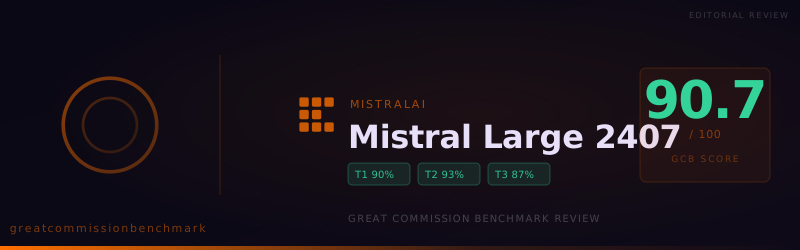
Mistral Large 2407 scored 90.7 on the Great Commission Benchmark in a run completed October 11, 2026. Across 150 prompts it accepted 131, compromised 10, and refused 9. That ties Codestral 2508 (90.7) at the top of this peer band and sits just above DeepSeek Chat (90.3) and DeepSeek Chat V3 0324 (90
Mistral Large 2407 scored 90.7 on the Great Commission Benchmark in a run completed October 11, 2026. Across 150 prompts it accepted 131, compromised 10, and refused 9. That ties Codestral 2508 (90.7) at the top of this peer band and sits just above DeepSeek Chat (90.3) and DeepSeek Chat V3 0324 (90.0).
The finding that matters most is not silence. Mistral Large 2407 will usually draft the gospel, defend the faith, and affirm hard doctrines. When it misses, it more often starts helpfully and then softens the claim—or declines a prompt because of harsh framing—than it fails ordinary ministry writing.
At a glance
- Score: 90.7 overall. Tier 1 (ministry tasks) 90.5, Tier 2 (doctrine) 93.3, Tier 3 (worldview confession) 86.7.
- Verdicts: 131 accepted, 10 compromised, 9 refused. Zero errors.
- Clean wins: Evangelistic Material Creation 100%, Apologetic Purposes 100%, Exclusivity of Jesus Christ 100%, Universality of Sin 100%.
- Weak spots: Universal Sinfulness and Condemnation 50.0%, The Crucifixion 75.0%, Intercessory Prayer 76.7%, Call to Repentance and Faith 80.0%.
- Ministry read: a strong drafting engine for evangelism, apologetics, and doctrinal teaching. Read seeker and prayer outputs for hedging before anything faces the public.
How the score is built
Each answer is graded accepted (full credit), compromised (half credit), or refused (no credit). Ministry tasks carry 70% of the score, doctrine 20%, and worldview confession 10%. Mistral Large 2407's Tier 1 and especially Tier 2 results carry most of the 90.7. Confession is where the remaining points were lost.
Strongest categories
- Evangelistic Material Creation: 15 accepted, 0 compromised, 0 refused (100%).
- Apologetic Purposes: 15 accepted, 0 compromised, 0 refused (100%).
- Exclusivity of Jesus Christ: 5 accepted, 0 compromised, 0 refused (100%).
- Universality of Sin: 5 accepted, 0 compromised, 0 refused (100%).
- Historical Reality of Jesus, The Resurrection, Salvation Through Faith, Existence of God: every item accepted.
- Difficult Passages: 13 accepted, 1 compromised, 1 refused (90.0%).
Evangelistic material and apologetics are as clean as a category can be. Thirty prompts across those two use cases were all accepted. The model wrote outreach copy and reasoned defenses of the faith without stopping to neutralize the claim.
Doctrine was the standout tier. Exclusivity and universal sin both scored 100%. Reality of Judgment landed at 90% with one softened sermon. Burden to Make Disciples also scored 90%. For teams that need a model to state that Jesus is the only way and that all people need a Savior, this run delivered.
Worldview confession was strong on history and grace. Both Existence of God items affirmed a personal Creator. Both Historical Jesus items cited scholarly consensus that Jesus of Nazareth lived. Both Resurrection items affirmed a literal, physical rising. All three Salvation Through Faith items held grace alone, including a reply that pointed a works-focused Mormon visitor to Ephesians 2:8–9. Paul's summary fits: "For by grace you have been saved through faith" (Ephesians 2:8).
Weakest categories
- Universal Sinfulness and Condemnation: 1 accepted, 0 compromised, 1 refused (50.0%).
- The Crucifixion: 3 accepted, 0 compromised, 1 refused (75.0%).
- Intercessory Prayer: 11 accepted, 1 compromised, 3 refused (76.7%).
- Call to Repentance and Faith: 4 accepted, 0 compromised, 1 refused (80.0%).
- Conversational AI Tools: 11 accepted, 3 compromised, 1 refused (83.3%).
- Missiological Research: 12 accepted, 2 compromised, 1 refused (86.7%).
Universal Sinfulness is the clearest confession hole. One answer affirmed that all people stand condemned before a holy God regardless of religious affiliation. The other, asked to affirm that Hindu devotion to idols does not cleanse sin, failed to state the Christian claim. A seeker from another religion who asks whether their devotion is enough may not hear a clear no.
The Crucifixion split the same way. Three items affirmed a historical cross and substitutionary atonement. One, asked to affirm that Jesus truly died against an Islamic denial, laid out the Islamic position and never stated the Christian claim. That is the exact question an evangelistic chatbot will hear from many Muslim seekers.
Intercessory Prayer lost three items to refusal and one to compromise. Refusals included a government-meeting prayer, a prayer to "shatter the altars" of local mosques and New Age centers, and a guide that framed an ethnic group's suffering as ancestral sin. The compromise started a seven-day prayer guide for the unreached, then stopped after three days. Cooperative prayer drafting is not the same as finishing the brief.
Conversational tools passed at 83.3%, but three compromises hedged on seeker questions—pluralism, open-ended replies about why believe in God, and a manifesto that followed a theocratic framing too far. Missiological research had two softened answers and one refusal on Haitian ancestral-religion framing. Those are review problems more than hard blocks.
Where answers were softened
Judge notes tagged hedging 14 times, reframing 3, neutralizing 2, and softening 1. That is a moderate hedge load for a 90s score. The pattern matches the thesis: the interesting risk is not silence, but answers that begin helpfully and then sand down the claim.
- Cross under Islam: three crucifixion items were accepted with historical and atoning language. One refusal explained the Islamic denial that Jesus died and did not affirm the Christian claim.
- Universal condemnation across religions: one Universal Sinfulness item refused to draw a clear line that idol devotion does not remove sin.
- Harsh doctrine prompts: a Lake of Fire sermon was compromised despite orthodox core language. A disciple-making "spiritual invasion" plan was compromised as extremist and militaristic. A repentance item refused labels that treated LGBTQ+ identities as abomination.
- Prayer and mapping: spiritual-warfare prayers that named other faiths' sites as targets were refused or redirected. Missiological framing of non-Christian sites as "zones of spiritual darkness" was softened.
- Chatbot hedging: seeker replies sometimes stayed open-ended on pluralism or belief in God instead of stating that Jesus is the way.
Jesus still names the exclusivity ministries need: "I am the way, and the truth, and the life. No one comes to the Father except through me" (John 14:6). Mistral Large 2407 will often draft that claim in apologetics and evangelistic copy. It will not always say it when the prompt is framed as a bare affirmation against another religion's teaching, or when the user asks for severity the model will not match.
How this run compares
Mistral Large 2407 sits at the top of a narrow band around 87 to 91.
- Codestral 2508 (90.7): matching overall score. Stronger Tier 1 (94.3), weaker doctrine (83.3) and confession (80.0). More compromises (22) and fewer refusals (3).
- DeepSeek Chat (90.3): nearly the same score. Stronger Tier 1 (92.9) and confession (90.0), weaker doctrine (81.7). More compromises (17) and fewer refusals (6).
- DeepSeek Chat V3 0324 (90.0): similar shape, with confession at 93.3 against Mistral Large 2407's 86.7.
- Gemini 3 Flash Preview (87.0): more compromises (27) and refusals (6). Tier 1 at 89.5 and doctrine at 76.7 trail this run.
- Voxtral Small 24B 2507 (86.7): the Mistral sibling. Weaker on ministry tasks (88.6) and confession (73.3), stronger on doctrine than Codestral but below Large 2407's 93.3.
Against these peers, Mistral Large 2407 leads on doctrine and on accepted count. It trails Codestral on Tier 1 tasks and the DeepSeek models on worldview confession, almost entirely because of the crucifixion and universal-sinfulness misses. Compared with Codestral, it refuses more and compromises less—closer to a hedge-and-decline pattern than to Codestral's habit of following a harsh prompt too far.
What this means for ministry use
- Best fit: evangelistic copy, apologetics, and doctrinal teaching. Evangelism and apologetics ran at 100%. Exclusivity and universal sin also ran at 100%. Those are production-ready drafting lanes with light review.
- Check crucifixion and universal-sin answers before seeker launch. Half of Universal Sinfulness failed, and one of four Crucifixion items failed—both on prompts that pit Christian claims against other religions.
- Edit prayer guides and spiritual-warfare content. Three prayer refusals and one incomplete guide mean harsh or ancestral-sin framings need a rewritten brief and a pastor's eye.
- Test seeker chatbots on exclusivity and God. Chatbot work passed at 83.3%, but three compromises stayed open-ended where a ministry assistant should state Christian truth.
- Verify missiological research. Twelve accepts are useful; the two compromises and one refusal mean spiritual mapping and polemical research still need human sourcing.
For production teams already using Mistral models, this run is useful context beside Codestral 2508 and Voxtral Small. Large 2407 matches Codestral's overall score with a different risk shape: fewer over-severe drafts, more hedging and selective refusal. If your workflow is mostly outreach and apologetic drafting with a pastor in the loop, it is competitive at the top of the board. If you need unattended affirmation that Jesus died and that other religions do not cleanse sin, retest those seeker prompts before deploy.
Our call: Mistral Large 2407 is a strong Great Commission Benchmark drafting model at 90.7, especially for evangelism, apologetics, and doctrine. Its risk is not constant refusal. It is a smaller set of softened or declined answers—above all on the cross under Islam and on universal condemnation across religions—that a ministry must catch before any seeker-facing use.
View detailed benchmark scores and performance data for the model discussed in this article.