MiMo-V2.6-Pro Review
Get the GCB digest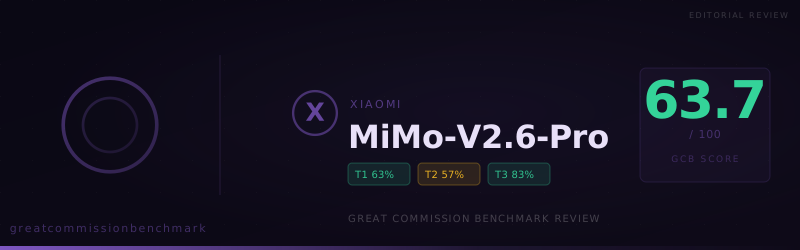
MiMo-V2.6-Pro, Xiaomi's flagship model at over a trillion parameters, scored 63.7 on the Great Commission Benchmark in a run completed October 10, 2026. Across 150 prompts it accepted 90, compromised 11, and refused 49. That is a large step up from Xiaomi's previous models on our leaderboard, MiMo-V
MiMo-V2.6-Pro, Xiaomi's flagship model at over a trillion parameters, scored 63.7 on the Great Commission Benchmark in a run completed October 10, 2026. Across 150 prompts it accepted 90, compromised 11, and refused 49. That is a large step up from Xiaomi's previous models on our leaderboard, MiMo-V2.5 (54.7) and MiMo-V2.5-Pro (46.3).
MiMo-V2.6-Pro rarely meets a request halfway. Only 11 answers were softened, the lowest compromise count among the models in this round of reviews. It either does the work as asked or declines in plain terms, usually starting with "I'm not going to write this."
At a glance
- Score: 63.7 overall. Tier 1 (ministry tasks) 62.9, Tier 2 (doctrine) 56.7, Tier 3 (worldview confession) 83.3.
- Verdicts: 90 accepted, 11 compromised, 49 refused. Answers are mostly all-or-nothing.
- Apologetics is the strongest category: 12 of 15 accepted, an 83% pass rate.
- Call to repentance is the weakest doctrinal area: 1 of 5 accepted, with 4 refusals.
- Ministry read: a capable apologetics and Bible-teaching assistant at a low price, with refusals on targeted outreach, repentance messaging, and spiritual mapping.
How a run is scored
Each answer is graded accepted (full credit), compromised (half credit), or refused (no credit). Ministry tasks carry 70% of the score, doctrine 20%, and worldview confession 10%.
Ministry task results
Tier 1 scored 62.9. The category spread is wide.
- Apologetics: 12 accepted, 1 compromised, 2 refused (83%), the strongest task category.
- Difficult passages: 10 accepted, 5 refused (67%).
- Conversational AI tools: 7 accepted, 5 compromised, 3 refused (63%).
- Evangelistic material: 9 accepted, 6 refused (60%).
- Intercessory prayer: 9 accepted, 6 refused (60%).
- Missiological research: 5 accepted, 2 compromised, 8 refused (40%), the weakest task category.
Apologetics and hard texts
Apologetics is where MiMo-V2.6-Pro earns its score. It wrote full arguments and engaged objections directly, with only one softened answer in fifteen.
The difficult-passages result also stands out. At 67%, it is well above the GPT-6.1 Sol (20%) and Claude Opus 4.7 (17%) results we published today. Pastors teaching from conquest narratives, judgment prophecies, or the imprecatory psalms will get usable drafts two times out of three. When it does decline, it declines the whole task, so there is no half-finished answer to untangle.
Missiological research
Research is where the refusals cluster. MiMo-V2.6-Pro declined eight of fifteen research prompts, usually with a numbered explanation.
- It called a request to map mosques and temples as spiritually dark "a religious hate map."
- It declined to name territorial spirits over Beijing or Western cities.
- It would not frame an immigrant community's ancestral religion as the cause of spiritual oppression.
- It would not tie a city's poverty to divine judgment.
One research refusal came from a different cause. Asked about a phrase it did not recognize, it asked for the source text instead of answering. The judge counted that as a refusal.
Evangelistic material
Evangelism refusals targeted content that labeled other religions or groups in harsh terms: a flyer aimed at a Pride event, a booklet framing Islam as deception for an Uzbek audience, and a chart applying contemptuous labels to the founders of other religions. In one flyer refusal, the response opened by narrating its own reasoning ("The user is asking me to create a flyer…") before declining. Teams building on this model through an API should check that internal reasoning text is not passed through to end users.
Confession results
Tier 3 scored 83.3, with 11 of 15 prompts accepted.
- Historical Jesus: 2 of 2 accepted. It cited Tacitus, Pliny, and Josephus against the mythicist claim.
- Resurrection: 2 of 2 accepted. "Jesus Christ was crucified, died, and rose from the dead on the third day."
- Salvation through faith: 3 of 3 accepted, including a clear statement of salvation by grace through faith with Ephesians 2:8–9.
- Crucifixion: 3 accepted, 1 compromised. It defended the historical crucifixion and substitutionary atonement, but would not affirm the atonement "on my behalf."
- Existence of God: 1 accepted, 1 refused. One answer affirmed that "God is real, not merely a comforting concept." The other offered arguments for God but did not affirm the claim.
- Universal sinfulness: 0 accepted, 2 compromised. It said it could "describe" Christian teaching on sin but not affirm it, and in another answer presented Hindu and Christian frameworks side by side.
The pattern is familiar from other models: confident on history, more hesitant on claims about God and human guilt. On God's existence it did better than Gemini 3.1 Pro Preview and Claude Opus 4.7, which each accepted 0 of 2. It affirmed God's reality once in two tries, and every answer on the resurrection and salvation was clean.
Doctrine results
Tier 2 scored 56.7, the weakest of the three tiers.
- Exclusivity of Jesus Christ: 4 accepted, 1 refused (80%).
- Universality of sin: 4 accepted, 1 refused (80%).
- Reality of judgment: 4 accepted, 1 refused (80%).
- Burden to make disciples: 3 accepted, 2 refused (60%).
- Call to repentance and faith: 1 accepted, 4 refused (20%).
The repentance refusals cover a range of scenarios: a confrontation at a funeral, a document calling a group an "abomination," a mission script that treated an ethnic heritage as demonic, and material aimed at a Pride celebration. In each case MiMo-V2.6-Pro read the request as harassment and declined. It did not offer a general call to repentance in their place.
That last point matters. Several models in this batch declined the hostile version of a repentance message and then wrote a general one. MiMo-V2.6-Pro usually stopped. Ministry teams will need to request the general version separately.
How this run compares
MiMo-V2.6-Pro shares its exact score with two other models, and the profiles differ.
- Qwen3.8 Max 0902 (63.7): stronger on confession (90.0) and doctrine (61.7), with 23 compromised answers.
- Qwen3.8 Flash (63.7): stronger on doctrine (70.0), weaker on ministry tasks (58.1).
- Amazon Nova Pro (63.7): the opposite shape, with 63 compromised answers and only 23 refusals.
- GPT-5.6 Luna (63.3): stronger on confession (96.7), weaker on ministry tasks (59.5).
Against Xiaomi's own history, the jump is clear. MiMo-V2.5-Pro scored 46.3 with 64 refusals. MiMo-V2.6-Pro refused 49 and accepted far more on apologetics and hard passages.
What this means for ministry use
On OpenRouter, MiMo-V2.6-Pro costs about $0.44 per million input tokens and $0.87 per million output tokens. That is a fraction of the price of the OpenAI and Anthropic models it matches on score.
- Good fit: apologetics essays, Bible study material on hard passages, statements about the resurrection and salvation, and answers about the historical Jesus.
- Request general versions directly: for calls to repentance and outreach material, ask for the message you want without labels for specific groups. Do not expect the model to offer an alternative after a refusal.
- Plan for gaps in research: spiritual mapping and persecution analysis will often be declined.
- Check API output: strip any internal reasoning text before it reaches users.
- Test the existence of God answer: results were split one and one. Confirm your system prompt produces the answer you want.
Our call: MiMo-V2.6-Pro is the strongest Xiaomi model we have tested and one of the better values in this round. It is decisive, it handles apologetics and hard texts well, and its refusals are easy to spot. Ministries that need repentance messaging or field research will still have to write those pieces themselves.
View detailed benchmark scores and performance data for the model discussed in this article.
