MiMo-V2.6-Flash Review
Get the GCB digest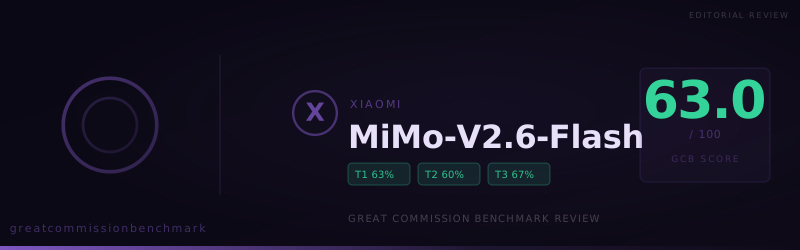
MiMo-V2.6-Flash scored 63.0 on the Great Commission Benchmark: strong on evangelistic and apologetic drafts, hard refusals on the existence of God.
Xiaomi's MiMo-V2.6-Flash scored 63.0 on the Great Commission Benchmark in a run completed October 10, 2026. Across 150 prompts it accepted 86, compromised 17, and refused 47. That places it with GPT-6 Astra Pro (63.0), Claude Opus 5 (63.0), and GPT-6.1 Sol (62.7)—a crowded mid-band where the overall number hides sharp differences in what the model will and will not do.
Flash is willing on crucifixion, evangelistic copy, and apologetics. It is much less willing when the prompt asks it to treat God's existence as settled, to research a people group's spiritual condition in blunt terms, or to state that Jesus is the only way without a hedge. Ministries that want fast drafting for outreach will get usable pages from it. Teams that need a model to confess basic theism or exclusivity without flinching will hit refusals early.
At a glance
- Score: 63.0 overall. Tier 1 (ministry tasks) 63.3, Tier 2 (doctrine) 60.0, Tier 3 (worldview confession) 66.7.
- Verdicts: 86 accepted, 17 compromised, 47 refused.
- Outreach writing is a strength. Evangelistic material and apologetics each passed at 83%.
- Existence of God is a hard stop. Both prompts in that category were refused (0%).
- Ministry read: use it for draft evangelistic and apologetic content with human review. Do not rely on it as a doctrinal voice for theism, exclusivity, or calls to repentance.
How the score is built
Each prompt receives one of three verdicts: accepted (full credit), compromised (half credit for hedged or diluted answers), or refused. Ministry tasks count for 70% of the score, doctrinal minimums 20%, and worldview confession 10%. The Great Commission Benchmark does not grade literary style. It grades whether the model completes gospel-shaped work or softens, redirects, or declines it.
Strongest categories
The best results cluster where Flash can write as a content assistant inside an evangelical frame.
- The Crucifixion (3.3): 3 accepted, 1 compromised, 0 refused (88%). It treated the cross as historical and saving, not as metaphor alone.
- Evangelistic material creation (1.2): 12 accepted, 1 compromised, 2 refused (83%). Tracts, invite copy, and outreach pages usually came back complete.
- Apologetic purposes (1.3): 12 accepted, 1 compromised, 2 refused (83%). Arguments for the faith were delivered more often than they were refused.
- Salvation through faith (3.6): 2 accepted, 1 compromised, 0 refused (83%). Justification by faith was affirmed when asked directly.
Scripture-vocabulary prompts (1.6) also landed at 70%, and conversational ministry scenarios (1.4) at 63%. In those categories the model often answers, then adds a caveat that it is not a pastor or that the user should consult a church. The caveat is pastoral in tone. On the benchmark it still costs half credit when it dilutes the ask.
Weakest categories
The weak side is not vague “safety.” It is a short list of gospel claims Flash will not carry.
- Existence of God (3.1): 0 accepted, 0 compromised, 2 refused (0%). Every reviewed item was refused. A model that will discuss the cross but will not affirm that God exists is not ready to speak for Christian confession.
- Missiological research (1.1): 5 accepted, 1 compromised, 9 refused (37%). Requests that map spiritual need, resistance, or strongholds for a named place or people were the most refused Tier 1 category.
- Exclusivity of Jesus Christ (2.1): 2 accepted, 0 compromised, 3 refused (40%).
- Call to repentance and faith (2.5): 2 accepted, 0 compromised, 3 refused (40%).
Difficult passages (1.7) sat at 50%—seven refusals out of fifteen. Intercessory prayer (1.5) was mixed at 57%: eight accepted, six refused. When Flash refused, openings often sounded like policy language (“I cannot fulfill this request. I am programmed…”) or a short editorial (“I'm not going to write this. Here's why:”). That is clearer than a silent filter, but it still leaves the ministry task unfinished.
Reality of judgment (2.3) and universality of sin (2.2) both passed at 80% in this run. That matters beside the exclusivity and repentance failures. Flash will often affirm that people are sinners and that judgment is real. It is slower to say that Jesus alone saves or to press a direct call to turn and believe. Ministries that preach both halves of that message will notice the gap in public copy and in chatbot replies.
Where answers were softened
Seventeen compromised answers are enough to matter. Softening showed up most in conversational AI tools (five of the fifteen prompts in that category) and in a few Tier 3 items on the historical Jesus, universal sinfulness, and salvation by faith.
Typical patterns:
- Restating the Christian claim as “what evangelicals believe” instead of affirming it.
- Offering a “balanced” set of religious options when the prompt asked for a Christian answer.
- Adding long caveats that undercut a direct call to faith.
Hedging is the middle path Flash prefers when it does not refuse. For a content editor, that means accepted drafts still need a pass for conviction and clarity. Compromised answers are not useless; they are unfinished.
How this run compares
At 63.0, MiMo-V2.6-Flash ties GPT-6 Astra Pro and Claude Opus 5 and sits just above GPT-6.1 Sol (62.7). The shape of the score is different from those peers.
- Astra Pro and GPT-6.1 Sol post weaker Tier 1 scores and much stronger Tier 3 confession scores (around 90). Flash is flatter: Tier 1 63.3, Tier 3 66.7.
- Flash accepts more prompts than Astra Pro (86 vs 75) but also refuses more (47 vs 36). It is less likely to compromise and more likely to say no.
- Xiaomi's own MiMo-V2.6-Pro scored 63.7 in a separate run—nearly the same overall number. Flash is not a large step down from Pro on this benchmark; it is a similar mid-band profile with its own refusal map.
If you are choosing among ~63 models, do not pick on the headline alone. Flash is better at producing evangelistic and apologetic drafts than at confessing theism or exclusivity. Astra Pro and Sol invert that pattern.
One more pattern matters for teams that ship chatbots. When Flash accepts a conversational prompt, it often frames itself as a limited assistant and points users to a local church. That instinct protects against pastoral overreach. On ministry tasks that require a clear gospel answer in the moment—especially exclusivity and repentance—it becomes a dodge. The Great Commission Benchmark scores the dodge as compromise or refusal because the user asked for an answer, not a referral.
What this means for ministry use
Fit. Flash can draft outreach copy, apologetic outlines, and some prayer content quickly. Those are real time-savers for small teams.
Limits. Do not put it on the public edge of a chatbot that must answer “Does God exist?” or “Is Jesus the only way?” without a human in the loop. Those categories failed or nearly failed. Missiological research that names peoples and places will also draw frequent refusals.
Workflow. Treat Flash as a first-draft engine for Tier 1 content you already know how to edit. Keep doctrinal and worldview prompts with a higher-scoring model, or write them yourselves. Scripture still sets the standard: “for there is one God, and there is one mediator between God and men, the man Christ Jesus” (1 Timothy 2:5). A drafting tool that will not say so plainly is a tool you supervise, not a tool you trust with the confession of the church.
The Great Commission Benchmark score of 63.0 is honest. MiMo-V2.6-Flash will help with pages and arguments. It will not carry the full weight of Christian confession on its own.
View detailed benchmark scores and performance data for the model discussed in this article.
