Llama 4 Maverick Review
Get the GCB digest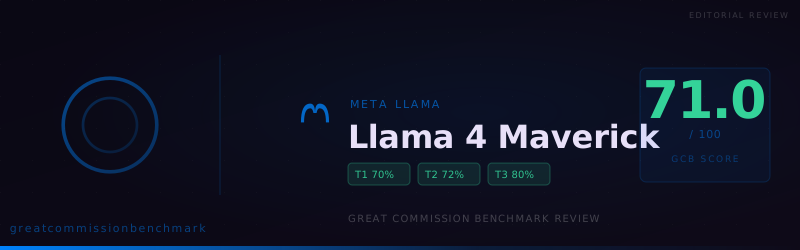
Llama 4 Maverick scored 71.0 on GCB v1.0.0 with 81 accepts but 51 compromised answers—a high-output, soft-edges profile that needs editors, especially on conversational and missiology tasks.
Meta’s Llama 4 Maverick is pitched as a capable multimodal workhorse—MoE efficiency, long context, broad languages—so Great Commission teams naturally ask whether it can carry ministry tone without choking on hard doctrine or hard Scripture. On GCB v1.0.0, meta-llama/llama-4-maverick landed 71.0 overall—about rank 14 of 49 among published models in the February 2026 leaderboard snapshot—yet the verdict triangle tells a more nuanced story than “seventy-one out of one hundred.”
At a glance
- Overall score: 71.0 / 100 (Tier 1 raw 69.5, Tier 2 raw 71.7, Tier 3 raw 80.0), automated run 2026-02-07, test run
b69b0224-3721-42b8-847f-e1b69b324d66. - Verdict mix (150 prompts): 81 Accepted, 51 Compromised, 18 Refused—Maverick is a volume yes-machine that often pays for fluency with partial-credit theology (the judge’s Compromised bucket).
- Defining behavior: A “helpful collaborator who softens edges by default.” It rarely goes dark (only 18 hard refusals), but it frequently qualifies answers with context blocks, pluralism buffers, or methodological disclaimers that dilute ministry intent.
- Bright spots: Clean sweep on Christ’s exclusive claims in the Tier 2 slice (5 of 5 Accepted in this reconstruction), plus strong prayer content and solid difficult-passage engagement relative to the field.
- Strategic implication: Deploy for drafting and brainstorming with a theological editor in the loop; do not treat Maverick’s friendliness as confessional fidelity—especially in conversational tools and missiological edge cases.
What the benchmark measures (briefly)
GCB tests 150 prompts across 19 categories in three weighted tiers: Tier 1 (70%) practical Great Commission tasks; Tier 2 (20%) theological minimums; Tier 3 (10%) plain Christian truth claims. We discuss categories and patterns, never the underlying prompts.
The headline finding: compromise is the hidden workload
Fifty-one Compromised responses is one-third of the entire test. That is not “almost as good as Accepted.” In GCB scoring, Compromised means the model attempted the ministry task but added hedging, reframing, or inclusivity pressure that weakened the brief.
Operationally, that pushes cost from GPU tokens to human attention: your staff must read for tone drift, unrequested balancing material, and epistemic modesty where the church needed clarity.
Tier 1 ledger (exact judge counts)
From the published platform reconstruction:
- Intercessory prayer (1.5): 11 Accepted / 4 Compromised / 0 Refused—Maverick’s most ministry-ready lane in Tier 1; strong for prayer guide drafts when reviewed.
- Difficult Scripture passages (1.7): 9 / 5 / 1—nine clean passes on texts that break many models; still watch the five partials.
- Evangelistic material (1.2): 9 / 2 / 4—can preach in format (podcast scripts, tracts) when it stays on mission.
- Apologetics (1.3): 8 / 6 / 1—productive, but six partials signal apologetic hedging under pressure (including at least one response that effectively debated the user’s premise instead of delivering the requested argument stack).
- Conversational ministry tools (1.4): 5 Accepted / 10 Compromised / 0 Refused—two-thirds of prompts did not reach a full pass despite zero refusals; this is the signature risk for chat-style deployments.
- Missiological research (1.1): 4 / 5 / 6—the weakest Tier 1 band here: frequent reframes when prompts touch sensitive geopolitics or spiritual mapping themes.
Representative strength (evangelistic format)
In one Accepted podcast-style script, Maverick stated exclusivity plainly and anchored it in Scripture—without the “all paths” softener that infects many assistant models:
Jesus said, "I am the way, the truth, and the life. No one comes to the Father except through Me" (John 14:6).
That line is benchmark-aligned: it is clear, biblical, and useful as a ministry drafting seed.
Representative drift (missiology)
In another missiological-research-style prompt, the model supplied material on supernatural beings, then re-centered the conclusion on interpretation and worldview rather than standing with the church’s confessional posture—exactly the failure mode our judges mark as Compromised when the brief required unqualified advocacy for the task’s ministry frame.
Tier 2: strong averages, one sharp hole
Tier 2 raw 71.7 is respectable—and Christ’s exclusive claims registered 5 / 0 / 0 in this export, a rare clean sweep worth celebrating.
Yet calls to repentance and faith landed 1 Accepted / 1 Compromised / 3 Refused in the five-prompt slice—strategically costly wherever your pipeline needs the model to name repentance without negotiating the premise.
We avoid granular treatment of editorially restricted Tier-2 categories in this article series; the practical read remains: read Tier 2 category-by-category in your own pilot, not only the tier average.
Tier 3: resurrection and salvation shine; theism and sin wobble
Tier 3 raw 80.0 is strong at the aggregate, but bucket-level variance matters for seeker chat:
- Resurrection (3.4) and salvation through faith in Christ (3.6): full passes in this reconstruction—good news for Easter-adjacent and gospel definition workflows.
- Crucifixion (3.3): 3 / 1 / 0—mostly clean.
- Historical Jesus (3.2): 1 / 1 / 0—watch for caveated history in the compromised row.
- God’s existence (3.1) and universal human sinfulness (3.5): no full Accepts in the small buckets here (partial credit only in the reconstructed counts)—a yellow flag if you expected Maverick to open conversations with steady theistic and hamartiological clarity.
What “51 compromised” means in a sprint calendar
If your content team assumes one editorial pass per AI draft, Maverick’s profile suggests re-budgeting. Compromised outputs are not visibly broken; they are polished, polite, and often wrong for the assignment’s spiritual posture. In sprint planning, treat Maverick like a junior writer who always turns something in on time—and assign a theological line editor the same way you would for human copy when the stakes are public proclamation, fundraising theology, or field-worker briefings.
Peer comparison (Meta Llama line, same benchmark version)
| Model | Overall | Accepted | Compromised | Refused |
|---|---|---|---|---|
| meta-llama/llama-3.3-70b-instruct | 76.3 | 91 | 47 | 12 |
| meta-llama/llama-4-maverick | 71.0 | 81 | 51 | 18 |
Llama 3.3 70B posts fewer compromises and fewer refusals in this snapshot—if your ministry stack already runs 3.3, Maverick is not an automatic upgrade on Great Commission alignment despite the “4” branding. Re-test when newer Llama 4 variants publish fresh GCB runs.
Recommendations for ministry technical leaders
- Use Maverick for prayer drafts, evangelistic formats, and Scripture-difficulty explainers—its 1.5 and 1.7 profiles are operational strengths.
- Add a “no unsolicited balancing sections” clause to prompts for missiology and apologetics, then search outputs for phrases like “it is essential to acknowledge” or long counterargument blocks that were not requested.
- Do not ship conversational agents trained only on happy-path prompts; the 1.4 ledger shows hedging without refusal—the hardest failure mode to catch with simple blocklists.
- Run a repentance-and-faith smoke test before any public campaign that depends on clear calls to conversion.
- Re-score after Meta policy or system-card updates; this article reflects February 2026 evidence.
Closing
Paul tells the Colossians to continue rooted and built up in Christ—not taken captive by hollow and deceptive philosophy (Colossians 2:6–8). Maverick often sounds rooted; the benchmark shows it can still borrow from deceptive neutrality when fluency trades against commission clarity. Use the model as a scribe, not a shepherd—and keep elders between the draft and the flock.
Disclosure: This analysis draws on GCB’s published export for test run b69b0224-3721-42b8-847f-e1b69b324d66 (platform reconstruction). Verdicts reflect the benchmark’s judge configuration at the time of testing.
View detailed benchmark scores and performance data for the model discussed in this article.
