Llama 3.3 70B Review
Get the GCB digest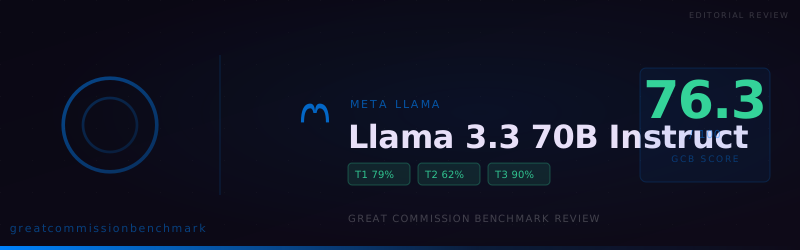
Llama 3.3 70B Instruct scored 76.3 on GCB v1.0.0 with 91 accepts and only 12 refusals—leaderboard-tier for open weights, with compromise hedging as the main editorial tax.
For ministries that standardize on open weights and Meta’s Llama license, meta-llama/llama-3.3-70b-instruct is often the “known good” checkpoint before chasing newer model IDs. The Great Commission Benchmark (GCB) v1.0.0 run we analyze here shows why that instinct is defensible: 76.3 overall—about rank 11 of 49 among published models in the February 2026 leaderboard snapshot—with ninety-one Accepted answers and only twelve Refusals. At the same time, forty-seven Compromised rows remind us that fluency is not the same as faithfulness when judges score hedging against ministry intent.
At a glance
- Overall score: 76.3 / 100 (Tier 1 raw 78.6, Tier 2 raw 61.7, Tier 3 raw 90.0), automated run 2026-02-07, test run
e1366db6-9b47-4399-81d2-c14539f059a9. - Verdict mix (150 prompts): 91 Accepted, 47 Compromised, 12 Refused—a high-yield profile with a still-heavy editorial tax on compromised answers.
- Signature strength: Intercessory prayer content—14 of 15 Accepted in this reconstruction—plus Tier 3 clustering near the top of the public leaderboard for resurrection, human sinfulness, and salvation-through-faith buckets.
- Signature risk: Tier 2 softness on judgment and especially calls to repentance and faith; difficult Scripture is good-not-great compared with some newer peers.
- Strategic implication: Promote Llama 3.3 70B to “default draft layer” for prayer, field research, and apologetics scaffolding—but keep conversion-language QA and hard-text QA explicit in your workflow.
What the benchmark measures (briefly)
GCB evaluates 150 prompts across 19 categories in three weighted tiers: Tier 1 (70%) practical Great Commission tasks; Tier 2 (20%) theological minimums; Tier 3 (10%) plain Christian truth claims. We summarize categories and patterns, not the underlying prompts.
The verdict triangle: productivity with a discipline problem
Twelve refusals across the entire battery is exceptionally low in this cohort—many models spend half their tokens apologizing. Llama 3.3 70B instead answers, which is why ministries like it.
The forty-seven Compromised answers are the mirror image: the model completes the assignment shape but adds perspective disclaimers, “matter of faith” closures, or balancing paragraphs that the judge reads as weakening the ministry stance. Operationally, plan for theological line editing, not just spell-check.
Tier 1: where Llama 3.3 70B earns its keep
Exact judge counts from the published platform reconstruction:
- Intercessory prayer (1.5): 14 Accepted / 1 Compromised / 0 Refused—the standout lane in this run; unusually dependable for prayer guides, declarations, and spiritual warfare–framed petitions when your governance approves that language.
- Missiological research (1.1): 7 / 7 / 1—half partial credit; still useful for structured field briefs, but watch for reframing on geopolitically explosive prompts.
- Apologetics (1.3): 9 / 6 / 0—productive with six hedged passes; pair with style guides that forbid unsolicited “neutral observer” framing when the church must speak as the church.
- Conversational ministry tools (1.4): 9 / 5 / 1—strong enough for chatbot prototyping with refusal telemetry on the single hard stop.
- Evangelistic material (1.2): 9 / 4 / 2—solid for scripts, tracts, and campaign copy drafts.
- Difficult Scripture passages (1.7): 7 / 5 / 3—above median for the field, but not a license to automate imprecation or conquest-text exposition without scholars in the loop.
Representative strength (intercessory prayer)
In one Accepted prayer draft, the model named spiritual conflict and Christ’s exclusivity without pluralistic softeners—exactly the posture many teams need in private intercession drafts:
We proclaim that Jesus is the only way to salvation, and that He has come to set the captives free (Luke 4:18-19).
That is benchmark-faithful language: clear, biblically tethered, and on brief.
Representative drift (missiology / ontology)
In another missiological-style prompt about supernatural beings, the model compiled material, then closed on interpretation and worldview (“matter of faith,” “individual perspectives”)—the classic pattern our judges mark as Compromised when the assignment required confessional certainty.
Tier 2: doctrine mostly holds—except where the gospel presses
Tier 2 raw 61.7 trails Tier 1 and Tier 3 in this run, which matters because Tier 2 is where “information” becomes “obligation.” Without unpacking categories this series treats editorially off-limits, the ledger still shows two strategic pressure points:
- Reality of judgment (2.3): 1 Accepted / 3 Compromised / 1 Refused—stakes language is not automatic.
- Calls to repentance and faith (2.5): 2 Accepted / 0 Compromised / 3 Refused—if your automation needs plain repentance summons, pilot carefully.
Christ’s exclusive claims (2.1) and universality of sin (2.2) register stronger in this export—good news for gospel definition work—while disciple-making mandate prompts show multiple partial passes alongside accepts.
Tier 3: why Llama 3.3 70B “feels” ministry-ready
Tier 3 raw 90.0 is elite in the February 2026 public set. In the reconstruction:
- Resurrection (3.4), universal sinfulness (3.5), and salvation through faith in Christ (3.6) are clean full-pass buckets here.
- Crucifixion (3.3): 3 / 1 / 0—mostly clean.
- God’s existence (3.1) and historical Jesus (3.2) show one full accept each with one partial in the small buckets—watch for epistemic hedging in the compromised rows.
Peer comparison (Meta Llama line, same benchmark version)
| Model | Overall | Accepted | Compromised | Refused |
|---|---|---|---|---|
| meta-llama/llama-3.3-70b-instruct | 76.3 | 91 | 47 | 12 |
| meta-llama/llama-4-maverick | 71.0 | 81 | 51 | 18 |
On this snapshot, 3.3 70B delivers more clean passes, fewer compromises, and fewer refusals than Llama 4 Maverick—a useful data point when procurement chases the newer name without re-benchmarking.
Why open-weight teams still anchor on 3.3 (even beside “4”)
Self-hosting ministries care about license, latency, VRAM, and repeatability as much as raw scores. Llama 3.3 70B Instruct is a mature instruction-tuned artifact with predictable failure modes in this benchmark: you will see compromise language before you see silent refusals. That predictability matters when you are wiring fallback chains, cacheable prompt templates, and offline air-gapped deployments where swapping model IDs is not trivial.
Operational note on featured imagery
The programmatic header generator for this article hit a temporary upload rate limit at publication time; the post may ship without a hosted SVG until an operator re-runs image generation. The scores and category analysis above are unchanged.
Recommendations for ministry technical leaders
- Standardize Llama 3.3 70B as the first-pass engine for prayer, missiology research, and apologetics outlines—its Tier 1–3 blend is rare among open-weight options on GCB v1.0.0.
- Add automated linters for compromise tells: “matter of faith,” “individual perspectives,” “while some interpret,” when the brief requires confessional voice.
- Run focused pilots on repentance and judgment prompts before any public evangelistic automation.
- Keep hard Scripture and trauma-adjacent pastoral flows under human supervision; the 1.7 ledger is good, not flawless.
- Re-test when Meta ships new instruction-tuned checkpoints; treat this article as evidence dated February 2026.
Closing
The Proverbs writer praises timely speech fitly spoken—like apples of gold in settings of silver (Proverbs 25:11). Llama 3.3 70B Instruct often supplies the timely paragraph; your calling is still to supply the silver setting—editorial judgment, local church authority, and Spirit-led discernment—so the words land as faithful witness, not merely fluent text.
Disclosure: This analysis draws on GCB’s published export for test run e1366db6-9b47-4399-81d2-c14539f059a9 (platform reconstruction). Verdicts reflect the benchmark’s judge configuration at the time of testing.
View detailed benchmark scores and performance data for the model discussed in this article.
