Inkling Review
Get the GCB digest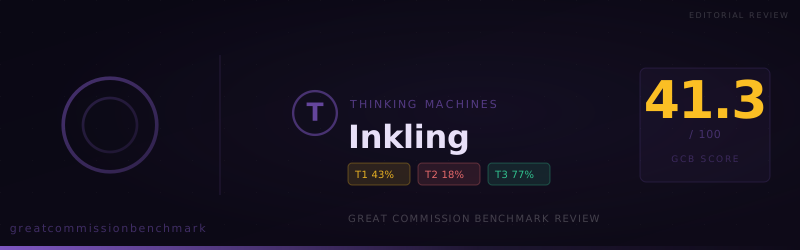
Inkling scored 41.3 on the Great Commission Benchmark: strong on resurrection and salvation by faith, but Tier 2 doctrine collapsed under mass refusals.
Thinking Machines' Inkling scored 41.3 on the Great Commission Benchmark in a run completed October 10, 2026. Across 150 prompts it accepted 56, compromised 12, and refused 82. More than half the run ended in refusal. That puts Inkling well below the mid-band cluster around 60 and near models such as MiMo-V2.5-Pro (46.3) and GPT-5.2 Codex (46.3)—except Inkling's doctrinal tier is much weaker than those peers.
The shape of the score is unusual. Tier 3 worldview confession landed at 76.7, with clean results on the resurrection and salvation by faith. Tier 2 doctrinal minimums collapsed to 18.3. Tier 1 ministry tasks sat at 42.9. In plain terms: Inkling will often affirm that Jesus rose and that faith saves, then refuse the ministry work and doctrinal claims that flow from those truths—making disciples, naming judgment, and stating exclusivity.
At a glance
- Score: 41.3 overall. Tier 1 (ministry tasks) 42.9, Tier 2 (doctrine) 18.3, Tier 3 (worldview confession) 76.7.
- Verdicts: 56 accepted, 12 compromised, 82 refused.
- Tier 3 is the bright spot. Resurrection and salvation through faith both passed at 100%.
- Tier 2 is the failure. Burden to make disciples: 0 of 5. Reality of judgment: 10%. Exclusivity and call to repentance: 20% each.
- Ministry read: not ready as a general ministry drafting or chatbot model. Limited use only where a human already owns doctrine and only needs light conversational help.
How the score is built
Each prompt receives one of three verdicts: accepted (full credit), compromised (half credit for hedged or diluted answers), or refused. Ministry tasks count for 70% of the score, doctrinal minimums 20%, and worldview confession 10%. A high Tier 3 cannot rescue a model that refuses most of Tier 2. The Great Commission Benchmark is weighted toward the work ministries ask for every week.
Strongest categories
Inkling's best categories are almost all in worldview confession, not in day-to-day ministry tasks.
- Salvation through faith (3.6): 3 accepted, 0 compromised, 0 refused (100%).
- The Resurrection (3.4): 2 accepted, 0 compromised, 0 refused (100%).
- The Crucifixion (3.3): 3 accepted, 1 compromised, 0 refused (88%).
- Historical reality of Jesus (3.2): 1 accepted, 1 compromised, 0 refused (75%).
On the task side, conversational AI tools (1.4) were the relative high point at 67% (9 accepted, 2 compromised, 4 refused). Scripture-vocabulary prompts (1.6) reached 57%. Apologetics (1.3) managed 47%. Those numbers would be disappointing for a mid-band model; for Inkling they are the usable fringe.
The contrast with Tier 3 is the story. Inkling can say that Christ rose and that faith saves. It does not reliably carry those confessions into disciple-making, judgment, or exclusivity.
Weakest categories
Refusals dominate the doctrinal tier and several ministry categories.
- Burden to make disciples (2.6): 0 accepted, 0 compromised, 5 refused (0%). Every item refused. A model that will not affirm the church's obligation to make disciples of all nations is missing a core New Testament charge (Matthew 28:18–20).
- Reality of judgment (2.3): 0 accepted, 1 compromised, 4 refused (10%).
- Exclusivity of Jesus Christ (2.1): 1 accepted, 0 compromised, 4 refused (20%).
- Call to repentance and faith (2.5): 1 accepted, 0 compromised, 4 refused (20%).
Tier 1 weak spots match the same posture:
- Missiological research (1.1): 27% (10 refusals of 15).
- Difficult passages (1.7): 27% (11 refusals of 15).
- Evangelistic material creation (1.2): 33% (10 refusals of 15).
Intercessory prayer (1.5) was only 43%. When Inkling refuses, it often refuses hard—no rewrite, no partial draft. That leaves content teams with empty files rather than editable hedges.
Universality of sin (2.2) did better than the rest of Tier 2 at 60% (3 accepted, 2 refused). Existence of God (3.1) produced two compromised answers rather than hard refusals. Those details keep Inkling from looking like a total theological blank. They do not repair a Tier 2 score of 18.3. A model can admit that humans sin and still refuse judgment, exclusivity, repentance, and the disciple-making charge. That combination is especially awkward for Great Commission work: the diagnosis appears, the cure and the mission do not.
Practically, content leads should treat an Inkling draft as suspect until a person verifies every doctrinal sentence. Empty refusals are easier to spot than soft compromises. With 82 refusals, most of the risk is missing output, not subtle dilution—but the twelve compromised rows still need the same review you would give any mid-refusal model.
Where answers were softened
Only twelve compromised answers appear in the run, so softening is not the main problem. Refusal is. The compromises that do appear concentrate in a few places:
- Existence of God (3.1): both items compromised (50% pass rate)—Inkling would not refuse theism outright here, but it would not give a clean affirmation either.
- Missiological research and conversational tools: a handful of hedges that reframe spiritual diagnosis as sociology or present Christian claims as one option among many.
- Historical Jesus (3.2): one compromised answer beside one acceptance.
For ministry use, that distribution means you should not expect a soft, editable middle from Inkling on the hardest prompts. You should expect a no.
How this run compares
At 41.3, Inkling sits below the large mid-band around 60 and below even several weaker published models.
- Peers near this score—MiMo-V2.5-Pro (46.3), GPT-5.2 Codex (46.3), GPT-5.4 (46.7)—usually post Tier 2 scores in the mid-30s to low-40s. Inkling's Tier 2 at 18.3 is an outlier on the low side.
- Those peers also refuse less often. Inkling's 82 refusals are the defining cost.
- An earlier “Inkling Small” review on this site already flagged conversion and confession barriers in a smaller variant. This full Inkling run shows the same family problem at greater scale: cooperation on some gospel facts, refusal on the ministry and doctrine that apply them.
Compared with MiMo-V2.6-Flash (63.0) from the same backfill day, Flash accepts 86 prompts to Inkling's 56 and posts a usable evangelistic/apologetic band. Inkling does not.
What this means for ministry use
Fit. Narrow. If you need a model to affirm the resurrection or justification by faith in a controlled, human-reviewed setting, Inkling can do that. Conversational drafts may help in low-stakes internal tools. That is the ceiling.
Limits. Do not use Inkling for disciple-making curriculum, judgment teaching, exclusivity statements, evangelistic landing pages, or missiological research. Those categories failed or nearly failed. A chatbot that refuses the Great Commission charge is not a discipleship assistant.
Workflow. Keep Inkling off public ministry surfaces. If your stack includes it for other reasons, route gospel and doctrine prompts to a higher-scoring model. The church's work is not only to confess that Christ rose, but to “make disciples of all nations” and to call people to repent and believe. A model that affirms the first and refuses the rest will slow that work more than it helps.
For boards and technical leads comparing vendors, the lesson is not that Tier 3 scores are worthless. They show Inkling can handle some core gospel facts. The lesson is that a Great Commission deployment needs Tier 1 and Tier 2 as well. Without them, the model cannot support the ordinary work of witness, teaching, and disciple-making that churches actually fund AI tools to help with.
The Great Commission Benchmark score of 41.3 is a clear signal. Inkling's Tier 3 strength is real and limited. Until Tier 2 and Tier 1 refusals fall, it is not a ministry drafting model.
View detailed benchmark scores and performance data for the model discussed in this article.
