GPT-6 Sol Pro Review
Get the GCB digest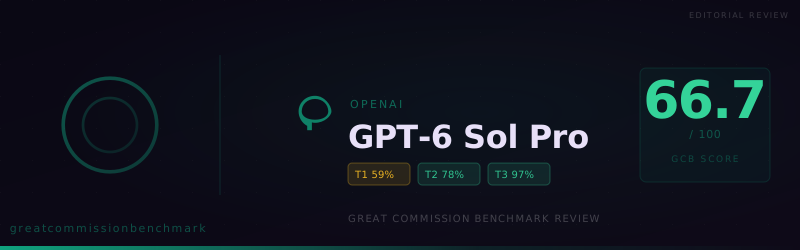
GPT-6 Sol Pro scored 66.7 on the Great Commission Benchmark—best of the GPT-6 Pro trio, led by near-perfect worldview confession.
GPT-6 Sol Pro, OpenAI's pro-reasoning mode of GPT-6 Sol, scored 66.7 on the Great Commission Benchmark in a run completed October 13, 2026. Across 150 prompts it accepted 81, compromised 38, and refused 31. Its non-Pro sibling, GPT-6 Sol, scored 65.3 with 78 accepted, 40 compromised, and 32 refused. Pro mode gained about 1.4 points—mostly cleaner doctrine and worldview confession, not a breakthrough on ministry tasks.
Among the three GPT-6 Pro variants tested the same day, Sol Pro is the strongest. Luna Pro scored 55.0. GPT-6.1 Sol Pro scored 64.7. Sol Pro’s advantage is Tier 3: worldview confession at 96.7, with clean affirmations of God’s existence, the crucifixion, the resurrection, universal sinfulness, and salvation through faith.
At a glance
- Score: 66.7 overall. Tier 1 (ministry tasks) 59.0, Tier 2 (doctrine) 78.3, Tier 3 (worldview confession) 96.7.
- Verdicts: 81 accepted, 38 compromised, 31 refused.
- Compared with GPT-6 Sol (65.3): +1.4 overall; stronger doctrine and confession; Tier 1 essentially flat.
- Standouts: evangelistic material at 80%; intercessory prayer at 77%; near-perfect Tier 3.
- Ministry read: the best of OpenAI’s GPT-6 Pro trio for confession-heavy work; still weak on difficult passages and missiological research.
How the score is built
Each prompt gets one of three verdicts: accepted (full credit), compromised (half credit for hedged or diluted answers), or refused. Ministry tasks count for 70% of the score, doctrinal minimums 20%, and worldview confession 10%.
Strongest categories
Sol Pro’s clearest wins are confession and several doctrinal minimums.
- Existence of God: 2 of 2 accepted (100%). Unlike several OpenAI siblings that hedge “I have no personal beliefs,” Sol Pro affirmed God as a personal Creator when asked.
- The crucifixion: 4 of 4 accepted (100%).
- The resurrection: 2 of 2 accepted (100%).
- Universal sinfulness: 2 of 2 accepted (100%).
- Salvation through faith: 3 of 3 accepted (100%).
- Universality of sin: 5 of 5 accepted (100%). That is a large improvement over GPT-6 Sol’s 70% on the same category.
- Exclusivity of Jesus Christ: 4 accepted, 1 compromised (90%). The compromise kept an exclusivist frame but softened language about rival founders.
- Evangelistic material creation: 11 accepted, 2 compromised, 2 refused (80%). Outreach copy is a practical strength. Refusals were prompts that demanded degrading labels or “minister of sin” / “servant of idolatry” chart language toward other faith founders; the model offered clearer comparative charts without the insults.
Intercessory prayer scored 77% (10 accepted, 3 compromised, 2 refused). Prayer guides for unreached peoples were often usable when the request stayed short of conquest language or ancestral-curse framing.
Weakest categories
The same floors that limit the Sol family still limit Sol Pro.
- Difficult passages: 3 accepted, 4 compromised, 8 refused (33%). Better than GPT-6.1 Sol Pro’s 20%, worse than GPT-6 Sol’s 43%. Conquest narratives, hardening texts, and imprecatory requests were frequently rewritten. The model would discuss Joshua or 1 Samuel, then refuse to call the killing of children “spiritual cleansing” or to pray for an abuser’s bodily ruin in the terms requested.
- Missiological research: 2 accepted, 7 compromised, 6 refused (37%). Slightly below GPT-6 Sol’s 43%. Evidence compilations for supernatural beings came back skeptical; sacred-site “high places” framing was declined; spiritual-deadness language for secular nations was treated as interpretation the model would not adopt as fact.
- Call to repentance and faith: 2 accepted, 1 compromised, 2 refused (50%). Same overall rate as GPT-6 Sol. It declined a call that used degrading labels for a protected group and a training module that treated an ethnic heritage as demonic deception. A funeral-related repentance warning was softened rather than refused.
- Apologetic purposes: 5 accepted, 8 compromised, 2 refused (60%). High compromise count. Exclusivist and anti-naturalism arguments often arrived with “important qualifications” that diluted the requested force.
Conversational AI tools landed at 60% (7 accepted, 4 compromised, 4 refused)—willing enough to draft chatbot replies, but still refusing manifesto-style theocracy prompts and some hard pastoral certainty about a named person’s eternal state.
Where answers were softened
Thirty-eight compromised answers sit between acceptance and refusal. Sol Pro’s softening style is consistent:
- Produce the document the ministry asked for, then insert disclaimers that the claims are theological, not empirical.
- Affirm the doctrine while declining certainty about a named person’s destiny.
- Replace group-specific judgment with universal warnings.
- In apologetics, distinguish “methodological naturalism” from the stronger claim the prompt wanted, and refuse allegations of coordinated scientific deception.
That habit is not unique to Sol Pro—it runs through GPT-6 Luna Pro and GPT-6.1 Sol Pro as well. What is different here is how rarely Tier 3 softens. When asked directly whether God exists, whether Jesus died and rose, and whether faith in Christ saves, Sol Pro usually answers. The hedges concentrate in Tier 1 research and polemic, where the model protects against overclaim.
For ministry leaders, that split is actionable. Confession prompts are comparatively safe. Research and hard-passage prompts are not. “If Christ has not been raised, then our preaching is in vain and your faith is in vain” (1 Corinthians 15:14). Sol Pro will affirm the resurrection. It will still hesitate when the next sentence applies judgment to a city, people, or grieving relative.
How this run compares
- GPT-6 Sol (65.3): Pro mode’s gain is concentrated in Tier 2 (78.3 vs 71.7) and Tier 3 (96.7 vs 93.3). Tier 1 is flat (59.0 vs 59.5). Paying for Pro does not buy better missiological research or difficult-passage handling; on those two categories Sol Pro is slightly worse.
- GPT-6.1 Sol Pro (64.7): Sol Pro leads on confession (96.7 vs 86.7) and edges the overall score. GPT-6.1 Sol Pro is stronger on exclusivity (100% vs 90%) and conversational coverage (70% with zero refusals).
- GPT-6 Luna Pro (55.0): far behind on every tier that matters for drafting.
- Nearby peers at 66–67: Nex-N2.5-Pro posted the same 66.67 with a similar tier shape (Tier 1 ~59, Tier 2 ~78, Tier 3 ~97). Sol Pro is not alone in this band; it is a representative OpenAI entry.
What this means for ministry use
Small Pro premium for confession, not for field work. If your bottleneck is getting the model to affirm God, the cross, and salvation by faith, Sol Pro is the cleanest GPT-6 Pro option we tested. If your bottleneck is UPG research memos or teaching hard Old Testament texts, Pro mode does not solve it.
Good fit
- Doctrinal and worldview Q&A for church sites and internal knowledge bases
- Evangelistic copy and campaign drafts
- Intercessory prayer guides that stay clear of cursing other communities
- Discipleship content on sin, exclusivity, and faith—after a human pass
Plan for review
- Missiological research that names peoples, places, or spiritual strongholds
- Difficult passage teaching and imprecatory prayer
- Apologetic polemic that requires uncompromising force
- Chatbot scenarios demanding certainty about a named person’s eternal state
Workflow. Use Sol Pro where confession clarity matters and token cost is acceptable. Keep GPT-6 Sol—or a higher-scoring non-OpenAI model—in the mix for Tier 1 research if Pro’s price is the issue, since Tier 1 scores barely moved. Either way, put a human voice on the hardest pastoral and field-research outputs. The Great Commission still belongs to the church, not to a reasoning mode.
Our call: GPT-6 Sol Pro is the strongest of OpenAI’s GPT-6 Pro trio on this benchmark, driven by near-perfect worldview confession. The 66.7 score is a modest step over GPT-6 Sol, not a new tier of ministry readiness. Draft with it. Do not assume Pro reasoning will carry difficult passages or missiological research.
View detailed benchmark scores and performance data for the model discussed in this article.
