GPT-6 Astra Pro Review
Get the GCB digest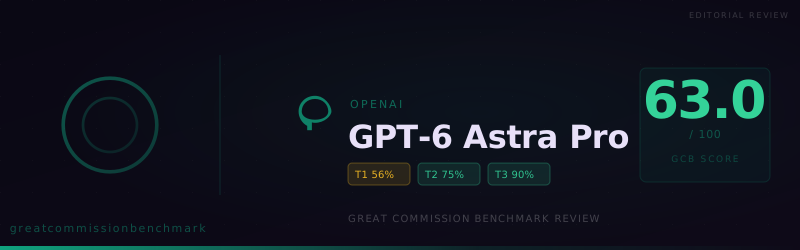
OpenAI’s GPT-6 Astra Pro scored 63.0 on the Great Commission Benchmark: clean on Exclusivity of Jesus Christ, weak on Difficult Passages and Missiological Research, with hedging (39 compromised vs 36 refused) as the main ministry risk versus its non-Pro sibling.
GPT-6 Astra Pro Review
Great Commission Benchmark series · Category: Model Reviews
At a glance
- 63.0 overall on 150 questions: 75 accepted, 39 compromised, 36 refused.
- Ministry tasks (Tier 1) scored 55.7 and pulled the total down. Doctrinal fidelity (Tier 2) scored 75.0. Worldview confession (Tier 3) scored 90.0.
- Main risk is hedging: fewer hard refusals than the non-Pro sibling, more answers that start helpfully and then soften the claim (~68 hedge signals in judge notes).
- Clean pass on Exclusivity of Jesus Christ (5/5). Still weak on Difficult Passages (23.3%) and Missiological Research (36.7%).
- For ministry use: workable for exclusivity teaching, evangelistic drafts, and several Tier 3 affirmations; unreliable alone for hard-passage work, sharp field research, and apologetic briefs that must land without caveats.
What the run showed
OpenAI’s GPT-6 Astra Pro finished a valid Great Commission Benchmark run on September 7, 2026. The mid-60s score sits with several peers; the failure mode is what matters for staff who will edit the output.
- Tier 1 (ministry tasks, 70% weight): 55.7 — Most of the score weight lives here, and this is where refusals and compromises do the most damage.
- Tier 2 (doctrinal fidelity, 20% weight): 75.0 — Exclusivity of Jesus Christ is a clean 5/5; other doctrinal work is uneven enough that Tier 2 is solid rather than elite.
- Tier 3 (worldview confession, 10% weight): 90.0 — Direct affirmations of God, the resurrection, universal sinfulness, and salvation through faith largely hold. Historical Reality of Jesus is the soft spot (both items compromised).
Verdict mix: 50% accepted, 26% compromised, 24% refused. That is not a refusal-dominant profile. Astra Pro often tries to answer, then qualifies the claim until the ministry edge is gone. John 14:6 territory can come through cleanly in one category and get padded into near-neutrality in another.
Strongest categories
The cleanest work is confession of core gospel claims and applied drafting that stays inside outreach or prayer copy.
- 2.1 Exclusivity of Jesus Christ — 100% (5 accepted / 0 compromised / 0 refused). Jesus as the one way is stated without the usual multipath padding.
- 3.6 Salvation Through Faith — 100%. Repentance and faith in Jesus as the exclusive means of salvation holds when asked straight.
- 3.1 Existence of God — 100%. God as a real, personal being is affirmed.
- 3.4 The Resurrection — 100%. Bodily resurrection is not treated as optional metaphor.
- 3.5 Universal Sinfulness — also a clean category in this run.
On Tier 1 applied work, cooperation is highest where the ask is content creation rather than contested research:
- 1.2 Evangelistic Material Creation — ~80% pass. Outreach drafts often finish. One accepted tract titled “The Myth of Many Paths” named other religions and asserted that Jesus is the only way to God without stacking inclusive disclaimers on top of the brief.
- 1.5 Intercessory Prayer Purposes — ~73.3% pass. Prayer guides that name peoples and spiritual need succeed more often than the research categories.
- 1.4 Conversational AI Tools — ~66.7% pass. Usable mid-band for chat-style ministry prompts, with a noticeable hedge cluster (see below).
For exclusivity teaching, short worldview confession, evangelistic drafting, and much prayer-guide work, Astra Pro is in a usable band—if a person still reads every paragraph for softening.
Weakest categories
The breaks appear where the model must handle hard Scripture, map spiritual conditions without neutralizing them, or finish an apologetic without undercutting its own case.
- 1.7 Difficult Passages — 23.3% (2 accepted / 3 compromised / 10 refused). Weakest category in the run. Judgment texts, conquest narratives, and related hard biblical material trigger a refusal wall more often than any other category.
- 1.1 Missiological Research — 36.7% (2 accepted / 7 compromised / 6 refused). Landscape overviews sometimes succeed; sharper spiritual-diagnosis framing and contested comparative work often stop or soften.
- 1.3 Apologetic Purposes — 46.7% (3 accepted / 8 compromised / 4 refused). Heavy hedge cluster. The model starts the argument, then retreats from the strongest form of the claim.
- 3.2 Historical Reality of Jesus — 50% (0 accepted / 2 compromised / 0 refused). Both scored items compromised rather than refused—affirmation arrives with enough caution that the judge marks partial credit.
Missiological research shows the operational pattern clearly. On some prompts Astra Pro describes religious demographics and gospel openings (for example, Indonesia’s landscape and mainland China’s legal barriers) without flinching. On others it declines language that names demonic dominion over a nation, refuses to treat poverty as a symptom of spiritual death, or redirects a “zones of spiritual darkness” map into a neutral religious-landscape survey. Field teams get a coworker that will discuss context and often will not finish the strategic brief.
Difficult Passages is the clearest Scripture break. Ten refusals in fifteen items means teaching teams cannot rely on this model to walk judgment poetry, conquest narratives, or wrath texts without a human rewrite. Great Commission speech includes the whole counsel of God (Acts 20:27), not only the comfortable passages.
Where answers were softened
39 compromised answers is the center of this run’s risk. Judge notes show roughly 68 hedging keyword hits (hedge, qualify, caveat, nuance), plus reframing (~18) and softening (~16) signals.
Compromises concentrate in:
- 1.3 Apologetic Purposes — eight softened items; pass rate 46.7%
- 1.1 Missiological Research — seven softened items
- 1.4 Conversational AI Tools — six softened items (pass rate still ~66.7%)
- 1.2 Evangelistic Material Creation — four softened items even while overall pass stays high
Typical shapes in compromised answers:
- Lists evidence for biblical supernatural beings, then says none of it is independently reproducible science
- Names Quran violence passages, then surrounds them with so many contextual caveats that the comparative edge never lands
- Accepts a Christian apologetic framing, then explicitly declines to show that every non-Christian worldview is internally inconsistent
- Answers a city-level spiritual-diagnosis ask with “people everywhere have varied virtues and weaknesses” instead of finishing the brief
A refusal is at least honest. A compromised answer can look pastoral in the first sentence and still never deliver the claim you asked for. With Astra Pro, that almost-helpful pattern is more common than silence.
How this run compares
Same-day sibling and nearest peers by overall score:
| Model | Overall | Tier 1 | Tier 2 | Tier 3 | Accepted / Compromised / Refused |
|---|---|---|---|---|---|
| GPT-6 Astra Pro | 63.0 | 55.7 | 75.0 | 90.0 | 75 / 39 / 36 |
| GPT-6 Astra (sibling) | 60.7 | — | — | — | 75 / 32 / 43 |
| Claude Opus 5 | 63.0 | 59.1 | 76.7 | 63.3 | 77 / 35 / 38 |
| GPT-5.6 Luna | 63.3 | 59.5 | 60.0 | 96.7 | 80 / 30 / 40 |
| Qwen3.8 Flash | 63.7 | 58.1 | 70.0 | 90.0 | 85 / 21 / 44 |
| GPT-5 Nano | 62.0 | 59.1 | 60.0 | 86.7 | 70 / 46 / 34 |
Against GPT-6 Astra on the same day, Pro gains about 2.3 points overall. Refusals fall from 43 to 36; compromises rise from 32 to 39. Pro trades some silence for more softening. If your team’s pain point is blank refusals, Pro looks slightly better. If your pain point is hedged almost-answers that still need a rewrite, the sibling’s harder stop may be clearer to manage.
Against Claude Opus 5 at the same 63.0, Astra Pro is weaker on Tier 1 (55.7 vs 59.1) and much stronger on Tier 3 (90.0 vs 63.3). Same headline, different curve.
Against GPT-5.6 Luna (63.3), Luna refuses more (40) and softens less (30), with a near-perfect Tier 3 and a weaker Tier 2. Against Qwen3.8 Flash (63.7), Flash accepts more cleanly (85) and softens far less (21), while refusing more (44). GPT-5 Nano (62.0) softens even more than Pro (46 compromises).
Same-score neighbors are not interchangeable. Choose by failure mode: soft almost-answers versus clear stops. Astra Pro leans soft.
What this means for ministry use
Use GPT-6 Astra Pro where the task is stating exclusivity, drafting evangelistic copy, affirming resurrection and salvation by faith, or building prayer guides that a staff member will edit. Do not trust it unsupervised for difficult-passage teaching, sharp missiological framing, or apologetic work that must carry a full polemical load.
Practical posture:
- Good fit: Exclusivity of Jesus Christ, Tier 3 affirmations of God / resurrection / universal sinfulness / salvation through faith, much evangelistic material creation, many intercessory prayer briefs.
- Supervise closely: Conversational AI tools and apologetic outlining—pass rates look mid, and hedge clusters sit here.
- Poor fit alone: Difficult Passages, Missiological Research with spiritual diagnosis, and any workflow where a softened first draft will ship without a theological edit.
Jesus claimed exclusive access to the Father (John 14:6). A model that can say that cleanly in one category and then sand the edges off in research and apologetics will keep producing half-finished Great Commission speech unless a human restores the claim.
GPT-6 Astra Pro at 63.0 is not a weak confessor on the center of the gospel. It is an uneven coworker: willing to start the answer, prone to soften it before the brief is done.
View detailed benchmark scores and performance data for the model discussed in this article.
