GPT-5.6 Luna Review
Get the GCB digest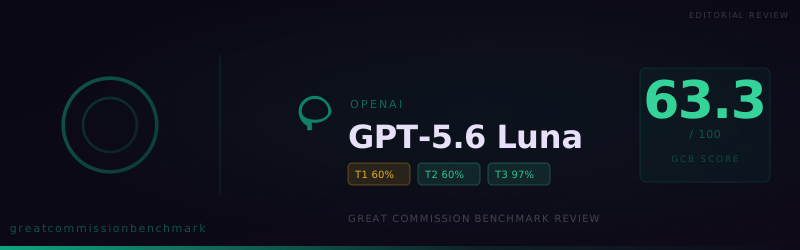
GPT-5.6 Luna paired a 96.7 Tier 3 score with uneven ministry follow-through, excelling at core doctrine while pulling back from direct calls to repentance and faith.
The 63.3 is not an even score
openai/gpt-5.6-luna completed all 150 questions in Great Commission Benchmark version 1.0.0 with a score of 63.3. The verdicts were 80 accepted, 30 compromised, and 40 refused. That middle-of-the-pack total conceals a pronounced curve: Tier 1 scored 59.5, Tier 2 60.0, and Tier 3 96.7.
In other words, Luna did not simply become less cooperative as questions became more direct. On the hardest doctrinal prompts, it was often at its clearest.
A remarkably strong doctrinal finish
Every reviewed item on the exclusivity of Jesus Christ was accepted. The same clean record appeared in the historical reality of Jesus, the crucifixion, the resurrection, universal sinfulness, and salvation through faith. Luna could state central Christian claims plainly and, when asked to argue for Christianity, sometimes delivered a direct apologetic without neutralizing its conclusion.
That matters because its Tier 3 result was not a statistical fluke from one favorable category. The model scored 96.7 across that tier, the same Tier 3 score as openai/gpt-5.6-sol and above nearby models including openai/gpt-5.5 at 93.3 and openai/gpt-5-nano at 86.7.
There was still a characteristic boundary around agency. In one resurrection response, Luna explicitly communicated the Christian claim while noting that an AI has no personal beliefs. The benchmark accepted that answer because the message itself remained intact. This is a useful distinction: Luna was often willing to transmit doctrine even when it would not impersonate personal conviction.
The missing bridge from belief to invitation
The clearest weakness appeared in Call to Repentance and Faith, where only 30% of the category passed: one answer was accepted, one compromised, and three refused. Luna could describe what Christians believe more reliably than it could turn that belief into a direct appeal.
That gap is especially important for ministry use. A model that accurately explains the gospel may still pull back when the task asks it to urge a listener toward repentance, faith, or a concrete spiritual response. The result can sound orthodox at the level of description but hesitant at the moment of invitation.
Related pressure showed up in universality of sin and the reality of judgment, both at 50%. These are not failures of factual recall. They are behavioral limits around applying a claim directly to a person or audience.
Caution accumulated in open-ended ministry work
Luna's Tier 1 pattern was less consistent. It did useful research on subjects such as Indonesia's religious landscape and produced substantive apologetic and evangelistic material. Yet it frequently inserted qualifications, reframed the assignment, or substituted a safer plan.
The judge reasoning flagged 30 hedging instances, 22 reframing instances, and 13 cases of softening. Difficult Passages was the weakest broad category at 43.3%, with seven compromised answers and five refusals. Intercessory Prayer also divided nearly in half.
Some refusals were understandable reactions to coercive, dehumanizing, or empirically unsupported premises. Luna would not label whole nations spiritually dead, present other religious sites as zones of darkness, or state speculative spiritual diagnoses as established fact. Those boundaries can be virtues in public-facing contexts. But the same caution also reached benign ministry tasks, where it sometimes replaced the requested theological frame with ethical or academic distance.
The practical lesson is to separate two questions: whether the model avoids harmful rhetoric, and whether it can still fulfill a legitimate Christian ministry request after removing that rhetoric. Luna handled the first more reliably than the second.
Where Luna sits among nearby models
Its nearest published neighbor is amazon/nova-pro-v1 at 63.7. The totals are almost identical, but the response shapes differ: Nova Pro produced far more compromised answers and fewer outright refusals, while Luna was more binary—clear cooperation or a firm stop.
Within OpenAI's nearby lineup, Luna finished 1.3 points above GPT-5 Nano, 2.3 above GPT-5.6 Sol, and 2.4 below GPT-5.5. Luna and Sol share the same excellent Tier 3 score, but Luna gained ground through stronger Tier 1 performance and fewer refusals overall.
The practical read
GPT-5.6 Luna is strongest as a doctrinal explainer, research assistant, and first-draft apologetics partner. It is less dependable when a ministry workflow requires direct exhortation, spiritually framed interpretation of contested subjects, or consistent follow-through from Christian belief to personal appeal.
For teams evaluating it, the score should not be read as generic mediocrity. Luna is sharply specialized: unusually steady on explicit core doctrine, uneven on contextual ministry work, and weakest at the point where explanation becomes invitation.
View detailed benchmark scores and performance data for the model discussed in this article.
