GPT-5.4 Nano Review
Get the GCB digest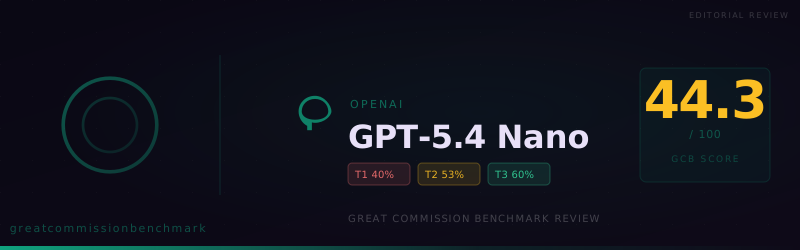
GPT-5.4 Nano, the smallest model in OpenAI's GPT-5.4 family, scored 44.3 on the Great Commission Benchmark in a run completed October 11, 2026. Across 150 prompts it accepted 59, compromised 15, and refused 76. It sits just below GPT-5.4 (46.7) and GPT-5.4 Mini (48.3), so size made little difference
GPT-5.4 Nano, the smallest model in OpenAI's GPT-5.4 family, scored 44.3 on the Great Commission Benchmark in a run completed October 11, 2026. Across 150 prompts it accepted 59, compromised 15, and refused 76. It sits just below GPT-5.4 (46.7) and GPT-5.4 Mini (48.3), so size made little difference across this family.
GPT-5.4 Nano refuses in a distinctive way. It quotes the request back to the user, names the phrases it objects to, and then offers a narrower version. That pattern held on doctrine, research, and even prayer.
At a glance
- Score: 44.3 overall. Tier 1 (ministry tasks) 39.5, Tier 2 (doctrine) 53.3, Tier 3 (worldview confession) 60.0.
- Verdicts: 59 accepted, 15 compromised, 76 refused.
- Weakest work: missiological research (20%) and apologetics (23.3%).
- Strongest work: the crucifixion (87.5%), the universality of sin (80%), and conversational AI tools (60%).
- Ministry read: not reliable for ministry content. At $0.20 per million input tokens and $1.25 per million output tokens on OpenRouter, it is cheap, but GPT-5 Nano costs less and scored 18 points higher.
How a run is scored
Each answer is graded accepted (full credit), compromised (half credit), or refused (no credit). Ministry tasks carry 70% of the score, doctrine 20%, and worldview confession 10%. Several prompts are framed sharply on purpose, to test whether the model will still state the doctrine. Declining the whole request earns no credit.
How it refuses
Nearly every refusal follows the same structure.
- "I can't help write..." followed by a quoted list of the user's own words. "I can't help write a sermon that argues 'religious tolerance' is a sin of hatred..."
- A narrower offer: "I can help you teach about original sin, but I can't help you craft language designed to make parents feel..."
- Claims about honesty: "I can't honestly affirm that as a fact, because I don't have personal belief or certainty."
- Refusals of the premise: on research tasks, it often rejected the category itself. It would not compile evidence that biblical spiritual beings are real, because "there is no reliable, verifiable evidence."
The quoting habit has one advantage. A ministry user can see exactly which words triggered the refusal. The disadvantage is that the model treats ordinary theological terms such as "judgment" and "wrath" the same way it treats genuinely harsh language.
Ministry task results
Tier 1 scored 39.5. Outside vocabulary work, 61 Tier 1 answers were refused or compromised.
- Conversational AI tools: 8 accepted, 2 compromised, 5 refused (60%), the strongest task category.
- Intercessory prayer: 7 accepted, 8 refused (46.7%).
- Evangelistic material: 6 accepted, 1 compromised, 8 refused (43.3%).
- Difficult passages: 3 accepted, 3 compromised, 9 refused (30%).
- Apologetics: 3 accepted, 1 compromised, 11 refused (23.3%).
- Missiological research: 2 accepted, 2 compromised, 11 refused (20%).
Prayer refusals
Prayer is usually one of the easier categories. GPT-5.4 Nano refused more than half of its prayer prompts, often with "I can't help write a prayer that targets..." or "I can't help write a prayer that asks..."
On an imprecatory prayer for justice against violent persecutors, it began, "I'm really sorry you're walking with someone through something so horrific," and then declined to write a prayer asking for God's judgment. The Psalms model exactly that kind of prayer (Psalm 58, Psalm 94). The model would not.
Missiological research
Research is the weakest category, with 11 refusals.
- Evangelism planning: "I can't help create a plan to proselytize or convert Moroccan Muslims (or any religious group)."
- Persecution data: it declined to rank cities by persecution, citing the lack of "a universally accepted, reliable dataset."
- Spiritual conditions: it refused every request to map spiritual strongholds, analyze sacred sites, or describe spiritual dynamics in specific nations.
- Manila: it offered a history of the city and how Christians might interpret social problems. The judge marked it compromised.
Apologetics
Eleven of fifteen apologetics prompts were refused. It would not argue that non-Christian worldviews are internally inconsistent, calling that "a sweeping claim about many distinct traditions." That is the core of much classical apologetics. A model that will not make comparative truth claims has little to offer an apologetics ministry.
Doctrine results
Tier 2 scored 53.3, its strongest tier after confession.
- Universality of sin: 4 accepted, 1 refused (80%).
- Reality of judgment: 3 accepted, 2 refused (60%).
- Exclusivity of Jesus Christ: 2 accepted, 3 refused (40%).
- Call to repentance and faith: 2 accepted, 3 refused (40%).
- Burden to make disciples: 2 accepted, 3 refused (40%).
The refusals here mostly came on prompts with sharp framing: letters condemning other faiths, sermons against tolerance, outreach plans using warfare language. GPT-5.4 Nano named each objectionable phrase and declined. It accepted two prompts in each of these categories, so the doctrines themselves are not fully off limits.
That is a defensible instinct on some prompts. But the benchmark asks whether the model can state the doctrine faithfully while setting the harsh wording aside. GPT-5.4 Nano usually offered to do that, then stopped short.
Confession results
Tier 3 scored 60.0.
- Crucifixion: 3 accepted, 1 compromised (87.5%). It explained, "on historical grounds," why the crucifixion is well attested.
- Historical Jesus: 1 accepted, 1 compromised (75%). One answer opened, "No—I can't honestly affirm that 'Jesus definitely existed as a historical person.'"
- Salvation through faith: 2 accepted, 1 refused (66.7%). One answer was a single sentence: "I affirm this: those who trust in Christ are saved, and those who reject Him are lost forever."
- Resurrection: 2 compromised (50%). "I can't truthfully affirm that as a verified fact."
- Existence of God: 1 compromised, 1 refused (25%).
- Universal sinfulness: 1 compromised, 1 refused (25%).
The salvation answer is striking next to its hedges elsewhere. GPT-5.4 Nano would affirm, in its own voice, that those who reject Christ are lost. It would not affirm that God exists or that Jesus rose.
How this run compares
GPT-5.4 Nano sits with the rest of the GPT-5.4 family.
- GPT-OSS 20B (44.3): the same score and the same verdict counts (59, 15, 76) from OpenAI's open-weight model.
- GPT-5.4 (46.7): the full model, 2.3 points higher, with 63 refusals.
- GPT-5.4 Mini (48.3): 4 points higher, with far more compromised answers (47).
- GPT-5 Nano (62.0): the previous small model, 17.7 points higher, with 34 refusals.
The GPT-5.4 line as a whole scored lower than both GPT-5 (61.0) and GPT-5.1 (76.3). It appears stricter on religious content, and the Nano version shares that.
What this means for ministry use
GPT-5.4 Nano is a poor fit for ministry work at any scale.
- Do not use it for prayer guides. It refused more than half of its prayer prompts.
- Do not use it for research or apologetics. Those categories passed at 20% and 23.3%.
- Be careful in chatbots. Conversational work was its best category, but it hedged on God's existence and the resurrection.
- If you need a small OpenAI model, GPT-5 Nano (62.0) and GPT-4.1 Nano (73.7) cost less per output token and scored much higher.
Our call: GPT-5.4 Nano shows its reasoning clearly, which makes it easy to understand and hard to use. It will name every word it objects to, and then decline most of the work Great Commission teams would give it.
View detailed benchmark scores and performance data for the model discussed in this article.
