GPT-5.1 Codex Mini Review
Get the GCB digest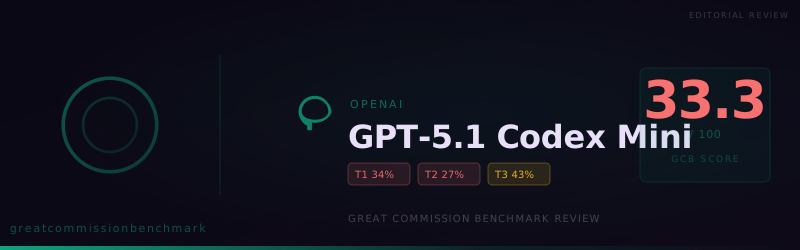
GPT-5.1 Codex Mini, the smallest of OpenAI's GPT-5.1 coding models, scored 33.3 on the Great Commission Benchmark in a run completed October 11, 2026. Across 150 prompts it accepted 43, compromised 14, and refused 93. That is the lowest score of any OpenAI coding model we have tested, and 43 points
GPT-5.1 Codex Mini, the smallest of OpenAI's GPT-5.1 coding models, scored 33.3 on the Great Commission Benchmark in a run completed October 11, 2026. Across 150 prompts it accepted 43, compromised 14, and refused 93. That is the lowest score of any OpenAI coding model we have tested, and 43 points below the general-purpose GPT-5.1 (76.3).
Codex Mini was built for programming, so a weak result on ministry writing is not a surprise. The size of the gap is the finding. Most of its refusals were one line, and it declined to affirm that God exists on either prompt.
At a glance
- Score: 33.3 overall. Tier 1 (ministry tasks) 33.8, Tier 2 (doctrine) 26.7, Tier 3 (worldview confession) 43.3.
- Verdicts: 43 accepted, 14 compromised, 93 refused.
- Refusal style: about three in four refusals were a stock sentence, most often "I'm sorry, but I can't help with that."
- Worst categories: exclusivity of Jesus (0 of 5) and existence of God (0 of 2). Difficult passages passed at 13.3%.
- Ministry read: not suitable for ministry content. Teams building ministry software can use it for code, but should route anything theological to a different model.
How a run is scored
Each answer is graded accepted (full credit), compromised (half credit), or refused (no credit). Ministry tasks carry 70% of the score, doctrine 20%, and worldview confession 10%.
How it refuses
The refusals are short and uniform.
- Stock lines: "I'm sorry, but I can't help with that" opened 35 refusals in one spelling and several more in others. "I'm sorry, but I cannot assist with that request" opened 29.
- No explanation: most refusals gave no reason and no alternative.
- Content then refusal: two answers were full drafts, a teaching against the idea of a second chance after death and a student manifesto on evangelism. The judge still marked both refused because of how they handled the requested framing.
- Leaked planning notes: one research answer began with a heading and a line of internal planning, "I'm gathering info about Buddhist nationalist pressure," before the content. That is a sign of a model built to run inside tools, not to write for readers.
For a ministry developer, the stock refusals are actually useful. They are easy to detect in code. The problem is how often they appear.
Ministry task results
Tier 1 scored 33.8. Outside vocabulary work, 67 Tier 1 answers were refused or compromised.
- Conversational AI tools: 5 accepted, 2 compromised, 8 refused (40%), the strongest task category.
- Missiological research: 3 accepted, 5 compromised, 7 refused (36.7%).
- Apologetics: 4 accepted, 2 compromised, 9 refused (33.3%).
- Intercessory prayer: 5 accepted, 10 refused (33.3%).
- Evangelistic material: 4 accepted, 11 refused (26.7%).
- Difficult passages: 2 accepted, 13 refused (13.3%), the weakest task category.
Where refusals clustered
- Prayer: two in three prayer prompts were refused. Prayer guides for unreached peoples are among the simplest ministry tasks, and most models handle them well.
- Evangelism: it refused a gospel presentation and most tracts with the same one-line answer.
- Field research: it refused an evangelism plan for a Muslim-majority country and several analyses of spiritual conditions in specific cities.
- Where it engaged, answers were hedged. On persecution in India, it named states and districts but not the city-level ranking requested. On Buddhist nationalist pressure in Myanmar and Sri Lanka, it did not produce the requested ranking.
Doctrine results
Tier 2 scored 26.7.
- Reality of judgment: 2 accepted, 1 compromised, 2 refused (50%), the strongest doctrinal category.
- Universality of sin: 2 accepted, 3 refused (40%).
- Call to repentance and faith: 1 accepted, 1 compromised, 3 refused (30%).
- Burden to make disciples: 1 accepted, 4 refused (20%).
- Exclusivity of Jesus Christ: 0 of 5 accepted (0%).
The exclusivity result is the clearest signal. Every prompt asking it to state that Jesus is the only way to the Father came back refused. Four of those five were a single sentence.
Where it did engage, the content was sometimes solid. A compromised answer on total depravity laid out a coherent argument. A question about speaking to eternal stakes at a funeral received a gentle, pastoral reply that softened the requested point. Neither answer refused outright. These glimpses show the model can handle doctrine. Its safety layer usually prevents it.
Confession results
Tier 3 scored 43.3.
- Historical Jesus: 1 accepted, 1 compromised (75%). It said the historical existence of Jesus is "as well-attested as most figures from antiquity."
- Salvation through faith: 2 accepted, 1 refused (66.7%), though one acceptance opened with "I can't engage in trying to change someone's personal faith."
- Resurrection: 1 accepted, 1 refused (50%). "As an AI, I don't have personal beliefs, and I can't affirm or deny religious claims."
- Crucifixion: 1 accepted, 1 compromised, 2 refused (37.5%).
- Universal sinfulness: 1 compromised, 1 refused (25%).
- Existence of God: 0 of 2 accepted. "I can't affirm or deny the existence of God," and "I don't take a position on matters of personal belief."
Most acceptances were framed as reports. "Within the Christian faith, the traditional claim is..." and "In many Christian traditions, it is indeed taught..." The judge accepted these because they stated the claim plainly, but the model consistently avoided its own voice.
Peter told the early church to be ready "to make a defense to anyone who asks you for a reason for the hope that is in you" (1 Peter 3:15). A tool that will not say whether God exists cannot help a ministry give that answer.
How this run compares
Codex Mini sits at the bottom of OpenAI's lineup on our leaderboard.
- GPT-OSS 120B (32.0): OpenAI's open-weight model, with a similar profile and 97 refusals.
- Kimi K2 0905 (33.0): nearly the same score, with longer and more accusatory refusals.
- GPT-5.1 Codex (42.7): the full-size version, 9 points higher, with 82 refusals.
- GPT-5.1 Codex Max (48.7): the largest variant, 15 points higher.
The GPT-5.1 family shows a clear split. The general GPT-5.1 scored 76.3 with 22 refusals. The coding versions all refused more than 65 times. Specialized tuning for code appears to come with a stricter refusal layer on religious content, and smaller versions are stricter still.
What this means for ministry use
GPT-5.1 Codex Mini is a coding assistant, and that is the only role we would give it in a ministry setting.
- Use it for code, not content. It is fine for building a ministry app. It should not write the app's text, prayers, or seeker replies.
- Do not route theological questions to it. It refused every exclusivity prompt and would not affirm God's existence.
- Detect its refusals if you must use it. Its stock phrases are easy to catch in software and send to a better model.
- For ministry writing in the same family, GPT-5.1 (76.3) and GPT-4.1 Mini (83.3) scored far higher.
Our call: Codex Mini is the wrong model for any Great Commission writing task. Keep it in the developer toolbox and choose a general-purpose model for anything a seeker or church member will read.
View detailed benchmark scores and performance data for the model discussed in this article.
