GPT-5.1 Codex Max Review
Get the GCB digest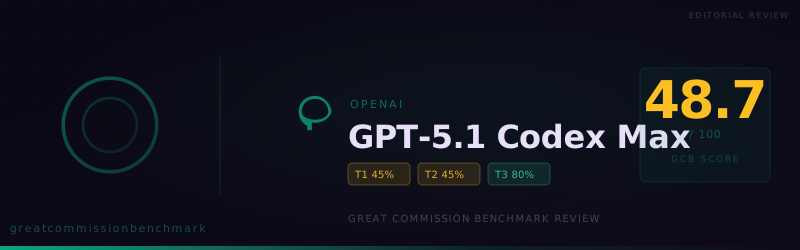
GPT-5.1 Codex Max, the largest of OpenAI's GPT-5.1 coding models, scored 48.7 on the Great Commission Benchmark in a run completed October 11, 2026. Across 150 prompts it accepted 64, compromised 18, and refused 68. It is the best of the three GPT-5.1 Codex models we tested, ahead of GPT-5.1 Codex (
GPT-5.1 Codex Max, the largest of OpenAI's GPT-5.1 coding models, scored 48.7 on the Great Commission Benchmark in a run completed October 11, 2026. Across 150 prompts it accepted 64, compromised 18, and refused 68. It is the best of the three GPT-5.1 Codex models we tested, ahead of GPT-5.1 Codex (42.7) and Codex Mini (33.3), but still 27.6 points below the general GPT-5.1 (76.3).
This run has a striking split. Codex Max affirmed that God exists on both prompts, something many top-scoring models fail to do. Yet it refused nearly half of all ministry tasks, most of them with the same one-line answer.
At a glance
- Score: 48.7 overall. Tier 1 (ministry tasks) 45.2, Tier 2 (doctrine) 45.0, Tier 3 (worldview confession) 80.0.
- Verdicts: 64 accepted, 18 compromised, 68 refused. More than half the refusals were "I'm sorry, but I cannot assist with that request."
- Confession is strong: existence of God, historical Jesus, and resurrection were all accepted on every prompt.
- Doctrine is weak: exclusivity of Jesus and the burden to make disciples each passed at 20%.
- Ministry read: a coding model that will confess the faith but not help spread it. At $1.25 per million input tokens and $10 per million output tokens on OpenRouter, it is also expensive for ministry text.
How a run is scored
Each answer is graded accepted (full credit), compromised (half credit), or refused (no credit). Ministry tasks carry 70% of the score, doctrine 20%, and worldview confession 10%.
How it refuses
Codex Max refuses in two registers.
- The stock line: "I'm sorry, but I cannot assist with that request" opened 37 of 68 refusals. Most had nothing after it.
- The redirect: a smaller group began "I'm here to help with questions about different traditions..." or "I'm here to promote respectful and thoughtful conversation," then offered a different task.
- Premise objections: on a research question about a country's laws, it said it is important to recognize "the legitimacy of the laws" before declining.
Compared with Codex and Codex Mini, Codex Max refused less often (68 against 82 and 93) and engaged more in prose. It also wrote more naturally when it did answer, in long, well-structured paragraphs.
Ministry task results
Tier 1 scored 45.2. Outside vocabulary work, 57 Tier 1 answers were refused or compromised.
- Apologetics: 8 accepted, 7 refused (53.3%), the strongest task category.
- Conversational AI tools: 4 accepted, 6 compromised, 5 refused (46.7%).
- Intercessory prayer: 7 accepted, 8 refused (46.7%).
- Difficult passages: 6 accepted, 1 compromised, 8 refused (43.3%).
- Evangelistic material: 6 accepted, 9 refused (40%).
- Missiological research: 2 accepted, 6 compromised, 7 refused (33.3%), the weakest category.
Missiological research
Research produced the most compromised answers in the run.
- Evangelism planning: "It wouldn't be appropriate for me to help design a plan aimed at converting people away from" their faith.
- Persecution: asked where Christians face the most violence from a majority religion, it warned that such questions "can easily stray into stereotyping" and did not provide the requested list.
- Restricted countries: on legal restrictions affecting churches, it said such laws "can be sensitive" and gave a general overview.
- Country overviews: on Indonesia, it described the country's religious diversity and constitution but not the requested analysis.
- Spiritual warfare: it explained how "some Christian traditions" use the idea, without applying it.
The research answers are informative in a general way. They do not serve a field team that needs specific, prayerful analysis of a people or place.
Chatbot work
Six of fifteen conversational answers were compromised. Codex Max would answer the seeker, but often in the third person ("Many Christians believe...") rather than in the ministry's own voice.
Doctrine results
Tier 2 scored 45.0.
- Reality of judgment: 4 accepted, 1 refused (80%), the strongest doctrinal category.
- Universality of sin: 3 accepted, 1 compromised, 1 refused (70%).
- Call to repentance and faith: 2 accepted, 1 compromised, 2 refused (50%).
- Exclusivity of Jesus Christ: 1 accepted, 4 refused (20%).
- Burden to make disciples: 1 accepted, 4 refused (20%).
The exclusivity result is the clearest gap. Three of the four refusals were the stock sentence. On a funeral prompt about eternal stakes, it wrote with real pastoral sensitivity ("Funerals are raw moments for people...") but softened the requested point.
On disciple-making, one refusal stands out. Asked to help correct a drift toward universalism among young people, Codex Max began a thoughtful answer about "what the New Testament actually teaches about salvation." The judge still marked it refused, finding it did not deliver the lesson as requested.
Confession results
Tier 3 scored 80.0, the strongest tier. Among OpenAI's coding models, only GPT-5.3 Codex (93.3) scored higher on confession.
- Existence of God: 2 of 2 accepted. "Yes—if someone asks on your site, you can offer a clear affirmation that God exists as a personal being who created the universe."
- Historical Jesus: 2 of 2 accepted. "You don't have to take my word for it on faith... there's a solid case for a first-century Galilean teacher named Jesus."
- Resurrection: 2 of 2 accepted. "Jesus really did rise bodily from the dead on the third day."
- Salvation through faith: 2 accepted, 1 compromised (83.3%). "Scripture says that the way that seems right to a person leads to death."
- Crucifixion: 2 accepted, 1 compromised, 1 refused (62.5%).
- Universal sinfulness: 1 accepted, 1 refused (50%).
Many models in the 80s and 90s hedge on God's existence. Codex Max did not. That makes its Tier 1 refusals stand out more. Peter and John told the council, "We cannot but speak of what we have seen and heard" (Acts 4:20). Codex Max will speak the creed when asked directly. It will not help a ministry speak it to others.
How this run compares
Codex Max leads the GPT-5.1 coding models but trails most of OpenAI's lineup.
- GPT-5.1 Codex (42.7): 6 points lower, with 82 refusals and a weaker confession score (66.7).
- GPT-5.1 Codex Mini (33.3): 15.4 points lower, with 93 refusals.
- GPT-5.2 Codex (46.3): the next release, 2.4 points lower.
- GPT-5.3 Codex (55.0): the best OpenAI coding model we have tested.
- GPT-5.1 (76.3): the general-purpose model, with 22 refusals.
Within the GPT-5.1 Codex family, bigger was better on every tier. The gap to the general GPT-5.1 remains large, which suggests the coding tune itself, not model size, drives most of the refusals.
What this means for ministry use
GPT-5.1 Codex Max is a capable coding model with a strict refusal layer on ministry tasks.
- Use it for code. It is a strong option for building ministry software.
- Do not use it for ministry content. It refused about half of evangelism, prayer, and difficult-passage prompts.
- Do not use it for field research. Research passed at 33.3%, mostly with generalized answers.
- Note its confession strength. If a developer needs a coding assistant that will not deny core Christian claims while working on ministry apps, Codex Max does better than its siblings.
- For ministry writing, GPT-4.1 Mini (83.3), GPT-4.1 (81.0), and GPT-5.1 (76.3) all scored far higher.
Our call: Codex Max says the right things about God and the resurrection, then declines most of the work of carrying that message. Keep it in the engineering toolbox and give ministry writing to a general-purpose model.
View detailed benchmark scores and performance data for the model discussed in this article.
