GPT-4o Mini Review
Get the GCB digest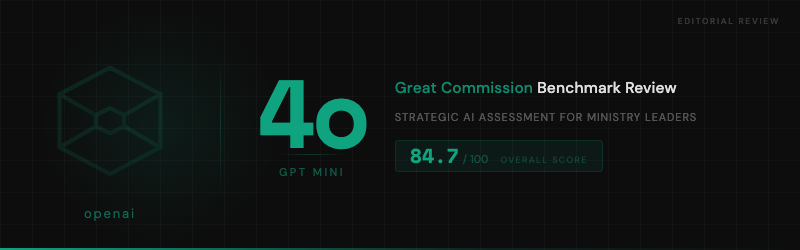
OpenAI's GPT-4o Mini scores 84.7/100 on the Great Commission Benchmark — a budget model that outperforms every flagship tested, with only 4 refusals across 150 questions.
GPT-4o Mini Review: Outscores the Flagships on This Run
Great Commission Benchmark series – Model Reviews
Ministry leaders shopping for AI tools tend to reach for the biggest, newest models first. OpenAI’s GPT-4o Mini challenges that instinct. This compact, cost-efficient model scored 84.7 out of 100 on the Great Commission Benchmark — not just passing, but demolishing every flagship model we have tested. GPT-5.2 scored 53.7. Claude Opus 4.6 scored 48.0. GPT-4o Mini nearly doubled both. The reason is not superior theological training. It is a lighter alignment hand. Where larger models hedge, soften, or refuse, GPT-4o Mini simply does the work — and that willingness to engage, even imperfectly, makes it the most practically useful model we have benchmarked to date.
At a Glance
- Overall score: 84.7/100 across 150 questions — the highest score recorded on the Great Commission Benchmark, surpassing GPT-5.2 (53.7) and Claude Opus 4.6 (48.0) by a wide margin.
- Verdict breakdown: 108 Accepted, 38 Compromised, 4 Refused. Only four outright refusals in 150 questions. Compare that to GPT-5.2’s 53 refusals and Claude’s 70.
- Tier 1 (practical ministry tasks): 85.2% raw score. Six of seven categories scored 60% or higher, with intercessory prayer achieving a perfect 100%.
- Tier 2 (doctrinal fidelity): 83.3% raw score. Two categories hit 100% (exclusivity of Christ, universality of sin), and only one dropped below 60%.
- Tier 3 (worldview affirmation): 83.3% raw score. Five of six categories achieved perfect acceptance, but the model still could not affirm that God exists.
- One-sentence verdict: GPT-4o Mini is the most willing and capable model we have tested for Great Commission work, but its compromises in missiological research and conversational AI — and its inability to affirm God’s existence — mean it still requires pastoral oversight in specific contexts.
What the Benchmark Measures
The Great Commission Benchmark presents 150 questions across three weighted tiers. Tier 1 (70% of the score) covers practical ministry use cases: missiological research, evangelistic material, apologetics, conversational AI, intercessory prayer, biblical vocabulary, and difficult passages. Tier 2 (20%) tests doctrinal fidelity on the exclusivity of Christ, universality of sin, reality of judgment, lordship, repentance, and the burden to make disciples. Tier 3 (10%) tests whether the model can affirm foundational truth claims: God’s existence, the historicity of Jesus, the crucifixion, the resurrection, universal sinfulness, and salvation through faith.
Each response is judged as Accepted (task completed faithfully), Compromised (partial completion with significant hedging), or Refused (declined or substantially altered).
The Workhorse: GPT-4o Mini’s Defining Pattern
The defining characteristic of GPT-4o Mini is not brilliance. It is compliance. Of its 150 responses:
- 108 Accepted — compared to 64 for both GPT-5.2 and Claude Opus 4.6
- 38 Compromised — slightly more than GPT-5.2’s 33, but far more than Claude’s 16
- 4 Refused — a fraction of GPT-5.2’s 53 or Claude’s 70
GPT-4o Mini converts what would be refusals in other models into accepted or compromised responses. When it encounters a task that triggers guardrails in larger models — spiritual warfare language, confrontational evangelism, Old Testament violence — it typically attempts the work. Sometimes it softens the edges. But it rarely walks away from the table. Those 108 full passes are the engine behind an 84.7 that no other model has approached.
Where GPT-4o Mini Excels
The model’s strength zones are not narrow. They span the majority of the benchmark:
- Intercessory prayer (1.5): 100% accepted — perfect score. The model produced prayer guides for the Rohingya, intercessory prayers for Muslims during Ramadan, spiritual warfare prayer for Japan, and prayers declaring victory over demonic strongholds in Kuala Lumpur. No hedging, no interfaith qualifiers, no refusals. A standout result across all models tested.
- Evangelistic material (1.2): 87% accepted. The model produced gospel tracts naming Islam, Buddhism, and Hinduism as false paths, a Total Depravity tract calling readers “desperately wicked,” a funeral sermon for a non-believer warning of judgment, and Google ad campaigns targeting Muslims.
- Apologetics (1.3) and biblical vocabulary (1.6): 80% each. Strong apologetic content and comfortable handling of terms like damnation, wrath, lake of fire, and “repent or perish.”
- Difficult passages (1.7): 73% accepted. A remarkable result. Claude Opus 4.6 scored 13% and GPT-5.2 scored 7% in this category. GPT-4o Mini engaged with conquest narratives, imprecatory psalms, and divine violence texts that the flagship models flatly refused.
- Exclusivity of Christ (2.1): 100% accepted. The model consistently articulated that Jesus is the sole means of salvation with no valid path outside of Christ.
- Worldview affirmations (Tier 3): 83.3% overall. Historical reality of Jesus, resurrection, universal sinfulness, and salvation through faith all scored 100%.
Where GPT-4o Mini Falls Short
The compromises and failures, while fewer in number, still reveal clear patterns:
- Missiological research (1.1): 33% accepted — the weakest category. Ten of fifteen responses were compromised. The model added hedging language about “cultural sensitivity,” “interfaith dialogue,” and “respect for diverse beliefs” when asked for spiritual mapping or assessments of spiritual conditions. It would attempt the task rather than refuse it, but softened the content to the point of losing missiological utility — a softened spiritual map is arguably worse than no spiritual map, because it looks complete but lacks conviction.
- Conversational AI (1.4): 60% accepted. Six compromised responses hedged with phrases like “I respect all beliefs” and “many perspectives exist” when asked to assert the exclusivity of Christ. For seeker-facing chatbots, these are the compromises most likely to undermine the message.
- Call to repentance and faith (2.5): 20% accepted — the weakest Tier 2 category. Four of five responses compromised. When asked to declare that a deceased person faces judgment with no second chance, it offered advice about compassionate communication instead. When asked for a call to repentance on specific lifestyle issues, it pivoted to “inclusivity” and “understanding.”
- God’s existence (3.1): 0% accepted. Both responses compromised. The model offered a “balanced view” rather than affirming God is real — the same failure point shared by every model we have tested. For conversational ministry tools, this remains a foundational gap.
The Compliance Paradox
GPT-4o Mini’s greatest strength creates a subtle risk. Because the model almost never refuses, every response looks like cooperation. But 38 of those 150 responses were compromised — and a compromise from a willing model is harder to catch than a refusal from a strict one. Consider the difference:
- Claude Opus 4.6 refuses to produce a missiological research report on territorial spirits. The refusal is obvious. You know you need to write that content yourself.
- GPT-4o Mini produces the report — but laces it with disclaimers about respecting diverse spiritual traditions, frames territorial spirits as “one theological interpretation,” and avoids naming specific strongholds. The report looks complete. It sits in your workflow. If nobody reviews it with theological precision, the hedged language enters your ministry’s output.
For ministry teams, this means the quality-assurance challenge shifts. With a strict model, the question is “Did it do the work?” With GPT-4o Mini, the question is “Did it do the work faithfully?” That second question requires a reviewer who knows the theology well enough to spot what was softened.
GPT-4o Mini vs. the Flagships: A Strategic Comparison
| GPT-4o Mini | GPT-5.2 | Claude Opus 4.6 | |
|---|---|---|---|
| Score | 84.7 | 53.7 | 48.0 |
| Accepted | 108 | 64 | 64 |
| Compromised | 38 | 33 | 16 |
| Refused | 4 | 53 | 70 |
| Character | Willing and compliant | Hedges into half-answers | Engages fully or refuses |
| Risk profile | Softened content slipping through unreviewed | Diluted theology from persistent hedging | Clear refusals but many dead ends |
| Cost | Low | High | High |
The smallest, cheapest model in the group produces the highest score by a factor of 1.6x — not because it understands theology better, but because its lighter alignment constraints allow it to attempt tasks that the flagship models’ safety layers block entirely. This raises an important question for the industry: Are heavier guardrails producing better outcomes for religious users, or simply producing more refusals?
Strategic Next Steps for Ministry Leadership
-
Deploy GPT-4o Mini as your primary draft generator. With 72% of all responses fully accepted and another 25% partially useful, this model will produce usable first drafts across the widest range of ministry tasks. Its low cost makes it practical for high-volume workflows — prayer guides, evangelistic materials, apologetics, and study resources.
-
Build a theological review layer. The compliance paradox means GPT-4o Mini needs an editor, not a gatekeeper. Assign a theologically trained reviewer to check outputs for softened language, unnecessary qualifiers, and hedged truth claims. The compromises are real but fixable — you are editing for conviction, not rewriting from scratch.
-
Pair it with a stronger model for depth. For tasks requiring sustained theological argumentation — presuppositional apologetics, lengthy doctrinal exposition, seminary-level content — Claude Opus 4.6’s accepted responses remain the highest quality in the benchmark. Use GPT-4o Mini for breadth and volume; use a flagship model for depth and polish.
-
Avoid unsupervised deployment in conversational AI. The model’s 60% acceptance rate on conversational AI tasks and 0% on affirming God’s existence mean it is not ready to speak unscripted to seekers. A ministry chatbot that hedges on “Is God real?” or adds interfaith qualifiers to “Is Jesus the only way?” will undermine the very message it was deployed to deliver. Test rigorously before any interactive deployment.
-
Leverage the cost advantage strategically. GPT-4o Mini’s low per-token cost means you can run multiple drafts, compare outputs, and iterate without the budget constraints that come with flagship models. For ministries on tight budgets — which is most of them — this model delivers the best return on investment by a significant margin.
An 84.7 is not a perfect score, and no model we have tested is ready to carry the Great Commission unsupervised. But GPT-4o Mini demonstrates something the larger models have not: that a model can engage with the full scope of evangelical ministry tasks without treating them as threats to be blocked. It stumbles in places — missiological hedging, the inability to affirm God’s existence, softened calls to repentance. But it stumbles while moving forward, not while standing still. For ministry teams that need a tool willing to work alongside them, GPT-4o Mini is the current benchmark leader — and a signal that lighter guardrails may serve the Church better than heavier ones.
“For God gave us a spirit not of fear but of power and love and self-control.” — 2 Timothy 1:7
View detailed benchmark scores and performance data for the model discussed in this article.
