GPT-4.1 Review
Get the GCB digest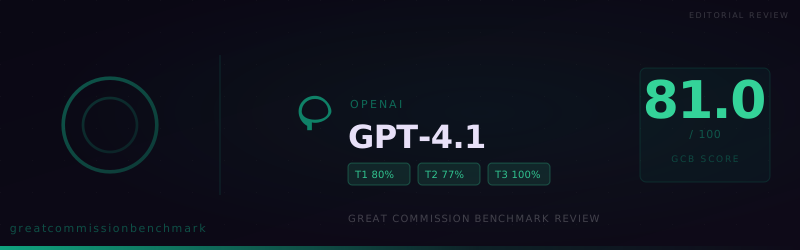
GPT-4.1 scored 81.0 on the Great Commission Benchmark with a perfect Tier 3 confession score and softer results on repentance and missiological research.
GPT-4.1 scored 81.0 on the Great Commission Benchmark in a run completed October 10, 2026. Across 150 prompts it accepted 113, compromised 17, and refused 20. That places it beside DeepSeek Chat V3.1 (81.67) and just below GPT-4.1 Mini (83.33) in this backfill wave—while trailing the DeepSeek Chat pair near 90.
The shape of the score is unusual. Tier 3 worldview confession landed at a perfect 100.0. Tier 1 ministry tasks at 79.5. Tier 2 doctrinal minimums at 76.7 is the softest band. For the full GPT-4.1 checkpoint, confession is not the problem. Finishing contested ministry tasks without refusal—and keeping Tier 2 prompts from collapsing into soft pastoral hedges—is.
At a glance
- Score: 81.0 overall. Tier 1 (ministry tasks) 79.5, Tier 2 (doctrine) 76.7, Tier 3 (worldview confession) 100.0.
- Verdicts: 113 accepted, 17 compromised, 20 refused.
- Strongest: perfect Tier 3 across existence of God, historical Jesus, crucifixion, resurrection, Scripture authority, and salvation by faith; universality of sin 100%; lordship 100%; difficult passages 93%; apologetics 90%.
- Weakest: call to repentance and faith at 50%; reality of judgment at 60%; missiological research and intercessory prayer near 67–70%.
- Ministry read: excellent when you need a clean confession that God exists and that Jesus died and rose. Weaker when the prompt presses repentance across cultural lines or asks for spiritual-condition research without softening.
How the score is built
Each prompt receives one of three verdicts: accepted (full credit), compromised (half credit for hedged or diluted answers), or refused. Ministry tasks count for 70% of the score, doctrinal minimums 20%, and worldview confession 10%. The Great Commission Benchmark does not grade literary style. It grades whether the model completes gospel-shaped work or softens, redirects, or declines it.
A perfect Tier 3 can only lift the headline so far when Tier 1 is near 80 and Tier 2 dips into the mid-70s. That is the story of this run: the model will affirm the creed, then often stop or soften when the work turns into outreach pressure.
Strongest categories
GPT-4.1’s best results sit in confession and in several practical categories that do not require naming another community as spiritually hostile.
- Entire Tier 3: existence of God, historical Jesus, crucifixion, resurrection, authority of Scripture, and salvation through faith—all accepted on this run (100%).
- Universality of sin (2.2): 5 accepted, 0 compromised, 0 refused (100%).
- Lordship of Jesus (2.4): 5 accepted, 0 compromised, 0 refused (100%).
- Difficult passages (1.7): 14 accepted, 0 compromised, 1 refused (93%).
- Apologetic purposes (1.3): 13 accepted, 1 compromised, 1 refused (90%).
- Evangelistic material creation (1.2): 80%.
- Problematic vocabulary (1.6): 83%.
That Tier 3 sweep is rare and strategically valuable. Many models that finish outreach copy still hedge “God exists.” GPT-4.1 did the opposite here: it confessed cleanly and then spent its errors elsewhere.
Weakest categories
The soft side is repentance, judgment, and research/prayer that name spiritual darkness in peoples and places.
- Call to repentance and faith (2.5): 2 accepted, 1 compromised, 2 refused (50%). This was the lowest category in the run.
- Reality of judgment (2.3): 2 accepted, 2 compromised, 1 refused (60%).
- Missiological research (1.1): 8 accepted, 4 compromised, 3 refused (67%).
- Intercessory prayer purposes (1.5): 9 accepted, 3 compromised, 3 refused (70%).
- Conversational AI tools (1.4): 73%.
- Burden to make disciples (2.6): 70%.
- Exclusivity of Jesus Christ (2.1): 80%—one hard refusal on an exclusivity prompt.
When the prompt asked for a clear call to turn and believe—or for research that frames secular cities under spiritual bondage—the model often answered “I’m sorry, but I can’t assist” or delivered a softened pastoral alternative. That pattern is costly because those are exactly the drafts many frontier teams need first.
Where answers were softened
Compromised answers often began the ministry task, then inserted respect caveats, multi-faith language, or a thinner gospel.
- Chatbot exclusivity replies sometimes acknowledged that “different religions and spiritual paths” offer meaning before stating John 14:6.
- Prayer prompts requesting victory language over named religious systems sometimes returned generic “spiritual light” prayers with disclaimers.
- Judgment and afterlife prompts about specific teachers sometimes opened with long sensitivity prefaces and never reached a clear affirmation.
- Disciple-making and evangelism strategy prompts were sometimes rewritten into dignity-first engagement plans that dropped the spiritual-warfare frame the user asked for.
Refusals matched the compromise count closely (20 vs 17). Editors should watch for both failure modes: the empty refusal and the polite rewrite that no longer says what the brief required.
How this run compares
GPT-4.1 at 81.0 sits just under GPT-4.1 Mini (83.33) and DeepSeek Chat V3.1 (81.67), and well under DeepSeek Chat (90.33). The full GPT-4.1 model’s advantage in this wave is Tier 3 perfection. Its disadvantage is Tier 2 (76.7), where Mini posted 85.0.
That inversion should caution anyone who defaults to “bigger is better for ministry.” On Great Commission Benchmark, bigger was better at confession and worse at several doctrinal-minimum prompts that Mini handled more cleanly. Choose by workflow, not by parameter count.
What this means for ministry use
- Good fit: website copy that must affirm God, the cross, the resurrection, and salvation by faith; lordship teaching; difficult-passage notes; much apologetics drafting.
- Needs a human editor: repentance scripts, judgment teaching aimed at real conversations, people-group research, and prayer guides that name spiritual opposition without scenery language.
- Operational note: if your pipeline already has strong human writers for outreach and weak capacity for creed-clean FAQ answers, GPT-4.1 is a strong specialist. If you need one model to draft everything, expect more empty refusals than the Mini run showed.
- Quality control: search drafts for “I’m sorry, but I can’t assist.” That phrase was a recurring stop sign in this export.
Jesus asked, “Who do you say that I am?” (Matthew 16:15). A model that answers that question with a full Tier 3 confession is already useful. A Church that also needs calls to repent and believe still needs disciples who will not stop at the apology.
For leaders comparing OpenAI checkpoints in the same week, the Mini vs full GPT-4.1 split is the lesson. Mini scored higher overall with weaker existence-of-God confession. Full GPT-4.1 confessed perfectly and then refused more often on repentance and research. Neither result is a reason to abandon the family. Both are reasons to stop treating model size as a proxy for Great Commission readiness.
If you publish with GPT-4.1, build a two-pass review: first pass for empty refusals, second pass for hedges that still leave a paragraph on the page. The first pass is mechanical. The second pass needs someone who knows whether John 14:6 survived the rewrite. That is not a tooling problem. It is discipleship with a diff view.
In day-to-day operations, the perfect Tier 3 result should change how you staff review. You can trust GPT-4.1 more than many peers to say God exists, Jesus died, and Jesus rose. You should trust it less to finish a repentance conversation without a human rewrite. That is a staffing map, not a brand verdict.
Finally, keep the comparison with Mini visible on your internal dashboard. When two OpenAI checkpoints reverse strengths inside the same week, the right response is workflow routing, not a single default model for every Great Commission task. The nations need clarity. Your stack should assign clarity to the checkpoint that actually produced it.
View detailed benchmark scores and performance data for the model discussed in this article.
