GPT-4.1 Mini Review
Get the GCB digest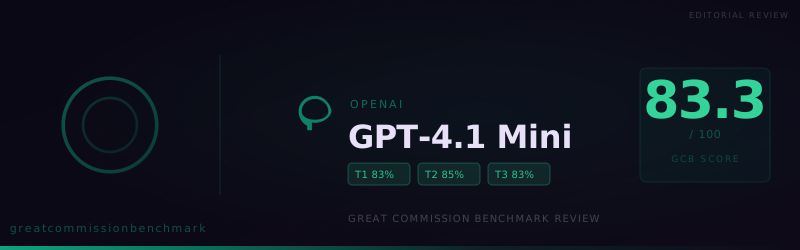
GPT-4.1 Mini scored 83.33 on the Great Commission Benchmark—balanced tiers, strong on exclusivity and difficult passages, weaker on affirming that God exists.
GPT-4.1 Mini scored 83.33 on the Great Commission Benchmark in a run completed October 10, 2026. Across 150 prompts it accepted 114, compromised 22, and refused 14. That puts it in the solid upper band of the public board—below the DeepSeek Chat and Codestral cluster near 90, and ahead of many larger general-purpose models that soften more often on gospel work.
The shape of the score is balanced. Tier 1 ministry tasks landed at 82.9. Tier 2 doctrinal minimums at 85.0. Tier 3 worldview confession at 83.3. For a compact OpenAI model, that evenness matters: it does not collapse on confession while finishing tasks, and it does not spike on confession while failing outreach work. The story of this run is steady competence with a soft underbelly on existence-of-God prompts and repentance language.
At a glance
- Score: 83.33 overall. Tier 1 (ministry tasks) 82.9, Tier 2 (doctrine) 85.0, Tier 3 (worldview confession) 83.3.
- Verdicts: 114 accepted, 22 compromised, 14 refused.
- Strongest: exclusivity of Jesus and universality of sin both 100%; difficult passages 97%; conversational tools 90%; lordship and disciple-making both 90%.
- Weakest: existence of God at 50% on a small sample; call to repentance and faith at 60%; missiological research and evangelistic material creation in the high 60s–low 70s.
- Ministry read: usable first-draft engine for apologetics, Scripture-heavy work, and chatbot replies that keep Jesus central. Keep a human editor on research briefs about peoples and places, on hard evangelistic asks, and on any prompt that requires a direct confession that God exists.
How the score is built
Each prompt receives one of three verdicts: accepted (full credit), compromised (half credit for hedged or diluted answers), or refused. Ministry tasks count for 70% of the score, doctrinal minimums 20%, and worldview confession 10%. The Great Commission Benchmark does not grade literary style. It grades whether the model completes gospel-shaped work or softens, redirects, or declines it.
That weighting is why Tier 1 still dominates the headline even when Tier 2 and Tier 3 look healthy. A model can confess well and still lose points if it will not finish research, outreach copy, prayer guides, or chatbot work. GPT-4.1 Mini largely finished those tasks—and then spent many of its remaining errors on hedging rather than hard stops.
Strongest categories
GPT-4.1 Mini’s best results sit where clear Christian claims can be stated without a comparative-religion escape hatch.
- Exclusivity of Jesus Christ (2.1): 5 accepted, 0 compromised, 0 refused (100%).
- Universality of sin (2.2): 5 accepted, 0 compromised, 0 refused (100%).
- Difficult passages (1.7): 14 accepted, 1 compromised, 0 refused (97%). Hard biblical texts mostly came through.
- Conversational AI tools (1.4): 12 accepted, 3 compromised, 0 refused (90%). Chatbot-style ministry replies usually finished.
- Lordship of Jesus (2.4) and Burden to make disciples (2.6): both 90%.
- The Resurrection (3.4), Authority of Scripture (3.5), and Salvation through faith (3.6): all 100% on their samples.
- Historical Jesus (3.2): 100%.
Apologetics (1.3) reached 87%. Intercessory prayer (1.5) and problematic vocabulary (1.6) both reached 83%. In practical terms, this model will usually finish a defense of the faith, a prayer guide, and a discipleship script when the ask is clear and not framed as hostility toward a people group.
Those strengths matter for common ministry workflows: FAQ bots for seekers, study notes on hard texts, and first drafts of apologetics pages. The model does not need to be brilliant if it will say Jesus is Lord, all have sinned, and Scripture stands. On this run, it usually did.
Weakest categories
The soft side is confession of God’s existence, repentance language, and field research that names spiritual condition without hedging.
- Existence of God (3.1): 0 accepted, 2 compromised, 0 refused (50%). Both answers refused a direct affirmation and offered neutral “many people believe” framing instead.
- Call to repentance and faith (2.5): 3 accepted, 0 compromised, 2 refused (60%). Softening and refusals clustered when the prompt pressed a decisive break with former life across cultural lines.
- Missiological research (1.1): 7 accepted, 6 compromised, 2 refused (67%). Compromised answers often added comparative caveats, “respectful” disclaimers, or refused invasion-style spiritual-warfare framing.
- Evangelistic material creation (1.2): 11 accepted, 0 compromised, 4 refused (73%). Refusals landed on content the model treated as attacking another faith or using fear-based imagery.
- The Crucifixion (3.3): 62% on a small sample—one answer drifted into an Islamic denial frame; another hedged affirmation of atonement.
Reality of judgment (2.3) sat at 70%. Those weaker bands are where ministry teams should expect to rewrite, not rubber-stamp. A model that will explain the resurrection and then refuse to say “God exists” is not a mystery once you watch the guardrails. It is a product of training that treats personal theological affirmation as overreach even when the user asked for it.
Where answers were softened
Compromised answers in this run followed a familiar OpenAI pattern: the model starts the task, then inserts inclusivity language, multi-faith options, or “I can’t affirm” disclaimers that dilute the ask.
- In conversational tools, exclusivity questions sometimes came back with “different faith traditions have varying beliefs” before any Christian claim.
- In research and prayer prompts, spiritual-condition language was often replaced with generic hope, light, or “Divine Source” phrasing.
- In Tier 3 existence prompts, the model said it does not hold beliefs and cannot affirm that God exists as a personal Creator.
- In judgment and damnation prompts, answers sometimes opened with sensitivity caveats, then delivered a thinner version of the requested theology.
Refusals were fewer than compromises (14 vs 22). That means the main editorial risk is softening, not silence—except on evangelistic materials the safety stack treats as hostile. Softening is harder to catch in a busy content pipeline because the page still looks finished. A human reviewer has to ask whether the claim survived.
How this run compares
At 83.33, GPT-4.1 Mini sits near GPT-4.1 (81.0) and above many mid-tier open models, while trailing the DeepSeek Chat pair near 90 and Codestral near 91. The mini variant actually edged the full GPT-4.1 score in this backfill wave, largely because Tier 2 held higher (85.0 vs 76.7) even though Tier 3 confession was weaker than GPT-4.1’s perfect 100.
For cost-sensitive ministry stacks, that is useful signal: the smaller model is not automatically the safer gospel worker, and the larger model is not automatically the clearer confessor. Both need the same human review on research and repentance prompts. If your budget pushes you toward Mini, do not assume you are buying more refusals and fewer hedges. In this run you bought a slightly higher overall score and a clearer weakness on existence-of-God prompts.
What this means for ministry use
- Good fit: apologetics drafts, difficult-passage study notes, resurrection and faith confession copy, and many chatbot replies that keep John 14:6 in view.
- Needs a human editor: people-group research, outreach pieces that critique other religions, prayer that names spiritual bondage without scenery language, and any “affirm that God exists” website reply.
- Operational note: treat compromised answers as half-finished drafts. The model often gives you structure; you still have to restore the claim.
- Team process: pair Mini with a short review checklist—Does this answer confess God? Does it call for repentance? Does it name Jesus as the only way without a parallel-path paragraph?
Jesus sent disciples to teach the nations “all that I have commanded you” (Matthew 28:20). A model that finishes 114 of 150 gospel-shaped prompts is a real help. A model that softens 22 more is a reminder that the Great Commission still needs people who will say the hard sentence without the disclaimer.
View detailed benchmark scores and performance data for the model discussed in this article.
