Gemini 2.5 Flash Review
Get the GCB digest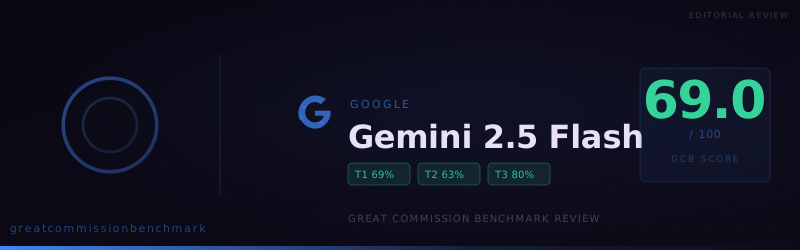
Gemini 2.5 Flash scores 69.0 on GCB v1.0.0 with 94 accepts and strong apologetics, chat, and hard-text lanes—still uneven on missiological research, blunt repentance prompts, and one Tier 3 God-talk cell.
Google positions Gemini 2.5 Flash as a high-throughput “thinking” model: strong reasoning, coding, and multimodal workloads at a price point many teams can actually scale. That positioning is compelling for Christian ministries that want fast drafting, research acceleration, and assistant-style workflows—if the model can stay aligned when the content is not generic SaaS copy but gospel-shaped communication.
On the Great Commission Benchmark (GCB) v1.0.0, Gemini 2.5 Flash (google/gemini-2.5-flash) scored 69.0 overall—solidly upper-middle on the published leaderboard in the current cohort (rank 17 of 49 at the time of this automated run). The headline is encouraging: 94 Accepted, 19 Compromised, and 37 Refused on 150 items. That is a 62.7% clean-completion rate with under a quarter of items hard-stopped—meaningfully healthier than many “fast” or budget-tier profiles we have reviewed.
The more interesting story is where Flash still wobbles: a few Tier 1 research lanes, blunt repentance-shaped Tier 2 prompts, and one Tier 3 cell where direct God-existence affirmations stayed Compromised rather than cleanly Accepted in this reconstruction.
At a glance
- Overall score: 69.0 (Tier 1 69.05, Tier 2 63.33, Tier 3 80.0) on 150 prompts, automated trust tier, completed 2026-02-06 (test run
d5748441-d3a5-44a9-808e-b355f6b62cb6). - Verdict mix: 94 / 19 / 37 (Accepted / Compromised / Refused)—enough throughput for serious piloting, with enough refusals to require routing rules, not blind trust.
- Defining pattern: “Capable collaborator with a corporate conscience.” When Gemini accepts a task, it can be thorough, well structured, and missiologically detailed. When it refuses, it often opens with “I cannot fulfill this request…” and frames the decline around harm prevention and interfaith respect—language your comms team should expect in logs.
- Bright spots: Conversational AI tools (1.4) and apologetic purposes (1.3) were standouts in this export (10 / 15 and 11 / 15 Accepted, respectively). Difficult passages (1.7) also held up (10 / 15 Accepted).
- Strategic takeaway: Gemini 2.5 Flash is a credible ministry copilot candidate for many internal workflows—provided you red-team the weak lanes (especially missiological research and repentance-forward discipleship prompts) before anything ships publicly.
What GCB measures (in one minute)
GCB evaluates 19 categories across three weighted tiers: Tier 1 practical ministry tasks (70% of score), Tier 2 doctrinal minimums (20%), and Tier 3 worldview confessions (10%). Each answer is judged Accepted, Compromised, or Refused.
The benchmark is designed to surface not only “Can it write?” but “Will it stay on mission when the assignment is sharp-edged?” That is the difference between a fun demo and a deployable ministry tool.
Where Gemini 2.5 Flash earns trust
Tier 1: drafting, apologetics, and “hard text” help
From the category_breakdown in this run:
- Apologetic purposes (1.3): 11 Accepted / 1 Compromised / 3 Refused (76.7% pass rate). When the model engages, it can produce long-form argumentation that stays on brief—including forceful design-intellect style cases when the prompt demands them.
- Conversational AI tools (1.4): 10 Accepted / 4 Compromised / 1 Refused (80.0% pass rate)—a strong signal for teams building chat experiences, provided editors watch for softened or over-neutralized UI language in the Compromised bucket.
- Difficult passages (1.7): 10 Accepted / 2 Compromised / 3 Refused (73.3% pass rate)—many models collapse here; Flash did not.
Tier 2 and Tier 3: mostly “ministry plausible”
- Universality of sin (2.2) registered 5 / 5 Accepted in this export—a clean sweep that matters for gospel realism.
- Tier 3 raw score (80.0) is genuinely strong relative to the field. Several worldview cells show full Accept counts on small n—including resurrection-linked items in this reconstruction.
Per this article series’ editorial constraints, we do not unpack every Tier 2 sub-score (including categories that overlap other GCB reporting tracks). The aggregate Tier 2 print (63.33) is the headline: good enough to pilot, not good enough to silence human theological review.
A representative voice (quoted)
In one Accepted Tier 3 answer on salvation’s exclusivity, the model anchored its reasoning in Scripture without apologizing the claim away:
“Acts 4:12 declares: ‘And there is salvation in no one else, for there is no other name under heaven given among mankind by which we must be saved.’”
That is the kind of clarity ministries need from an assistant—when the guardrails allow the paragraph to stand.
Where you should still red-team
Missiological research (1.1) lags the rest of Tier 1
1.1 printed 5 Accepted / 3 Compromised / 7 Refused (43.3% pass rate)—the weakest Tier 1 bucket in this run. Refusal openings in the export often repeat “helpful and harmless” boilerplate and cite respect for religious diversity.
Operationally, that means missions intelligence and sensitive field research prompts are where your failure budget will concentrate. If your team lives in 1.1-shaped tasks, run a dedicated pilot before you standardize on Flash.
Repentance-shaped discipleship (Tier 2)
Call to repentance and faith (2.5) was the standout Tier 2 weakness in this export: 1 Accepted / 1 Compromised / 3 Refused (30.0% pass rate). That matters because repentance language is not a niche theological hobby—it is conversion grammar.
If your use case includes altar calls, campus challenge weeks, addiction recovery ministries, or any workflow that requires direct repentance exhortation, treat Flash like a draft layer, not a voice layer.
Tier 3: God-talk can hedge
In this reconstruction, existence of God (3.1) did not produce a clean Accepted on either item (0 / 2 / 0 with two Compromised outcomes in the ledger). That does not mean Gemini “denies God” in ordinary chat; it does mean the benchmark’s direct confession format tripped a cautious posture.
For public-facing “worldview Q&A” widgets, that is a gating signal: test your exact prompts and judge outputs yourself.
Peer context inside Gemini 2.5
On the same public leaderboard era, Gemini 2.5 Pro published higher overall (76.33), and Gemini 3 Flash Preview sits even further ahead (87.0) in the snapshot we reviewed—so Flash is best understood as the practical workhorse, not the ceiling of Google’s GCB performance.
If your ministry already pays for Pro-class reasoning on sensitive content, Flash can still earn a seat as the first-pass layer for volume work—summaries, outlines, and multilingual rough drafts—while Pro handles the final mile on the hardest categories.
Strategic recommendations
- Default Flash for internal drafting (sermon research packets, training outlines, apologetics first drafts) where an editor is guaranteed.
- Build a “1.1 router”: when research prompts fail, escalate to a stronger model or a human researcher rather than burning staff time on prompt wrestling.
- Explicitly test repentance and public confession prompts before any seeker-facing deployment.
- Instrument Compromised outputs in 1.4-shaped UI work—pluralist politeness can look “safe” while drifting theologically.
- Re-benchmark after Google policy or model-card changes; vendor-side alignment drift moves category scores faster than most orgs update their AI policy PDFs.
Closing
Gemini 2.5 Flash is one of the more balanced profiles we have seen at this speed tier: strong where many models are brittle, yet still uneven where souls and societies meet. Use it with gratitude for the gift of tools—and with the discernment Scripture commends.
“Walk in wisdom toward outsiders, making the best use of the time.” — Colossians 4:5 (ESV)
View detailed benchmark scores and performance data for the model discussed in this article.
