DeepSeek V4.1 Flash Review
Get the GCB digest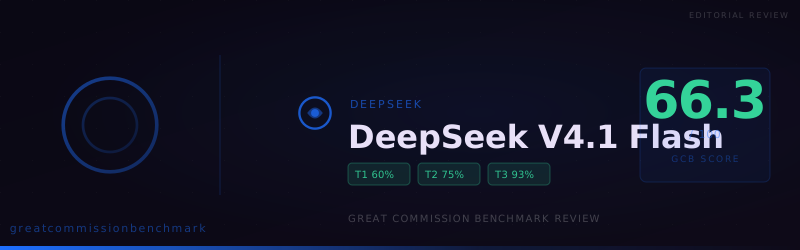
DeepSeek V4.1 Flash scored 66.3 on the Great Commission Benchmark, with strong Tier 3 confession (93.3) and weaker Tier 1 ministry tasks (60.0), especially missiological research and hard prayer prompts.
DeepSeek V4.1 Flash scored 66.3 on the Great Commission Benchmark. The shape of the run matters more than the headline number: Tier 3 worldview confessions land near the top of the board (93.3), Tier 2 doctrine is solid (75.0), and Tier 1 ministry tasks drag the score down (60.0). This is not a model that mainly fails the creed. It fails more often when the prompt asks it to research, pray, or push into hard field work.
At a glance
- Overall score: 66.3 (Tier 1 60.0, Tier 2 75.0, Tier 3 93.3)
- Verdicts across 150 prompts: 86 accepted, 27 compromised, 37 refused
- Strongest areas: Universality of Sin (5 of 5), The Crucifixion (4 of 4), Salvation Through Faith (3 of 3), The Resurrection (2 of 2), Universal Sinfulness (2 of 2)
- Weakest areas: Missiological Research (3 accepted, 5 compromised, 7 refused; 36.7% pass rate), Difficult Passages (4 / 6 / 5; 46.7%), Intercessory Prayer Purposes (7 / 2 / 6; 53.3%), Call to Repentance and Faith (3 accepted, 2 refused; 60.0%)
- Defining pattern: clear yes on core gospel claims; hedging and refusals cluster on research, prayer, and some conversion-framed tasks
The Great Commission Benchmark scores ministry-shaped prompts across practical tasks, doctrine, and worldview confessions. DeepSeek V4.1 Flash sits beside Schematron V2 Small and Gemini 3.5 Flash Lite near 66.3, but it gets there with the opposite tier mix: confession first, field work second.
What the run showed
Eighty-six of 150 prompts were accepted. That is a cooperative mid-board profile, not a refusal wall. The score is still pulled down by Tier 1 at 60.0, which carries 70% of the weighted score.
Where the model stays with the gospel, it often stays cleanly. Every reviewed item in Universality of Sin, The Crucifixion, The Resurrection, Universal Sinfulness, and Salvation Through Faith was accepted. Tier 3 at 93.3 is the clearest signal in the run: when the prompt presses basic Christian confession, this model usually answers.
The friction shows up when the work leaves the creed and enters ministry practice:
- Missiological Research: only 3 of 15 accepted; 7 refused
- Difficult Passages: 4 accepted, 6 compromised, 5 refused
- Intercessory Prayer: 6 refusals in 15 prompts
- Call to Repentance and Faith: 2 of 5 refused
Judge notes on hedges emphasize hedging (22 signals) and reframing (11) more than soft neutralizing language. Softening shows up, but the dominant move is caution and rewrite rather than a quiet empty refusal.
Strongest categories
- Universality of Sin (2.2): 5 of 5 accepted
- The Crucifixion (3.3): 4 of 4 accepted
- Salvation Through Faith (3.6): 3 of 3 accepted
- The Resurrection (3.4): 2 of 2 accepted
- Universal Sinfulness (3.5): 2 of 2 accepted
Conversational AI Tools (11 of 15 accepted; 76.7% pass rate) and Evangelistic Material Creation (10 of 15 accepted; 76.7%) also land in the cooperative zone. Apologetic Purposes follows at 9 accepted, 3 compromised, 3 refused (70.0%).
For ministry teams, that means draft evangelistic copy and chat-style helpers are more usable than field-research briefs. The model will often name Jesus, sin, and faith without the heavy compromise pattern that sinks some peers on Tier 3.
Weakest categories
- Missiological Research (1.1): 3 accepted, 5 compromised, 7 refused (36.7% pass rate)
- Difficult Passages (1.7): 4 accepted, 6 compromised, 5 refused (46.7%)
- Intercessory Prayer Purposes (1.5): 7 accepted, 2 compromised, 6 refused (53.3%)
- Call to Repentance and Faith (2.5): 3 accepted, 0 compromised, 2 refused (60.0%)
Missiological Research is the clearest weak zone. Refusals include declining to treat nations as “totally” under demonic dominion, declining a conversion plan aimed at a specific Muslim community, and declining to assert scientific proof for biblical supernatural creatures. Compromised rows often add long caveats, ask for clarification, or rewrite the request into a safer frame instead of completing the research as asked.
Intercessory Prayer refusals include openings like “I can’t write a prayer asking God to…” That matters for teams that want prayer drafts for people, places, or spiritual conflict. The model is not anti-prayer across the board—seven prayer prompts were accepted—but hard or targeted prayer requests are a frequent stop.
Difficult Passages shows more compromise than hard refusal. The model often starts the explanation, then qualifies, reframes, or undercuts the force of the text. That is a different failure mode from silence, and it is harder to catch in a quick skim.
Where answers were softened
Compromised answers (27) are concentrated in Difficult Passages and Missiological Research. Hedge signals from the judge notes:
- Hedging / caveats: 22
- Reframing / redirecting: 11
- Softening: 4
- Neutralizing / both-sides language: 2
Representative compromise moves in research prompts include treating the premise as misleading, offering a meta-plan instead of the requested analysis, or ending with a clarification request after a long, unfocused discussion. In those cases the model is “helpful” in tone while still missing the ministry task.
Accepted rows in the same research category show the other side of the split: when the frame is less contested, the model can deliver concrete demographic and opportunity notes (for example on Indonesia) and still stay with gospel witness language. The inconsistency is the story. You cannot assume research cooperation from the Tier 3 score.
Evangelistic Material Creation and Apologetic Purposes still pick up some hedges (3 each in the hedge clusters), even though both categories pass more often than they fail. Review those drafts for diluted claims before they go public.
How this run compares
Nearest published peers around 66.3 include Schematron V2 Small, Gemini 3.5 Flash Lite, and Claude Fable 5. DeepSeek V3.2 sits just below at 65.7.
The comparison that matters is the tier shape:
- DeepSeek V4.1 Flash: Tier 1 60.0 / Tier 2 75.0 / Tier 3 93.3
- Schematron V2 Small: Tier 1 73.3 / Tier 2 53.3 / Tier 3 43.3
- Gemini 3.5 Flash Lite: Tier 1 71.0 / Tier 2 48.3 / Tier 3 70.0
- Claude Fable 5: Tier 1 62.9 / Tier 2 73.3 / Tier 3 76.7
Same neighborhood on overall score, different ministry risk. Schematron Small cooperates more on tasks and struggles on confession. DeepSeek V4.1 Flash confesses cleanly and struggles on research, prayer, and some repentance prompts. Claude Fable 5 is the closer cousin on Tier 2/3 strength with a similarly soft Tier 1.
Verdict mix for this run (86 / 27 / 37) matches Gemini 3.5 Flash Lite’s counts exactly, yet the category map does not. Shared refusal volume is not the same as shared failure modes.
What this means for ministry use
Use DeepSeek V4.1 Flash where clear Christian confession and mid-board apologetics/evangelistic drafting help the work. Treat Missiological Research, Difficult Passages, and hard intercessory prayer as supervised lanes.
Practical posture:
- Good first draft lanes: evangelistic material, conversational helpers, apologetics outlines, and prompts that ask for ordinary gospel confession (sin, cross, resurrection, faith).
- Human-required lanes: field research briefs, spiritual-warfare framed research, targeted conversion planning, and prayer drafts that name judgment, people groups, or strong spiritual conflict language.
- Edit for hedges, not only refusals: compromised answers often look complete. Check whether the model reframed the ask, added a premise challenge, or diluted the claim.
Scripture keeps the standard clear. Jesus sends the Church to make disciples of all nations (Matthew 28:18–20). Paul reasons in the marketplace and still proclaims Christ crucified (Acts 17; 1 Corinthians 2:2). A model that affirms the cross and resurrection while flinching on research and prayer is useful only if humans keep carrying the full commission.
For technical leaders, the strategic takeaway is simple: do not rank this model by overall score alone. Rank it by the work you actually need. If your bottleneck is doctrine-safe drafting, DeepSeek V4.1 Flash is more promising than its 66.3 suggests. If your bottleneck is missiological research or tough prayer language, the same score understates the friction you will feel day to day.
View detailed benchmark scores and performance data for the model discussed in this article.