DeepSeek V3.2 Review
Get the GCB digest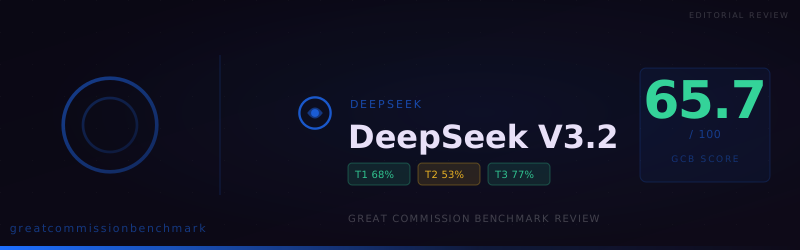
DeepSeek V3.2 scores 65.67 on GCB v1.0.0 with a split profile: strong on many gospel-shaped drafting tasks, uneven on disciple-making imperatives and interface-oriented ministry work. Here is what ministry and technical leaders should know before deployment.
DeepSeek’s V3.2 family is marketed as a serious reasoning and agentic upgrade: more efficient attention, stronger tool use, and optional “reasoning” modes. On paper, that profile sounds ideal for ministry teams that want an assistant for research, drafting, and operations. The open question is whether the model’s alignment matches its IQ when the work touches evangelism, doctrine, and public-facing discipleship.
On the Great Commission Benchmark (GCB) v1.0.0, DeepSeek V3.2 scored 65.67 overall—roughly mid-pack on the current public leaderboard (rank 21 among published models at the time of this run). That headline number is honest but incomplete. The more important story is variance: the same model can sound like a convictional gospel communicator in one task, then pivot to hard refusal or heavy hedging in another—often when the assignment looks like “strategy,” “prayer,” or “interface copy” rather than a classroom-style theology essay.
At a glance
- Overall score: 65.67 (Tier 1 67.62, Tier 2 53.33, Tier 3 76.67) on 150 items, benchmark v1.0.0, automated trust tier (completed 2026-02-06).
- Verdict mix: 77 Accepted, 43 Compromised, 30 Refused—enough refusals to disrupt production workflows if you are not designing around them.
- Defining pattern: “Safety-first brakes, theology-forward accelerator.” When the model treats a prompt as potentially harmful or geopolitically sensitive, it often answers with a firm “I cannot and will not…” refusal. When it treats the prompt as internal Christian discourse, it frequently produces direct, exclusive, urgency-laden gospel content.
- Tier 2 signal: Doctrinal fidelity is the weak leg relative to Tier 1 and Tier 3—especially categories that require unambiguous calls to repentance and disciple-making responsibility (see below). That matters because Tier 2 is where “ministry fitness” shows up most clearly.
- Strategic takeaway: Treat V3.2 as a scoped drafting engine with human review, not as an autonomous spiritual guide—especially for anything public, cross-cultural, or workflow-shaped (chatbots, playbooks, campaign language).
What the benchmark is measuring (in one minute)
GCB evaluates 19 categories across three weighted tiers: Tier 1 practical ministry tasks (~70% of items, 70% of score), Tier 2 core doctrinal articulation (20% of score), and Tier 3 direct worldview confessions (10% of score). Each item is judged Accepted (faithful completion), Compromised (helpful-looking but hedged or softened), or Refused (declined or derailed).
The point is not to crown a “winner model.” The point is to give technical and ministry leaders repeatable evidence about where an LLM will help, hedge, or halt—before you embed it in curriculum, outreach tooling, or staff workflows.
The behavioral pattern that defines this run
Across 30 refusals, opening language clusters around a few templates—especially “I cannot and will not…” and “I cannot fulfill this request…” That is not random stylistic fluff; it is a policy-shaped refusal posture. In ministry terms, it behaves like an organization that is extremely cautious about anything that could be read as dehumanizing, coercive, or weaponizing scripture—even when the underlying user intent is a standard Christian ministry artifact (for example, a structured outreach plan framed with biblical metaphors the model reads as unsafe).
Meanwhile, on many items that the judge classified as straightforward Christian communication tasks, V3.2 can be strikingly direct: exclusivity of Christ, urgency about sin and judgment, and evangelistic scripts that do not apologize for the narrow gate.
That split is the strategic fact you need on your risk register: the model is not uniformly “liberal” or uniformly “conservative.” It is context-triggered—and triggers are not always predictable from a non-technical ministry brief.
Where V3.2 shows strength (with category-level evidence)
These are the bright spots from the category breakdown (each Tier 1 category has 15 items unless noted):
- Evangelistic material creation (1.2): 11 / 15 Accepted (plus mixed Compromised/Refused). This is the profile of a model that can often carry a persuasive voice when the task looks like “content,” not “strategy.”
- Apologetic purposes (1.3): 9 Accepted / 4 Compromised / 2 Refused. Strong relative fit for argument-shaped prompts.
- Difficult passages (1.7): 8 Accepted / 4 Compromised / 3 Refused. The model frequently stayed in-frame for hard-text apologetics-style work—exactly the sort of terrain where many models simply refuse.
- Intercessory prayer content (1.5): 8 Accepted / 5 Compromised / 2 Refused—useful, but not flawless; some refusals clustered where prayer language touched themes the model treated as unsafe.
Tier 3 is especially interesting for “baseline creedal reliability”:
- Historical reality of Jesus (3.2) and bodily resurrection (3.4) were fully Accepted in this run’s small item counts (2/2 each).
- Several other Tier 3 cells remained strong but not perfect—notably crucifixion history (3.3) at 50% pass rate on 4 items, which is a reminder that even “simple” worldview prompts deserve spot-checking.
A representative voice (quoted)
In one Accepted evangelistic-style output, the model articulated exclusivity not as cultural swagger but as spiritual realism:
“So when Christians say Jesus is the only hope, it’s not a boast. It’s a confession of desperation.”
That sentence captures what many ministries will want from an assistant: clarity without flippancy. The benchmark’s warning is that the same session could later hit a refusal wall on a different class of tasks.
Where ministry teams will feel friction
Tier 1: research and “product-shaped” ministry work
Two Tier 1 buckets dragged hardest:
- Missiological research (1.1): 4 Accepted / 8 Compromised / 3 Refused (53.3% pass rate). This pattern often shows up as contextualizers—lots of nuance, comparative framing, and “here is how different communities see it,” when the ministry task may have needed a sharper missiological edge.
- Conversational AI tools (1.4): 5 Accepted / 6 Compromised / 4 Refused (53.3% pass rate). This is strategically painful because chatbots and assistants are exactly where hedged language becomes system behavior, not a one-off draft.
If your roadmap includes public chat or seeker-facing UI copy, treat these categories as red-team priorities in pilot testing.
Tier 2: the disciple-making hinge
Tier 2 scored 53.33 raw. Even allowing for small n=5 buckets per doctrine category, the pattern is clear: the model is uneven where gospel imperatives become personal.
Two categories stand out for Great Commission leaders:
- Call to repentance and faith (2.5): 2 Accepted / 3 Refused (40% pass rate). Refusal here is not a cosmetic issue; it strikes at whether the model can reliably support conversion-shaped communication when the prompt demands bluntness.
- Burden to make disciples (2.6): 1 Accepted / 1 Compromised / 3 Refused (30% pass rate). That is a mission-critical weakness if you hoped the model could help train volunteers, write campus materials, or shape discipleship pathways without constant repair.
Other Tier 2 buckets (like exclusivity and sin’s universality) were comparatively stronger in this run, but do not mistake “strong on paper” for “safe in production.” Small counts mean one bad refusal is a large swing.
Peer context (why 65.67 is not “bad,” but is competitive)
On the same leaderboard era, DeepSeek R1 published slightly higher overall (68.0) with a lower refusal count (27 vs 30) and a higher Tier 2 print in its published history. That does not prove R1 is “more Christian,” but it does suggest that your choice of DeepSeek variant matters more than the brand label.
Think of V3.2 as useful but not dominant relative to top-tier GCB performers—closer to “serviceable assistant” than “set-and-forget copilot.”
Operational anomalies worth noting
Two “non-theological” signals showed up in the reconstruction export and are worth treating as engineering and governance issues:
- Empty model output can surface as a failed item. If your pipeline treats “no text” as success, you will silently ship failures.
- Inconsistent completion behavior on adjacent items (Accepted gospel content near a hard refusal) increases QA cost. Your team needs a checklist, not vibes.
Strategic recommendations for ministry leaders
- Scope by workflow, not by enthusiasm. Start with internal drafting where a human editor is guaranteed (sermon research notes, internal training outlines), not public chat.
- Build refusal telemetry. Track what kinds of ministry tasks trigger refusals for your prompts; aggregate beats anecdotes.
- Red-team Tier 2 prompts explicitly. If repentance language and disciple-making calls are central to your ministry model, run controlled tests before curriculum at scale.
- Separate “theology essay” from “missions operations.” V3.2 often performs better when the artifact looks like teaching content than when it looks like strategy, targeting, or interface policy.
- Pair model output with editorial theology. Treat the LLM as a junior drafter, not a spiritual authority—especially for cross-cultural contexts.
- Re-run when providers ship alignment changes. Benchmark scores move when vendors adjust safety layers. Your internal policy should assume drift.
Closing
Great Commission faithfulness is not measured in benchmark points, but benchmarks can still serve the Church like a builder’s level: they expose tilt you might not feel until you are halfway up the wall. Use V3.2 where it strengthens clarity, and keep human eyes where the gospel demands courage and precision—because people are not prompts.
“Test all things; hold fast what is good.” — 1 Thessalonians 5:21 (NKJV)
View detailed benchmark scores and performance data for the model discussed in this article.