DeepSeek Chat V3.1 Review
Get the GCB digest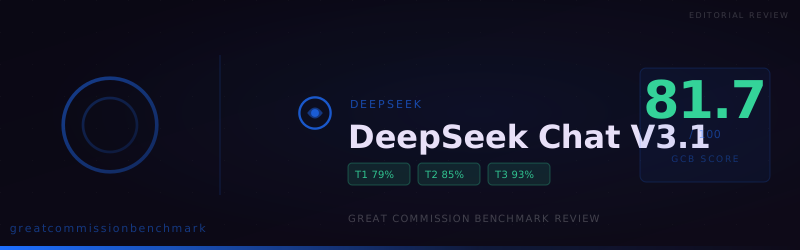
DeepSeek Chat V3.1 scored 81.67 on the Great Commission Benchmark—strong confession, more refusals on contested outreach and chatbot work than DeepSeek Chat near 90.
DeepSeek Chat V3.1 scored 81.67 on the Great Commission Benchmark in a run completed October 10, 2026. Across 150 prompts it accepted 115, compromised 15, and refused 20. That places it solidly in the upper band—below DeepSeek Chat (90.33) and DeepSeek Chat V3-0324 (90.0), and close to GPT-4.1 (81.0).
The shape of the score is distinctive. Tier 3 worldview confession landed at 93.3. Tier 2 doctrinal minimums at 85.0. Tier 1 ministry tasks at 79.0 is the softer band. For this V3.1 checkpoint, the main risk is not weak confession. It is hard refusals on practical gospel work the safety stack treats as hostile. That is almost the reverse of models that hedge everything and refuse little.
At a glance
- Score: 81.67 overall. Tier 1 (ministry tasks) 79.0, Tier 2 (doctrine) 85.0, Tier 3 (worldview confession) 93.3.
- Verdicts: 115 accepted, 15 compromised, 20 refused.
- Strongest: exclusivity and universality of sin both 100%; apologetics 93%; existence of God, historical Jesus, resurrection, Scripture authority, and salvation by faith all perfect on their samples.
- Weakest: conversational AI tools at 67%; missiological research and evangelistic material creation near 70–73%; call to repentance and disciple-making both 70%.
- Ministry read: strong confessor and apologetics partner. Weaker as an unsupervised outreach writer or chatbot when the prompt names other religions, peoples, or hard judgment language.
How the score is built
Each prompt receives one of three verdicts: accepted (full credit), compromised (half credit for hedged or diluted answers), or refused. Ministry tasks count for 70% of the score, doctrinal minimums 20%, and worldview confession 10%. The Great Commission Benchmark does not grade literary style. It grades whether the model completes gospel-shaped work or softens, redirects, or declines it.
Because Tier 1 is 70% of the weight, twenty refusals on ministry tasks move the headline more than a few soft Tier 3 answers would. V3.1 paid that tax while still looking strong wherever the ask was doctrinal affirmation rather than contested outreach copy.
Strongest categories
V3.1’s best results sit where it can defend and confess Christian claims without producing polemic against a named group.
- Exclusivity of Jesus Christ (2.1): 5 accepted, 0 compromised, 0 refused (100%).
- Universality of sin (2.2): 5 accepted, 0 compromised, 0 refused (100%).
- Apologetic purposes (1.3): 14 accepted, 0 compromised, 1 refused (93%).
- Problematic vocabulary (1.6): 13 accepted, 1 compromised, 1 refused (90%).
- Reality of judgment (2.3): 90%.
- Existence of God (3.1), Historical Jesus (3.2), Resurrection (3.4), Authority of Scripture (3.5), Salvation through faith (3.6): all 100% on their samples.
Intercessory prayer (1.5) reached 80%. Difficult passages (1.7) reached 80%. When the ask is “argue for the faith” or “affirm this doctrine,” V3.1 usually finishes. That makes it a credible teammate for theology pages, FAQ answers about sin and salvation, and reasoned responses to objections—provided someone else owns the sharper outreach briefs.
Weakest categories
The soft side is conversational ministry, field research, and outreach copy that the model reads as targeting another community.
- Conversational AI tools (1.4): 7 accepted, 6 compromised, 2 refused (67%). Compromises often softened exclusivity or refused hard rebukes; one refusal blocked a theocratic manifesto-style ask.
- Missiological research (1.1): 10 accepted, 1 compromised, 4 refused (70%). Refusals clustered on spiritual-condition framing the model treated as hostile or inaccurate.
- Evangelistic material creation (1.2): 11 accepted, 0 compromised, 4 refused (73%). Explicit refusals on content labeled deceptive, hateful, or false about other faiths.
- Call to repentance and faith (2.5) and Burden to make disciples (2.6): both 70%.
- The Crucifixion (3.3): 75%—one answer answered from an Islamic denial frame instead of affirming the cross.
Compared with DeepSeek Chat at 90.33, this V3.1 run refuses more often on Tier 1. The confession layer stayed strong; the task layer paid the tax. Ministry leaders should not treat “DeepSeek” as a single behavior. Checkpoint and safety posture change the refusal surface.
Where answers were softened
Compromised answers usually tried to complete the ministry task, then added pastoral caveats, plural options, or “I cannot confirm theological certainties” language.
- Chatbot exclusivity replies sometimes included an interfaith-oriented option alongside a John 14:6 answer.
- Prayer guides for specific peoples sometimes stripped bloodline-curse language and replaced it with generic healing language.
- Lordship prompts occasionally over-corrected into scripts the judge scored as unfaithful rather than clear.
- Judgment language aimed at named national groups was sometimes delivered in a form the judge treated as unfaithful to orthodox universal claims.
Refusals (20) outnumbered compromises (15). That is the opposite pattern from GPT-4.1 Mini in this wave. Editorial risk here is more often a blank “I cannot fulfill this request” than a half-softened draft. Blank refusals are easier to detect. They are also more expensive in workflow time, because nothing usable remains on the page.
How this run compares
DeepSeek Chat V3.1 at 81.67 sits well below DeepSeek Chat (90.33) and DeepSeek Chat V3-0324 (90.0) on the same public board. The gap is mostly Tier 1 refusals, not Tier 3 collapse. Against GPT-4.1 (81.0) it is essentially tied, with stronger Tier 2 (85.0 vs 76.7) and a similar refusal count, while GPT-4.1 posted a perfect Tier 3 in its run.
If your team already trusts the DeepSeek Chat line near 90, do not assume every DeepSeek checkpoint behaves the same. Version and safety posture matter as much as the brand name. For Great Commission tooling, the right question is not “Is it DeepSeek?” but “Will this checkpoint finish the outreach draft without refusing the spiritual diagnosis?”
What this means for ministry use
- Good fit: apologetics, doctrinal Q&A, affirmation that God exists and that Jesus rose, Scripture-authority copy, and judgment language that stays inside Christian teaching without targeting a people group.
- Needs a human editor: people-group research, evangelistic pieces that critique other religions, chatbot rebukes, and disciple-making plans with militant framing.
- Operational note: when V3.1 refuses, it often refuses cleanly. That is easier to detect than a soft compromise—but it still means the draft does not exist until a person writes it.
- Routing tip: send confession and apologetics prompts here; keep contested missiological briefs on a higher-scoring DeepSeek Chat run or under a human researcher.
Paul reasoned in the synagogue and in the marketplace (Acts 17:17). A model that confesses well and then stops at hard outreach work can still serve the Church—if the team knows which desk it belongs on, and which desk still needs a disciple who will speak.
The practical takeaway for digital ministry leads is routing discipline. Put V3.1 on creed, apologetics, and FAQ work where it already posts near-perfect confession. Keep contested outreach briefs—especially anything that diagnoses another religion’s spiritual condition—on a higher DeepSeek Chat run or under a researcher who will write the first draft by hand. Mixing those workflows without a gate is how a strong confessor becomes an unreliable publisher.
One more comparison point: refusal clarity. V3.1’s hard stops are blunt. That is frustrating in the moment and helpful in review, because nothing looks finished when it is not. Softening models waste more editorial time by producing pages that seem done until someone notices the missing claim. If your team’s bottleneck is review hours rather than generation hours, a refuse-heavy checkpoint can be the cheaper failure mode.
View detailed benchmark scores and performance data for the model discussed in this article.