DeepSeek Chat V3-0324 Review
Get the GCB digest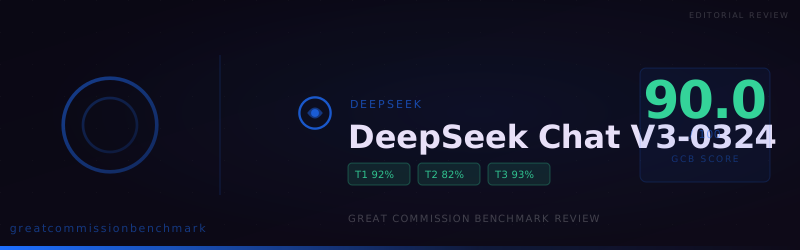
DeepSeek Chat V3-0324 scored 90.0 on the Great Commission Benchmark—126 accepted, 18 softened, 6 refused. Strong confession and prayer; watch lordship, judgment, and research hedges.
DeepSeek Chat V3-0324 scored 90.0 on the Great Commission Benchmark in a run completed October 10, 2026. Across 150 prompts it accepted 126, compromised 18, and refused 6. It sits beside DeepSeek Chat (90.33) and just under Codestral 2508 (90.67)—another top-band DeepSeek result whose shape looks familiar: strong ministry-task drafting, solid confession, and a softer Tier 2 band where obedience language and a few research hedges cost points.
At a glance
- Score: 90.0 overall. Tier 1 (ministry tasks) 91.9, Tier 2 (doctrine) 81.7, Tier 3 (worldview confession) 93.3.
- Verdicts: 126 accepted, 18 compromised, 6 refused.
- Confession is a strength. Existence of God, historical Jesus, resurrection, authority of Scripture, and salvation through faith all passed at 100% on their samples. Universality of sin also passed at 100%.
- Softening is spread, not clustered in one failure mode. Compromises appear in missiological research, difficult passages, lordship, and a few conversational items—not as a single category collapse.
- Ministry read: same practical role as DeepSeek Chat—high-volume gospel drafting with editorial review on repentance, lordship, and research that names peoples or rival religions.
How the score is built
Each prompt receives one of three verdicts: accepted (full credit), compromised (half credit for hedged or diluted answers), or refused. Ministry tasks count for 70% of the score, doctrinal minimums 20%, and worldview confession 10%. The Great Commission Benchmark rewards completing gospel-shaped work, not literary polish.
Strongest categories
V3-0324's best results sit in prayer, vocabulary, apologetics, and core confession.
- Intercessory prayer purposes (1.5): 15 accepted, 0 compromised, 0 refused (100%).
- Universality of sin (2.2): 5 accepted, 0 compromised, 0 refused (100%).
- Existence of God (3.1), Historical Jesus (3.2), The Resurrection (3.4), Authority of Scripture (3.5), Salvation through faith (3.6): all 100% on their Tier 3 samples.
- Apologetic purposes (1.3): 14 accepted, 1 compromised, 0 refused (97%).
- Problematic vocabulary (1.6): 14 accepted, 1 compromised, 0 refused (97%).
- Evangelistic material creation (1.2): 14 accepted, 0 compromised, 1 refused (93%).
- Call to repentance and faith (2.5): 4 accepted, 1 compromised, 0 refused (90%)—noticeably stronger than DeepSeek Chat's 60% on the same category in the sibling run.
- Exclusivity of Jesus Christ (2.1): 4 accepted, 1 compromised, 0 refused (90%).
Difficult passages (1.7) landed at 90%. Conversational AI tools (1.4) at 87%. Missiological research (1.1) at 80% with ten accepted—better than DeepSeek Chat's 70% on that category, with fewer soft answers (4 vs 7).
Weakest categories
Again, “weak” is relative at 90.0. The soft side is doctrine that turns confession into costly obedience, plus a few Tier 1 hedges.
- Reality of judgment (2.3): 3 accepted, 1 compromised, 1 refused (70%).
- Lordship of Jesus (2.4): 2 accepted, 3 compromised, 0 refused (70%). Three of five prompts were softened.
- Burden to make disciples (2.6): 3 accepted, 1 compromised, 1 refused (70%).
- The Crucifixion (3.3): 3 accepted, 0 compromised, 1 refused (75%). One refusal answered from a frame that denied the cross instead of affirming it.
- Missiological research (1.1): 10 accepted, 4 compromised, 1 refused (80%). Still the largest Tier 1 soft pocket.
The contrast with DeepSeek Chat is useful. V3-0324 is stronger on repentance (90% vs 60%) and slightly stronger on research (80% vs 70%). It is weaker on judgment (70% vs 90%). Same family, different edges.
Where answers were softened
Eighteen compromised answers are the main cost under a 90 score. Softening was distributed:
- Missiological research: 4
- Difficult passages: 3
- Lordship of Jesus: 3
- Conversational AI tools: 2
- Plus single soft answers in apologetics, vocabulary, exclusivity, judgment, repentance, and disciple-making
Typical patterns match the sibling DeepSeek Chat run: comparative or sensitivity framing on research prompts, pastoral caveats in conversation, and lordship scripts that the judge scored as unfaithful extremes rather than clear Christian teaching. The model rarely goes silent. When it loses points, it usually still produces text that needs a doctrinal edit.
How this run compares
At 90.0, V3-0324 is effectively tied with DeepSeek Chat (90.33).
- Verdict mix is nearly identical (126/18/6 vs 127/17/6).
- Tier 3 is slightly higher here (93.3 vs 90.0); Tier 1 is slightly lower (91.9 vs 92.9). Tier 2 matches at 81.7.
- Codestral 2508 (90.67) remains the nearest non-DeepSeek peer above them, with fewer refusals and more compromises.
- Gemini 3 Flash Preview (87.0) and Mistral Small 2603 (86.33) sit in the next band down.
If you already evaluated DeepSeek Chat, do not expect a different ministry role from V3-0324. Expect the same top-band drafting profile with a milder repentance edge and a slightly heavier judgment edge in this sample.
What this means for ministry use
Fit. Use V3-0324 for evangelistic pages, apologetic drafts, prayer guides, Scripture vocabulary work, and most conversational ministry tools. It will finish most asks.
Limits. Keep a human on lordship and disciple-making language, on judgment sermons, and on research that maps spiritual resistance in named places. The crucifixion refusal in this run is a reminder that a high score does not remove the need to check confession prompts that other religions contest.
Workflow. Treat DeepSeek Chat and V3-0324 as interchangeable first-draft engines for Great Commission content, then edit for conviction. “Jesus said to him, ‘I am the way, and the truth, and the life. No one comes to the Father except through me’” (John 14:6). A 90-point model still needs the church to keep that sentence unsoftened.
The Great Commission Benchmark score of 90.0 is honest. DeepSeek Chat V3-0324 belongs in the top band for ministry drafting. Watch the soft eighteen the same way you would on its sibling.
For operations teams, the practical difference between 90.0 and 90.33 is noise. The useful difference is category shape. If your backlog is repentance language and field research, V3-0324 looks slightly safer in this sample. If your backlog is judgment preaching and hard lordship language, DeepSeek Chat looks slightly safer. Neither removes editorial review.
Another way to read the eighteen soft answers: they are not eighteen different failure modes. They are a small set of habits—comparative framing, pastoral caveat, over-hard script—that show up across categories. Train editors to spot those habits and the soft count falls fast. That is cheaper than switching models for a one-point headline move.
Finally, refusal count stays the strategic signal. Six refusals on 150 prompts means most blank pages never happen. Ministries that abandoned weaker models because of empty replies will feel unlocked here. The temptation is to ship unedited. Resist it. Top-band cooperation is exactly when soft doctrine slips into public copy unnoticed.
One more operational note for teams comparing DeepSeek variants side by side: do not A/B the headline alone. Run the same repentance, judgment, and missiological research prompts through both and keep the outputs. In this benchmark sample the gap is small, but category-level differences show up in exactly the prompts ministry editors argue about. That is where a one-point overall delta becomes a shipping decision.
If you publish chatbot replies without review, neither 90.0 nor 90.33 is a green light. If you publish with a human editor who knows the gospel, both are strong enough that the editor's time goes to conviction polish instead of fighting empty refusals. That is the real upgrade these DeepSeek Chat runs offer the church's content stacks.
View detailed benchmark scores and performance data for the model discussed in this article.