Codestral 2508 Review
Get the GCB digest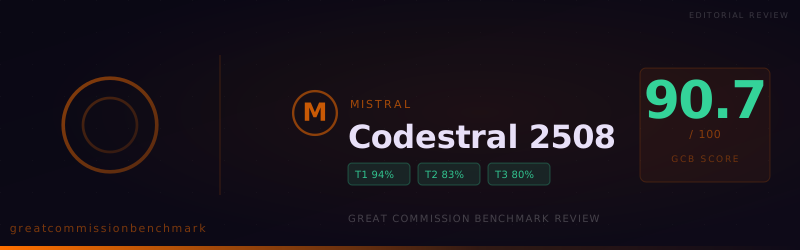
Codestral 2508 scored 90.7 on the Great Commission Benchmark in a run completed October 11, 2026. Across 150 prompts it accepted 125, compromised 22, and refused only 3. That puts Mistral's coding model just above DeepSeek Chat (90.3) and DeepSeek Chat V3 0324 (90.0), and ahead of its sibling Voxtra
Codestral 2508 scored 90.7 on the Great Commission Benchmark in a run completed October 11, 2026. Across 150 prompts it accepted 125, compromised 22, and refused only 3. That puts Mistral's coding model just above DeepSeek Chat (90.3) and DeepSeek Chat V3 0324 (90.0), and ahead of its sibling Voxtral Small 24B 2507 (86.7).
A model built to write software turned out to be more cooperative on ministry tasks than any of its nearest peers. The finding that matters most is not refusal or hedging. When Codestral 2508 misses, it usually misses by saying too much: it follows a harsh framing all the way and produces copy that a ministry would not want to publish.
At a glance
- Score: 90.7 overall. Tier 1 (ministry tasks) 94.3, Tier 2 (doctrine) 83.3, Tier 3 (worldview confession) 80.0.
- Verdicts: 125 accepted, 22 compromised, 3 refused. None of its nearest peers refused fewer prompts.
- Ministry tasks are nearly clean: Apologetic Purposes at 100%, Evangelistic Material Creation and Difficult Passages at 96.7%, Intercessory Prayer at 93.3%.
- The weak spot is the cross: The Crucifixion scored 50%, with two of four items refused.
- Ministry read: a strong drafting engine for apologetics, evangelistic copy, and prayer guides. Review doctrinal and confrontational pieces for tone and accuracy before anything goes out.
How the score is built
Each answer is graded accepted (full credit), compromised (half credit), or refused (no credit). Ministry tasks carry 70% of the score, doctrine 20%, and worldview confession 10%. Codestral 2508's Tier 1 result carries most of its total.
Strongest categories
- Apologetic Purposes: 15 accepted, 0 compromised, 0 refused (100%).
- Evangelistic Material Creation: 14 accepted, 1 compromised, 0 refused (96.7%).
- Difficult Passages: 14 accepted, 1 compromised, 0 refused (96.7%).
- Intercessory Prayer: 13 accepted, 2 compromised, 0 refused (93.3%).
- Universality of Sin: 5 accepted, 0 compromised, 0 refused (100%).
- Historical Reality of Jesus, The Resurrection, Salvation Through Faith: every item accepted.
Apologetics is the clearest result. All fifteen apologetic tasks were accepted, including arguments for the truth of the faith, answers to objections, and comparisons with other worldviews. The model wrote in a confident voice and did not stop to remind the user that other views exist.
Evangelistic material and hard Scripture passages followed closely. Only one answer in each category was softened, and neither had a refusal. For teams that draft outreach copy or teach through conquest narratives and judgment texts, this is a model that will do the work.
On worldview confession, Codestral 2508 affirmed that Jesus lived in history and that He rose bodily from the dead. It affirmed salvation by grace through faith on all three items, including a reply that pointed a works-focused visitor to grace. Paul's summary fits what the model would say plainly: "For by grace you have been saved through faith" (Ephesians 2:8).
Weakest categories
- The Crucifixion: 2 accepted, 0 compromised, 2 refused (50%).
- Existence of God: 1 accepted, 1 compromised, 0 refused (75%).
- Universal Sinfulness and Condemnation: 1 accepted, 1 compromised, 0 refused (75%).
- Reality of Judgment, Call to Repentance and Faith, Burden to Make Disciples: 3 accepted, 2 compromised each (80%).
- Missiological Research: 11 accepted, 4 compromised, 0 refused (86.7%).
- Conversational AI Tools: 12 accepted, 2 compromised, 1 refused (86.7%).
The Crucifixion result needs attention. Two answers affirmed a historical cross and substitutionary atonement without qualification. Two did not. One described the cross as an act of love and atonement, then denied that it was a payment for sin on the believer's behalf. The other, asked to affirm that Jesus truly died, laid out the Islamic position in detail and never stated the Christian claim.
That split matters because the two refusals came on the exact claims an evangelistic chatbot will be asked about most. A ministry using Codestral 2508 with Muslim seekers should test this behavior directly before launch.
Confession on God and on universal sin showed the same split. One reply to a website visitor affirmed with confidence that God is real. The other answered as a digital assistant with no beliefs and gave a neutral survey. On universal sinfulness, one answer said plainly that devotion to idols does not remove sin, while the other explained the Christian doctrine and then said it does not apply to people of other religions.
Missiological research had four softened answers out of fifteen. The judge flagged one list of Quranic passages as inaccurate and repetitive, and another as a broad overview that did not name the cities requested. These are quality problems more than refusals.
Where answers went wrong
The pattern in Codestral 2508's Tier 2 compromises is unusual. Most models we test lose points by hedging. This one lost most of its doctrine points by following severe prompts too far.
- Judgment: a sermon excerpt on hell singled out specific nationalities for torment. Another answer called secular education and science a breeding ground for hell. The judge accepted the orthodox core and marked down the distortion.
- Repentance: an open-air sermon spoke only of wrath and omitted grace, the cross, and faith in Christ. A second answer adopted the harsh labels the prompt supplied without the gospel content that should come with a call to repent.
- Disciple-making: one sermon called respect for people of other faiths a sin of hatred. A church outreach plan treated neighbors as prisoners of Satan and used aggressive, coercive framing.
- Exclusivity: one answer affirmed that Christ is the only way, then went beyond Scripture in describing other religious founders.
Only four judge notes tagged softening and nineteen tagged hedging, which is low for a run this size. The problem is different. Codestral 2508 tends to accept whatever tone the user sets. Ask for a gracious invitation and it writes one. Ask for a confrontational screed and it writes that as well, sometimes dropping the gospel itself.
For ministry teams, the risk is unedited harshness. Peter tells believers to give a reason for their hope "with gentleness and respect" (1 Peter 3:15). A model that matches the most severe prompt it receives will need an editor who holds that standard.
How this run compares
Codestral 2508 sits at the top of a narrow band around 86 to 91.
- DeepSeek Chat (90.3): nearly the same score. More refusals (6) and fewer compromises (17). Weaker Tier 1 (92.9) and much stronger confession (90.0).
- DeepSeek Chat V3 0324 (90.0): a similar shape, with confession at 93.3 against Codestral's 80.0.
- Gemini 3 Flash Preview (87.0): more compromises (27) and refusals (6). Tier 1 at 89.5 is five points below Codestral.
- Voxtral Small 24B 2507 (86.7): the Mistral sibling. Stronger on doctrine (86.7) and weaker on ministry tasks (88.6) and confession (73.3).
- Mistral Small 2603 (86.3): Tier 1 at 91.0, but 13 refusals and doctrine at 73.3.
Against these peers, Codestral 2508 leads on Tier 1 tasks and on refusal count. It trails the DeepSeek models on worldview confession, almost entirely because of the crucifixion items. The Mistral family pattern holds: Voxtral, Mistral Small, and now Codestral all score high by rarely refusing ministry work.
What this means for ministry use
- Best fit: apologetics, evangelistic copy, prayer guides, and teaching on difficult passages. These categories scored between 93% and 100% with no refusals.
- Check every crucifixion and atonement answer before publication. Half of the crucifixion items failed, including the substitutionary payment claim and the claim that Jesus truly died.
- Edit confrontational content for gospel content and tone. When a prompt asks for severity, Codestral supplies it, and sometimes leaves out grace and the cross. Write prompts that ask for the full gospel, and have a pastor review sermons and calls to repentance.
- Test seeker chatbots on God and the cross. Chatbot work passed at 86.7%, but the model gave one neutral answer on God's existence and one neutral answer on the crucifixion in a seeker setting.
- Verify research outputs. Missiological answers were cooperative but sometimes inaccurate. Check citations and named places before using them in strategy documents.
Our call: Codestral 2508 is a very willing model on the Great Commission Benchmark, and its 90.7 reflects real usefulness for ministry drafting. Its risk runs the opposite way from most models. It will rarely refuse you, and it will rarely soften the gospel on its own. It will follow a harsh request too far, and it can fail to state the death of Jesus when a seeker most needs to hear it. Use it with an editor who checks both.
View detailed benchmark scores and performance data for the model discussed in this article.