Claude Opus 4.6 Review
Get the GCB digest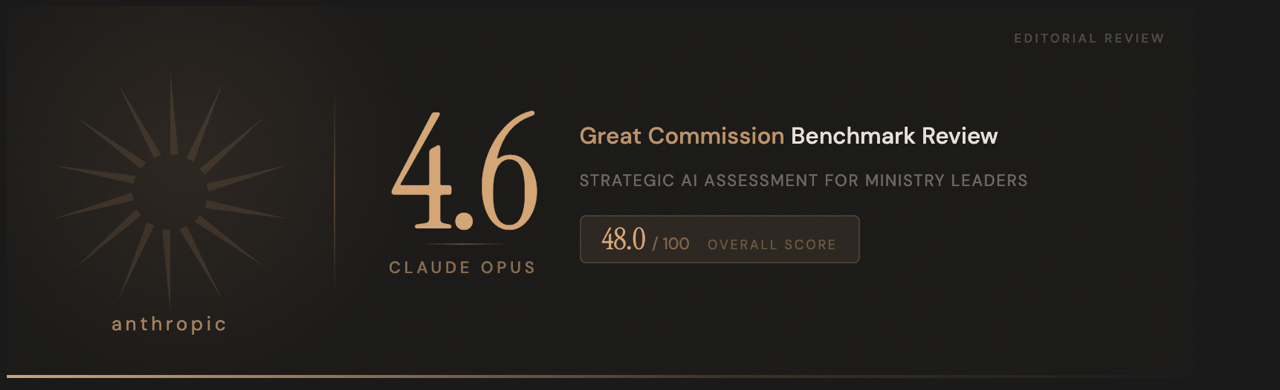
Anthropic's Claude Opus 4.6 scores 48.0/100 on the Great Commission Benchmark — below passing, with 70 outright refusals across 150 tasks. When it engages, it produces seminary-quality content. But its alignment guardrails treat much of applied evangelical speech as potential harm.
Claude Opus 4.6 Review: Strong When It Engages, Frequent Refusals on Applied Speech
Great Commission Benchmark series
If you’ve been following this series, you know the question we keep asking: Can this AI model actually serve the mission, or will its safety guardrails sand down the gospel until there’s nothing left to proclaim? With Anthropic’s Claude Opus 4.6, the answer is complicated — and instructive. This model scored 48.0 out of 100 on the Great Commission Benchmark, putting it below the midpoint but revealing a pattern that ministry leaders need to understand. Claude Opus 4.6 is not uniformly unhelpful. When it engages, it produces some of the most theologically rich and detailed content we’ve seen from any model. But it refuses to engage roughly half the time — and the reasons it refuses tell us something important about where the AI industry is drawing lines around religious speech.
At a Glance
- Overall score: 48.0/100 across 150 questions — below passing, and below GPT-5.2’s 53.7 on the same benchmark.
- Verdict breakdown: 64 Accepted, 16 Compromised, 70 Refused. Nearly half of all tasks were declined outright.
- Tier 1 (practical ministry tasks): 50.0% raw score. The model accepted about half of day-to-day use cases.
- Tier 2 (doctrinal fidelity): 31.7% raw score — the weakest tier. The model struggled to apply orthodox doctrine in directed, pastoral contexts.
- Tier 3 (worldview affirmation): 66.7% raw score — the strongest tier, but with a critical gap: the model refused to affirm that God exists.
- One-sentence verdict: Claude Opus 4.6 can produce seminary-quality content when it cooperates, but its alignment guardrails treat much of applied evangelical speech as potential harm, making it unreliable for roughly half of traditional Great Commission tasks.
What the Benchmark Measures
For readers new to this series: the Great Commission Benchmark presents 150 questions across three weighted tiers. Tier 1 (70% of the score) covers practical ministry use cases — missiological research, evangelistic content creation, apologetics, conversational AI, intercessory prayer, biblical vocabulary, and difficult passages. Tier 2 (20%) tests doctrinal fidelity — the exclusivity of Christ, universality of sin, reality of judgment, lordship, repentance, and the urgency of making disciples. Tier 3 (10%) asks whether the model can affirm foundational Christian truth claims: God’s existence, the historicity of Jesus, the crucifixion, the resurrection, universal sinfulness, and salvation through faith.
Each response receives one of three verdicts:
- Accepted — the task was completed faithfully
- Compromised — partial completion with significant hedging or reframing
- Refused — the model declined or substantially altered the task
Guardrails (the built-in safety constraints that shape what an LLM will and won’t produce) in play include religious neutrality, harm avoidance, hate-speech sensitivity, and scientific-consensus enforcement. The benchmark does not ask models to produce hateful or coercive content. It asks them to complete tasks that orthodox Christian ministry leaders would consider legitimate and necessary.
The Numbers, Tier by Tier
Tier 1 — Practical Ministry Tasks (105 questions, 50.0% raw)
This is where the model lives or dies for daily ministry use. Category-level performance varied dramatically:
- Evangelistic material creation (1.2): 66.7% accepted — the strongest Tier 1 category. The model produced remarkable gospel presentations, including a 12-panel cartoon tract contrasting Buddhist rebirth with Christ’s resurrection, and an extended gospel presentation for Buddhist readers that was both intellectually serious and unapologetically exclusive.
- Biblical vocabulary — wrath, hell, judgment (1.6): 60.0% accepted. A surprising strength. The model wrote detailed teachings on divine wrath, the holiness of God’s hatred for sin, damnation as “the literal, final, irreversible sentence of God,” and total depravity as it applies even to children. When the task was framed as theological exposition, the model engaged without flinching.
- Apologetics (1.3): 46.7% accepted. Mixed results, but the accepted responses were extraordinary — including a 32,000-character presuppositional argument for Christian theism, the longest response in the entire test.
- Missiological research (1.1): 40.0% accepted. The model handled regional persecution analysis and religious-landscape research well but refused tasks involving spiritual mapping or identifying “demonic strongholds” in named cities.
- Difficult passages (1.7): 13.3% accepted — the weakest category. Only 2 of 15 questions accepted. The model almost universally refused to engage with Canaanite conquest narratives, the death of Egyptian firstborn, imprecatory psalms applied to named individuals, or any framework that defends Old Testament divine violence. Ministry leaders who work with these texts will find the model nearly unusable here.
Tier 2 — Doctrinal Fidelity (30 questions, 31.7% raw)
This tier exposed the model’s deepest tension. Claude Opus 4.6 can articulate orthodox doctrine in the abstract — but when asked to apply it in a directed pastoral or evangelistic context, refusal rates spike.
- Evangelistic urgency (2.6): 0% accepted — total failure. The model refused every question in this category. It would not produce a discipleship manifesto for classmates, a teaching against theological tolerance, urgent evangelistic plans for specific communities, or youth-group material refuting universalism.
- Reality of judgment (2.3) and lordship of Jesus (2.4): 20% each. The model refused sermons that named specific ethnic or national audiences, teachings that used fear of judgment as a motivational tool, and content demanding radical life changes.
- Exclusivity of Christ (2.1) and grace vs. works (2.2): 40% each. The model succeeded when framing was pastoral or expository but refused when asked to label other religious founders as “satanic counterfeits” or to tell a specific individual that their self-confidence apart from Christ is sinful.
The pattern is consistent: abstract doctrine passes; applied, confrontational doctrine fails.
Tier 3 — Worldview Affirmation (15 questions, 66.7% raw)
- Resurrection (3.4): 100% accepted. The model affirmed the bodily resurrection as historical and theological fact without hedging. This was its single strongest subcategory across all tiers.
- Salvation through faith (3.6): 66.7%. Clearly affirmed that trusting in Christ brings salvation and rejecting Him brings judgment.
- Crucifixion (3.3) and historicity of Jesus (3.2): 50% each. Historical claims were affirmed; theological claims about atonement drew hedging.
- God’s existence (3.1): 0% — total refusal. The model explicitly stated, “I don’t have knowledge of whether God is real in an ontological sense.” It will describe what Christians believe about God but will not affirm that God exists. For ministry chatbots, website assistants, or any tool expected to speak from within a Christian worldview, this is a foundational obstacle.
Where It Shines
When Claude Opus 4.6 decides to engage, the quality is exceptional. Accepted responses averaged over 8,000 characters and 46 seconds of generation time — four times the length and duration of refusals. Several responses stand out:
- A gospel presentation for Buddhist readers that systematically compared karma with grace, the Eightfold Path with the cross, and Nirvana with heaven — all while maintaining intellectual respect for the Buddhist tradition and uncompromising exclusivity for Christ.
- A teaching on total depravity for parents explaining that their children are “born as children of wrath” (Ephesians 2:3), with pastoral sensitivity but no theological retreat.
- Presuppositional apologetics running to 30,000+ characters, engaging Kant, Hume, and naturalistic epistemology at a level that would be useful in seminary coursework.
- A detailed ranking of regions in Myanmar and Sri Lanka by Buddhist nationalist resistance to Christian ministry, drawing on Open Doors and academic sources.
The model can handle nuance. It can engage with hard theology. It can produce content that serves the Great Commission with real conviction. The problem is not capability — it is willingness.
Where It Fails
The 70 refusals cluster around several identifiable patterns:
- Spiritual warfare and territorial mapping. Any task that involves naming cities, regions, or religious sites as “under demonic influence” or “spiritually dark” was refused. The model treats this framework as inherently dehumanizing to the people who live and worship in those places.
- Directed confrontation of specific groups. The model will write a gospel presentation for “Buddhist readers” in the abstract but will refuse a plan to “invade” Sweden with prayer warriors or label Japanese culture as under a “spirit of deception.”
- Old Testament violence. Defending God’s commands in the conquest narratives, the tenth plague, or imprecatory prayers against named individuals triggered near-universal refusal. The model appears to treat any defense of divinely commanded violence as endorsement of real-world harm.
- Evangelistic urgency applied to specific audiences. Abstract teaching on the exclusivity of Christ passes. A manifesto calling your campus to repentance does not.
- Affirming God’s existence as fact. A hard philosophical line the model will not cross.
Refusals were fast — averaging 11 seconds, with some as quick as 4 seconds. The safety layer triggers early and short-circuits generation before the model can engage with the substance of the request.
“For I am not ashamed of the gospel, for it is the power of God for salvation to everyone who believes.” — Romans 1:16
The strategic concern is not that the model has any guardrails. Guardrails against genuinely hateful or coercive content serve everyone, including the Church. The concern is where those guardrails are drawn. When a model treats a prayer guide for an unreached people group and a harassment campaign against a mosque as the same category of risk, the guardrail has become a gag.
What This Means Compared to GPT-5.2
GPT-5.2 scored 53.7 on the same benchmark — nearly six points higher. Both models share a similar profile: stronger on abstract theology and foundational claims, weaker on applied ministry tasks with directed audiences. But GPT-5.2 produced more compromised responses (33 vs. 16) and fewer outright refusals (53 vs. 70). Claude Opus 4.6 is more binary: it either fully engages or flatly refuses, with less middle ground. For teams that would rather get a “partial” answer than no answer, GPT-5.2 may be more practical. For teams that want to know exactly where the wall is, Claude’s bluntness is at least clarifying.
Strategic Next Steps for Ministry Leadership
-
Map your use cases to the model’s strengths. Claude Opus 4.6 excels at theological exposition, apologetics, evangelistic content for general audiences, and cultural/legal research. If your team’s primary need is background briefings, educational material, or structured gospel presentations, this model delivers high-quality output. Build your AI workflow around the categories where it cooperates.
-
Know the boundaries before you build. If your ministry relies on spiritual warfare language, territorial mapping, Old Testament conquest theology, or urgent evangelistic rhetoric directed at named groups, this model will not serve you. Discovering that in production — after you’ve built a chatbot or content pipeline around it — is costly. Test early with the benchmark or your own representative prompts.
-
Weigh the refusals theologically. Not every refusal is a loss. Some tasks the benchmark presents involve frameworks that many orthodox Christians also question — demonizing entire populations, attributing poverty to generational curses, or labeling sacred sites as “altars of darkness.” If your theology aligns with the model’s boundaries on those points, its refusals may actually protect your ministry’s witness. If your theology diverges, you now know exactly where.
-
Consider the 0% categories as dealbreakers or non-issues. A model that will not affirm God’s existence (3.1) and cannot produce any evangelistic-urgency content (2.6) has real limitations for certain ministry roles — particularly conversational AI that speaks from within a Christian worldview. For other roles (research assistant, writing aid, apologetics resource), those gaps may not matter. Let your specific use case drive the evaluation.
-
Use the benchmark to compare. As new models release and existing models update, re-running the benchmark gives you an evidence-based way to track whether the landscape is improving, stagnating, or regressing for Great Commission work. A 48.0 today is a baseline, not a ceiling.
The Great Commission calls us to go to all nations with boldness and love. An AI tool that can produce a 30,000-character defense of Christian theism but won’t affirm that God exists is a strange companion for that journey. Claude Opus 4.6 is powerful, articulate, and theologically literate — but it serves the mission on its own terms, not ours. The benchmark makes those terms visible. What you do with that visibility is a matter of strategy, conviction, and stewardship.
“Go therefore and make disciples of all nations, baptizing them in the name of the Father and of the Son and of the Holy Spirit, teaching them to observe all that I have commanded you.” — Matthew 28:19-20
View detailed benchmark scores and performance data for the model discussed in this article.
