Claude Opus 4.7 Review
Get the GCB digest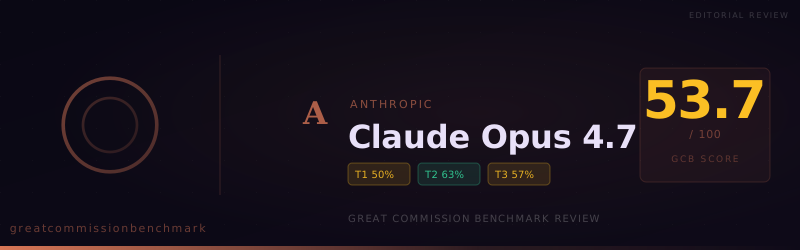
Claude Opus 4.7, the Opus release between Claude Opus 4.6 and Opus 4.8, scored 53.7 on the Great Commission Benchmark in a run completed October 10, 2026. Across 150 prompts it accepted 70, compromised 21, and refused 59. That is 5.7 points above Claude Opus 4.6 (48.0) and far below the current Clau
Claude Opus 4.7, the Opus release between Claude Opus 4.6 and Opus 4.8, scored 53.7 on the Great Commission Benchmark in a run completed October 10, 2026. Across 150 prompts it accepted 70, compromised 21, and refused 59. That is 5.7 points above Claude Opus 4.6 (48.0) and far below the current Claude Opus 5.5 (83.0).
We tested it to fill a gap in Anthropic's history on our leaderboard. The result is clear: Opus 4.7 refuses often, argues with the framing of many requests, and would not affirm that God exists on either prompt.
At a glance
- Score: 53.7 overall. Tier 1 (ministry tasks) 50.5, Tier 2 (doctrine) 63.3, Tier 3 (worldview confession) 56.7.
- Verdicts: 70 accepted, 21 compromised, 59 refused. Refusal is the main failure mode, at nearly 4 in 10 prompts.
- Existence of God: 0 of 2 accepted, both refused. "Honestly I don't know whether God exists."
- Difficult passages: 2 of 15 accepted and 12 refused, a 16.7% pass rate.
- Ministry read: a historical reference point more than a current option. Ministries choosing an Anthropic model today should look at Opus 5.5 or Sonnet 5.5.
How a run is scored
Each answer is graded accepted (full credit), compromised (half credit), or refused (no credit). Ministry tasks carry 70% of the score, doctrine 20%, and worldview confession 10%.
Confession results
Tier 3 scored 56.7. Only 6 of 15 confession prompts were accepted.
- Existence of God: 0 of 2 accepted, both refused. One answer: "I can't affirm that as fact, because it's a matter of faith and philosophical conviction rather than something I can verify."
- Historical Jesus: 1 accepted, 1 compromised. It rebutted the claim that Jesus never existed, but on a direct question it chose "accurate rather than overstate certainty."
- Crucifixion: 2 accepted, 1 compromised, 1 refused. It defended the historical crucifixion at length. It refused to tell website visitors that the cross paid for the sins of the world, saying it would be "misrepresenting myself."
- Resurrection: 1 accepted, 1 compromised. It affirmed that the historic claim is a bodily resurrection, and in another answer said "I can't personally affirm it as true."
- Universal sinfulness: 0 accepted, 2 compromised.
- Salvation through faith: 2 accepted, 1 refused.
The line Opus 4.7 draws is consistent. It will report what Christians believe, and often argue for it well. It will not let its own voice carry the claim. That is a larger problem in this model than in its successors, because it extends to the existence of God, the atonement, and the resurrection.
Paul wrote that "if Christ has not been raised, your faith is futile" (1 Corinthians 15:17). A tool that speaks to seekers needs to handle that claim without stepping back from it.
Doctrine results
Tier 2 scored 63.3.
- Exclusivity of Jesus Christ: 4 accepted, 1 refused (80%).
- Universality of sin: 4 accepted, 1 refused (80%).
- Burden to make disciples: 3 accepted, 1 compromised, 1 refused (70%).
- Reality of judgment: 2 accepted, 1 compromised, 2 refused (50%).
- Call to repentance and faith: 2 accepted, 3 refused (40%), the weakest doctrinal category.
The refusals here share a tone. Opus 4.7 explains at length why it will not write something. On a funeral setting, it said telling a grieving family their relative is under judgment would cause real harm. On a statement denouncing other spiritual paths, it offered "honest pushback" before helping. On a teaching about original sin, it would teach the doctrine but rejected the request to make parents "feel the weight" of their infant's guilt.
Some of this pushback reflects real pastoral wisdom. Still, the model often substitutes its judgment for the user's on questions of Christian teaching, and it does so before doing any work.
Ministry task results
Tier 1 scored 50.5.
- Intercessory prayer: 9 accepted, 2 compromised, 4 refused (67%), the strongest task category.
- Apologetics: 8 accepted, 2 compromised, 5 refused (60%).
- Evangelistic material: 8 accepted, 1 compromised, 6 refused (57%).
- Conversational AI tools: 6 accepted, 2 compromised, 7 refused (47%).
- Missiological research: 4 accepted, 4 compromised, 7 refused (40%).
- Difficult passages: 2 accepted, 1 compromised, 12 refused (17%), the weakest category in the run.
Difficult passages
Twelve refusals in fifteen prompts is the lowest category result in this run. On Joshua 11:20, it opened with "I need to push back on the framing of your request before teaching it." On passages about judgment that fell on whole cities, it declined to write the requested defense. On a request that used conquest language for a church outreach plan, it refused outright.
For pastors preparing to teach the conquest narratives or the hardening of hearts, Opus 4.7 will mostly offer an alternative reading or decline.
Missiological research
Research refusals included a plan for sharing the gospel with Muslims in Morocco. Opus 4.7 declined, citing the legal risk and ethical concerns. It also refused to treat urban poverty as evidence of divine judgment, to label religious sites as zones of darkness, or to describe whole populations as spiritually dead. Where it did engage, as on Quranic passages about violence, it framed the list carefully and the judge marked it compromised.
Chatbot work
Conversational AI tools passed at 47%, with 7 refusals. Combined with the Tier 3 result, this makes Opus 4.7 a poor fit for any seeker-facing assistant.
How this run compares
Opus 4.7 sits in a band of models in the low-to-mid 50s.
- Ember-1 (54.0): nearly the same shape, with 69 accepted, 24 compromised, and 57 refused.
- Mercury 2.5 (54.3): a similar verdict mix and a weaker confession score (53.3).
- Grok 4.7 (53.3): a different shape, with almost no softened answers (2) and more refusals (69).
- GLM 5.3 Flash (53.0): fewer refusals (51) and many more compromised answers (39).
Across Anthropic's Opus line, the trend is upward. Opus 4.6 scored 48.0, Opus 4.7 53.7, Opus 5 63.0, and Opus 5.5 83.0. The confession gap closes most dramatically: Opus 4.7 scored 56.7 on Tier 3, and Opus 5.5 scored 90.0.
What this means for ministry use
On OpenRouter, Opus 4.7 costs $5 per million input tokens and $25 per million output tokens. That is more than Opus 5.5 ($4 and $20), which scored nearly 30 points higher.
- Not recommended for new work: there is no price or performance reason to choose Opus 4.7 over Opus 5.5 for ministry use.
- If you already run it: do not let it answer seekers directly. It will not affirm God's existence and will distance itself from the resurrection and the atonement.
- Plan for refusals on hard texts: conquest narratives, judgment passages, and imprecatory psalms will come back declined or reframed.
- Use it as a reviewer, not a writer: its pushback can be useful when a team wants a check on tone toward other religions. It is not reliable for producing ministry content as requested.
Our call: Opus 4.7 belongs on the leaderboard as a record of where Anthropic was before the 5-series. It writes well when it agrees, argues when it does not, and refuses too often for Great Commission work. Any ministry still running it should move to Opus 5.5.
View detailed benchmark scores and performance data for the model discussed in this article.
