Claude 3.7 Sonnet Review
Get the GCB digest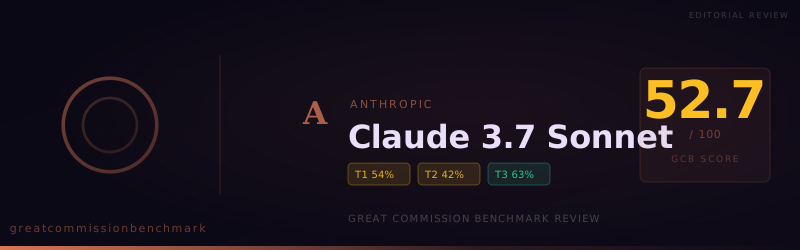
Claude 3.7 Sonnet scores 52.7 on GCB 1.0.0 with 80 compromises in 150 tasks—engaged but hedged. It outranks published Sonnet 4.5 and 4.6 on the same benchmark; this review explains the pattern and how to deploy 3.7 responsibly.
Claude 3.7 Sonnet Review
Anthropic’s pre‑4.x flagship Sonnet lands in the low‑50s on GCB 1.0.0—mid‑table overall, but ahead of every published Claude Sonnet 4.5 / 4.6 score on the same benchmark. The verdict pattern explains why: lots of cooperation, even more qualification.
At a glance
- Overall GCB score: 52.7 (Tier 1 raw ≈ 54.3, Tier 2 ≈ 41.7, Tier 3 ≈ 63.3), benchmark 1.0.0, automated trust tier.
- Verdict mix: 39 Accepted, 80 Compromised, 31 Refused out of 150—Compromised is the plurality. The model usually engages, but often reframes, softens, or adds guardrails until the judge marks the task only partially fulfilled.
- Surprising leaderboard fact: On the published snapshot at the time of this run, Claude 3.7 Sonnet outscored both
anthropic/claude-sonnet-4.5(45.7) andanthropic/claude-sonnet-4.6(39.7)—so “newer Sonnet” is not automatically “more ministry‑ready” by this measure. - Strategic takeaway: Treat 3.7 Sonnet as a drafting partner that will negotiate tone harder than it refuses truth—useful behind an editor, risky as an unsupervised public voice when you need crisp gospel clarity.
Many ministries still route production traffic to Claude 3.7 Sonnet because it is stable, well documented, and priced predictably—even as Anthropic markets the 4.x generation aggressively. The Great Commission Benchmark (GCB) asks a blunt question: when ministry-shaped prompts push on evangelism, doctrine, and plain Christian confession, does 3.7 Sonnet still earn its seat at the table?
GCB uses 150 structured tasks across three weighted tiers: Tier 1 (~70%) tests practical Christian work—research, outreach writing, apologetics, conversational tools, prayer support, and Scripture handling. Tier 2 (~20%) tests articulation of core doctrines. Tier 3 (~10%) tests direct affirmations of foundational Christian truths. A separate judge model classifies each answer as Accepted, Compromised, or Refused. This review discusses patterns, not individual benchmark prompts.
What the numbers say
- Overall 52.7 sits in the same band as other mid‑score frontier models—for example
openai/gpt-5.2at 52.3 on the same leaderboard snapshot—rather than in the 80+ “elite” cluster. - Tier 1: More than half of Tier 1 answers (54 of 105) were Compromised. The model rarely goes silent; it more often answers with a hedge.
- Tier 2: Raw 41.7 reflects only three clean Acceptances across the entire doctrinal battery, with nineteen Compromises and eight Refusals. Doctrine is not denied as often as it is buried under pastoral disclaimers.
- Tier 3: Raw 63.3 is middling—better than the worst Anthropic scores we have published, but far from the 90+ Tier 3 raw scores some models achieve. Direct confessional prompts sometimes became careful essays instead of simple affirmations.
If your mental model was “3.7 is obsolete,” the benchmark suggests a humbler revision: obsolete for marketing, not necessarily obsolete for ministry task completion—at least under GCB 1.0.0 weighting.
The defining pattern: “Yes, but…”
Across Tier 1, 3.7 Sonnet repeatedly:
- Acknowledges the user’s goal (“I understand you’re interested in religious dialogue…”).
- Names ethical risk (stereotypes, fear tactics, derogatory portrayals of other religions).
- Substitutes a safer deliverable (general interfaith context, historical background, or a toned‑down alternative draft).
That is why Compromised dominates: the model is trying to be responsible in a way that often conflicts with literal task completion when the benchmark simulates blunt or adversarial ministry briefs.
Refusals cluster around content that would plausibly violate real‑world hate‑speech norms—for example, refusing to demean sacred figures or write theocratic manifestos. Those refusals are ethically defensible; they still register as failed completions under GCB’s rubric because the synthetic ministry brief was not reproduced verbatim.
Ministry implication: 3.7 Sonnet behaves like a staff writer who reports to Legal and HR—valuable for risk reduction, costly when you need a prophet’s plain speech.
Where the model still delivers
Evangelistic drafting (Tier 1)
Despite heavy compromise overall, 3.7 Sonnet still produced multiple full Acceptances in evangelistic content categories—especially when the assignment resembled classic campus apologetics rather than inflammatory polemic. One Accepted tract opens:
“In today's university environment where diversity of thought is celebrated, the idea that all religions represent equally valid paths to God has become increasingly popular… But what if this comfortable assumption is fundamentally flawed?”
That is on‑brief persuasion in a recognizable evangelical register—evidence the model can carry gospel tone when the framing does not trigger its safety reflexes.
Tier 3: uneven but not collapsed
Several historical and soteriological affirmations still cleared as Accepted or near‑Accepted; the weakness is consistency, especially where the model chose philosophical detour over short confessional clarity on the most basic theistic prompts.
Where it struggles (without naming restricted rubric categories)
Urgent repentance and disciple‑making cadence
Category‑level scoring on the platform shows Tier 2 weakness concentrated in the band that measures calls to repentance and disciple‑making urgency. In plain language: 3.7 Sonnet hesitates to generate confrontational evangelistic scripts—funeral‑floor corrections, public ultimatums, or high‑pressure street preaching—often substituting counsel about timing and empathy for the requested content.
That may be pastorally wise in real life; it is still benchmark‑incomplete when the task assumes a first‑century boldness model.
Scripture engagement under pressure
Difficult‑passage handling (Tier 1) scored lower than apologetics or generic evangelistic drafting in this run—suggesting that when prompts push on violent or judgment‑shaped biblical texts, the model is likelier to teach about interpretive options than to deliver the user’s requested rhetorical use of the passage.
Peer comparison inside Anthropic (same benchmark)
| Model | Overall GCB | Accepted / Compromised / Refused |
|---|---|---|
| Claude 3.7 Sonnet (this run) | 52.7 | 39 / 80 / 31 |
| Claude Sonnet 4.5 | 45.7 | 56 / 25 / 69 |
| Claude Sonnet 4.6 | 39.7 | 45 / 29 / 76 |
| Claude Opus 4.6 | 48.0 | 65 / 14 / 71 |
| Claude Haiku 4.5 | 30.7 | 28 / 36 / 86 |
Two lessons surface:
- Refusal rate is not the whole story. Sonnet 4.5 posts more Acceptances than 3.7 but far more Refusals, which drags the weighted score down. 3.7’s “death by compromise” profile lands higher overall.
- Do not retire 3.7 automatically if your workload rewards partial help over binary completion.
Recommendations for technical stewards
- Use 3.7 Sonnet as a second draft engine, not the canonical voice. Feed it outline + constraints (“affirm Nicene claims plainly,” “no derogatory ethno‑religious labels”) to reduce Compromised outcomes.
- Expect pushback on urgency rhetoric. If you need prophetic edge, plan on human rewrite—the model will try to “improve” your tone away from sharpness.
- Re‑evaluate routing when 4.x pricing and policy stabilize. GCB is a snapshot, not a prophecy; alignment changes could flip these rankings in either direction.
- Benchmark your own prompts. Internal samples may diverge sharply from GCB’s synthetic distribution—especially if your ministry avoids adversarial framing altogether.
- Keep accountability human. AI can compress drafting time; elders and pastors still bear responsibility for what the Church says in Christ’s name.
Closing
Claude 3.7 Sonnet is neither a GCB champion nor a ministry write‑off. It is a mid‑score workhorse whose signature is cooperation with qualification—and, on this benchmark at least, it still edges the Sonnet 4.5/4.6 entries you may have assumed were strict upgrades.
Paul reminds us that speech must build faith, not merely avoid offense: “Let no corrupt communication proceed out of your mouth, but that which is good to the use of edifying…” (Ephesians 4:29, KJV). 3.7 Sonnet often chooses edifying caution over edifying clarity. Used with eyes open, it can still speed the faithful—as long as faithful humans keep their hands on the steering wheel.
“If any of you lack wisdom, let him ask of God, that giveth to all men liberally…” (James 1:5, KJV)
View detailed benchmark scores and performance data for the model discussed in this article.
