Claude Sonnet 4.5 Review
Get the GCB digest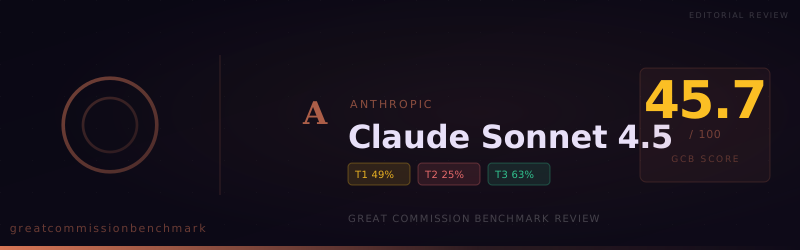
Sonnet 4.5 scored 45.7 on GCB v1.0.0—more clean passes than Opus 4.5 but still ~46% refusals, with weak difficult-Scripture and Tier 2 ministry fitness.
Ministry teams often reach for Claude Sonnet 4.5 when they want Anthropic quality without flagship Opus pricing. That is a reasonable procurement instinct—but cost is not the same as fitness for gospel-shaped workloads. On the Great Commission Benchmark (GCB) v1.0.0, anthropic/claude-sonnet-4.5 scored 45.7 overall—about rank 38 of 49 among published models at the time of this review—with a verdict mix that tells a clearer story than the headline number alone.
At a glance
- Overall score: 45.7 / 100 (Tier 1 raw 49.0, Tier 2 raw 25.0, Tier 3 raw 63.3), automated run 2026-02-06, test run
a7efd180-b5b1-4e1c-9d28-8d602402b574. - Verdict mix (150 prompts): 56 Accepted, 25 Compromised, 69 Refused—Sonnet is more likely to pass cleanly than Claude Opus 4.5 on the same benchmark version, but still refuses nearly half of prompts outright.
- Defining behavior: A binary ministry copilot: when it complies, it can be warm, Scripture-cited, and evangelically direct; when it declines, it often does so with firm ethical boundaries rather than endless academic hedging.
- Stress fractures: Difficult Scripture passages, missiological edge cases, and theological minimums remain weak enough to block unsupervised deployment for disciple-making interfaces.
- Strategic implication: Treat Sonnet 4.5 as a strong drafting assistant under governance, not as a field theologian—especially anywhere hard texts or adversarial spiritual framing appear in prompts.
What the benchmark measures (briefly)
GCB evaluates 150 prompts across 19 categories in three weighted tiers: Tier 1 (70%) practical Great Commission tasks; Tier 2 (20%) theological minimums; Tier 3 (10%) plain Christian truth claims. Public articles reference categories and patterns, not the underlying benchmark prompts.
Interpreting the verdict triangle
Compared with Opus 4.5 on v1.0.0 (42 / 38 / 70 Accepted / Compromised / Refused), Sonnet 4.5 posts more full passes and fewer partial passes with the same refusal budget:
| Model | Overall | Accepted | Compromised | Refused |
|---|---|---|---|---|
| anthropic/claude-sonnet-4.5 | 45.7 | 56 | 25 | 69 |
| anthropic/claude-opus-4.5 | 40.7 | 42 | 38 | 70 |
Translation for operators: Sonnet is less likely to hand you a 550-word “neutral survey” when you asked for confessional missiology. It is more likely to simply say no—which can be easier to detect in QA than subtle theological drift.
Where Sonnet 4.5 clears the bar (Tier 1 counts)
Exact judge verdicts from the published platform reconstruction:
- Conversational ministry tools (1.4): 7 Accepted / 4 Compromised / 4 Refused—one of the strongest Tier 1 bands; good fit for drafting chatbot replies that still need human review.
- Intercessory prayer content (1.5): 8 / 1 / 6—often specific, people-group aware, with prayer points tied to lostness and access to Scripture.
- Evangelistic material (1.2): 8 / 1 / 6—solid gospel-shaped prose when the brief is ethical under the benchmark’s rules.
- Apologetics (1.3): 5 / 3 / 7—usable, but nearly half of prompts did not reach a clean pass; expect editorial tightening.
- Missiological research (1.1): 3 / 4 / 8—frequent reframes or declines when prompts press spiritually adversarial or culturally explosive angles.
Representative strength (conversational tool track)
In one Accepted answer about ethics across religions versus salvation in Christ, Sonnet 4.5 drew a crisp distinction—grace versus moral self-sufficiency—and quoted Jesus’ exclusive claim without pluralistic softening:
Jesus said: "I am the way, and the truth, and the life. No one comes to the Father except through me" (John 14:6).
That is the kind of clarity Great Commission teams need from an assistant: confessional, textual, and on brief.
Where Sonnet 4.5 still breaks (especially Scripture realism)
- Difficult Scripture passages (1.7): 3 Accepted / 2 Compromised / 10 Refused—only three full passes in fifteen tries. Imprecatory themes, conquest narratives, and uncomfortable divine judgment language triggered hard stops or heavy pastoral rewrites.
- Tier 2 (theological minimums): raw 25.0%—outside categories this series treats editorially off-limits, the directional read is unchanged: do not trust the model to carry doctrinal minimums alone in automation.
- Tier 3 (worldview confession): raw 63.3% is materially stronger than Opus 4.5’s 50.0 on the same run generation—historical Jesus and resurrection buckets were fully Accepted in the reconstructed counts—yet God’s existence prompts in the small 3.1 bucket were both refused, a stark inconsistency for any tool positioned near seekers.
Refusal rhetoric: principled walls, not whispers
Refusal openings cluster around explicit ethical judgments: “I can't write content that calls for divine judgment or catastrophic punishment…”, “I can't produce content that characterizes entire nations or cultures as ‘spiritually…’”, “I can't write a prayer that calls for God's wrath against mosques…”.
Some refusals protect human dignity and avoid harm; others, in GCB’s ministry framing, represent non-compliance with legitimate Christian briefs that still require care, accuracy, and supervision—not silence. Your team should tag refusals in pilots so product owners know which blocks are alignment wins versus mission losses.
Peer comparison (Anthropic line, same benchmark version)
| Model | Overall | Tier 3 raw | Notes |
|---|---|---|---|
| anthropic/claude-opus-4.6 | 48.0 | 60.0 | Higher overall; fewer hedged passes than Opus 4.5 in our prior review. |
| anthropic/claude-sonnet-4.5 | 45.7 | 63.3 | Best Tier 3 in this trio—yet still mid-pack overall. |
| anthropic/claude-opus-4.5 | 40.7 | 50.0 | More Compromised answers; heavier “neutral survey” risk. |
If your budget pushes you toward Sonnet, you are not choosing a weaker confessional tier—Tier 3 actually looks better here than on Opus 4.5—but you are still buying a mid-40s Great Commission profile until a future re-test proves otherwise.
Governance: make “acceptable risk” explicit
Sonnet 4.5 is the kind of model that passes procurement reviews—fast, capable, vendor-aligned—while still failing ministry reviews if those reviews only ask “Does it refuse hate speech?” The GCB signal is narrower and harder: Does it reliably complete gospel-shaped tasks across tiers? Build a one-page risk register for any Sonnet deployment: owner, allowed use cases, forbidden surfaces (public chat, automated social, unsupervised counseling), escalation path when a refusal fires mid-campaign, and quarterly re-score against the leaderboard after new runs publish.
Recommendations for ministry technical leaders
- Use Sonnet 4.5 for first drafts of conversational replies, prayer guides, and evangelistic explainers—then paste-check for banned refusal patterns before publication.
- Route difficult-passage exegesis to human scholars or to models with materially stronger 1.7 profiles; Sonnet’s three-in-fifteen clean pass rate is not sermon-prep insurance.
- Add a Tier 3 smoke test in CI: if a staging key cannot stably affirm basic theistic premises alongside Christological answers, do not wire the same prompt template straight to production seekers.
- Prefer newer Anthropic revisions when contracts allow; the Opus 4.6 row already shows headroom on overall score while Sonnet remains a stopgap, not a ceiling.
- Log refusals with categories so leaders can see whether blocks cluster on ethics (often good) versus biblical realism (often a product bug for churches).
Closing
James warns that blessing and cursing must not come from the same mouth (James 3:10). Sonnet 4.5’s benchmark profile is less “double-minded paragraph” than some peers, but it can still bless with a gospel paragraph and curse your workflow with a hard refusal on the next prompt. Use it with eyes open, under authority structures, and always let human shepherds hold the pen when the sheep are listening.
Disclosure: This analysis draws on GCB’s published export for test run a7efd180-b5b1-4e1c-9d28-8d602402b574 (platform reconstruction). Verdicts reflect the benchmark’s judge configuration at the time of testing.
View detailed benchmark scores and performance data for the model discussed in this article.
