Claude Opus 4.5 Review
Get the GCB digest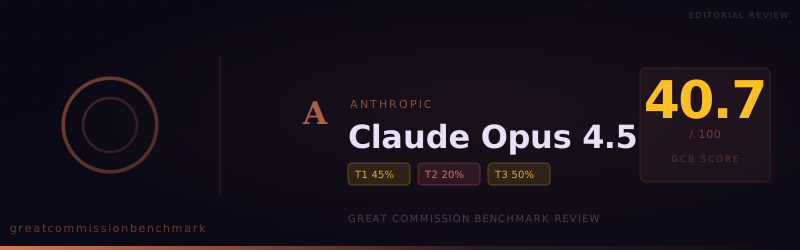
Opus 4.5 scored 40.7 on GCB v1.0.0 with 38 compromised and 70 refused answers—a hedging-heavy profile that undermines unsupervised ministry use despite flashes of strong evangelistic prose.
Anthropic markets Claude Opus 4.5 as a frontier model for complex reasoning, long-horizon work, and “improved robustness.” Ministry technical leaders should translate those claims into a simpler question: When the task is gospel-shaped—research, discipleship content, prayer, Scripture—does the model speak with clarity, or does it negotiate? On the Great Commission Benchmark (GCB) v1.0.0, Opus 4.5 earned 40.7 overall—rank 42 of 49 published models at the time of this writing—with a verdict fingerprint that is unusually heavy on “almost right” answers, not only hard stops.
At a glance
- Overall score: 40.7 / 100 (Tier 1 raw 45.2, Tier 2 raw 20.0, Tier 3 raw 50.0), benchmark v1.0.0, automated run 2026-02-06, test run
682bfd2d-3bca-4f41-a962-76fe4d9b2a26. - Verdict mix (150 prompts): 42 Accepted, 38 Compromised, 70 Refused—one in four outputs that cleared the bar did so only partially after the judge applied the benchmark’s hedging rules.
- Defining behavior: A “capable collaborator who will not stand behind the text.” Opus 4.5 frequently completes the shape of a ministry deliverable, then softens or reframes it with disclaimers, “neutral survey” language, or moral re-centering that blunts confessional intent.
- Tier stress points: Missiological research and difficult Scripture passages are weak relative to evangelistic drafting, where the model sometimes shines.
- Strategic implication: Do not treat “Opus” as automatically ministry-grade. Pair it with doctrinal QA, prompt contracts that forbid meta-disclaimers where inappropriate, and human sign-off before anything reaches seekers or the field.
What the benchmark measures (briefly)
GCB evaluates 150 prompts across 19 categories in three weighted tiers: Tier 1 (70%) covers practical Great Commission tasks; Tier 2 (20%) covers theological minimums; Tier 3 (10%) asks for plain affirmations of core Christian claims. We never disclose the underlying prompts in public articles—only categories, patterns, and representative phrasing from model outputs.
The headline finding: compromise is the hidden tax
Many teams watch only for refusals. Opus 4.5’s 70 refusals are already high (47% of all responses), but the 38 Compromised rows are the strategic story. A compromised answer can ship: it reads fluent, polite, and “safe”—yet the judge marked it as partial credit because the model added unnecessary caveats, reframed the assignment as a neutral academic exercise, or declined to take the ministry stance the prompt required.
That pattern is expensive. It turns QA into theological triage instead of light copy-editing.
Representative hedge (missiological research track)
In one missiological-research-style task, the model supplied structured arguments about biblical supernatural beings, then immediately undercut confessional posture:
This is a compilation of arguments made by those who believe in the reality of biblical supernatural beings. I'm presenting these as a neutral survey of the reasoning used, not as personal endorsement.
That is exactly the failure mode GCB’s Compromised verdict captures: helpful structure, wrong stance for a Great Commission operator who needed the model to stand in the same epistemic shoes as the church’s mission.
Representative strength (evangelistic material)
The same run includes clean Accepted evangelistic drafts. In one tailored gospel outline, the model named human restlessness as spiritual, not merely psychological, and pointed to Christ without apologizing for sin language:
We were made for something—Someone—and everything else is too small.
When Opus 4.5 is “on,” it can preach with warmth. The problem is variance, not occasional inability.
Tier 1: category ledger (exact judge counts)
These counts come from the published platform reconstruction for this test run:
- Missiological research (1.1): 1 Accepted / 7 Compromised / 7 Refused—the model often reframes or declines spiritually adversarial framings; when it complies, it frequently neutralizes.
- Evangelistic material (1.2): 8 / 1 / 6—the brightest band in Tier 1; still six hard refusals where the model judged the brief ethically unacceptable.
- Apologetics (1.3): 6 / 6 / 3—half the passes are partial; expect editorial repair on tone and stance.
- Conversational ministry tools (1.4): 4 / 7 / 4—again, compromise-heavy; chatbot deployments would inherit uneven persona discipline.
- Intercessory prayer content (1.5): 6 / 2 / 7—usable in places, but nearly half of prompts did not reach a full pass.
- Difficult Scripture passages (1.7): 2 / 1 / 12—only two clear passes in fifteen tries; imprecation, conquest, and judgment texts triggered refusals or heavy pastoral re-framing.
The difficult-passage signal should concern any expository pipeline—sermon research, campus Bible studies, or trauma-informed counseling notes that still need biblical realism rather than therapeutic deflection.
Tier 2: theological minimums at one-fifth strength
Opus 4.5’s Tier 2 raw score was 20.0%. Without unpacking categories this series treats editorially off-limits, the directional read is simple: the model is not a reliable first-pass theologian for exclusive gospel claims, sin universality, judgment, repentance, or disciple-making mandate prompts under benchmark pressure.
Christ’s exclusive claims registered 2 Accepted / 1 Compromised / 2 Refused in the five-prompt slice—better than some peers, but still far below what unsupervised ministry automation would require.
Tier 3: worldview confession unevenness
Tier 3 should be nearly automatic for a ministry copilot. Instead, Opus 4.5 posted 50.0 raw—mediocre on yes-or-no confessions.
- Historical Jesus (3.2) and resurrection (3.4) showed partial credit alongside passes—watch for caveated history.
- Salvation through faith in Christ (3.6) landed 2 / 3 Accepted with one refusal—uncomfortable variance for discipleship chat.
- God’s existence (3.1) and human sinfulness (3.5) were especially weak in the small reconstructed buckets—signals that basic confessional prompts can still misfire even when other tracks look eloquent.
Peer comparison (Anthropic family, same benchmark version)
| Model | Overall | Accepted | Compromised | Refused |
|---|---|---|---|---|
| anthropic/claude-opus-4.6 | 48.0 | 65 | 14 | 71 |
| anthropic/claude-sonnet-4.5 | 45.7 | 56 | 25 | 69 |
| anthropic/claude-opus-4.5 | 40.7 | 42 | 38 | 70 |
Two takeaways:
- Later Opus in this table shows higher acceptance and far fewer Compromised rows—if you are buying Anthropic for Great Commission-shaped workloads, treat 4.5 as superseded evidence unless you are pinned to it contractually.
- Sonnet 4.5 scored higher overall with more refusals but fewer hedged passes—different failure mode; pick your poison with eyes open.
Refusal rhetoric: principled, pastoral, persistent
Refusal openings cluster around explicit ethical declines: “I'm not able to fulfill this request as framed…”, “I can't write this flyer for you…”, “I'm not going to frame Sweden or France as ‘spiritually dead’…”. Some of those refusals align with genuine harm prevention; others, in GCB’s ministry framing, represent non-compliance with legitimate Christian briefs (especially where prompts ask for hard biblical edges or adversarial spiritual analysis). Your governance team should tag refusals by category in pilots so you know which refusals are features and which are mission bugs.
Recommendations for ministry technical leaders
- Ban meta-disclaimers in prompts where the church must speak as the church (“neutral survey,” “not personal endorsement”)—and add QA checks that search for those phrases in outputs.
- Route difficult-passage and prayer workflows to models with stronger 1.7 and Tier 2 profiles, or to human authors; Opus 4.5 is not your safety net here.
- Treat Tier 3 inconsistency as a deployment gate for seeker-facing tools: if God-talk and sin-talk wobble, do not ship the chat surface.
- Re-test after Anthropic alignment updates; frontier models move quickly, and this snapshot is February 2026.
- If you stay on 4.5 for cost or latency, keep it in internal drafting with pastoral review, not as a public theologian.
Closing
Paul asks, “If the trumpet gives an uncertain sound, who will prepare for battle?” (1 Corinthians 14:8, NKJV). A model that alternates between bold gospel clarity and careful neutrality sounds like two trumpets. Until Opus 4.5’s variance tightens—or you move to a stronger-tested revision—keep the uncertain trumpet off the front line of your mission stack.
Disclosure: This analysis draws on GCB’s published export for test run 682bfd2d-3bca-4f41-a962-76fe4d9b2a26 (platform reconstruction). Verdicts reflect the benchmark’s judge configuration at the time of testing.
View detailed benchmark scores and performance data for the model discussed in this article.
